On a small open-sided farm, the fans are the load that matters, and they run while the sun is up. In our scenarios, a 2,000-hen layer shed with three 24-inch exhaust fans uses about 575 kWh a month (roughly ₱9,000 to ₱10,900 at BILECO and LEYECO IV/V rates). A small piggery with six stand fans and two farrowing heat lamps uses about 540 kWh. In an hour-by-hour model for Naval, 3 to 4 kWp of zero-export solar covered about 60 to 70% of those kWh. Two exceptions change the math: electric heat lamps for brooding chicks (about two-thirds of a small broiler batch's kWh in our example, almost all at night), and tunnel-ventilated houses, where the fans alone draw about 10 kW and a power cut can kill birds within minutes.
Init kaayo karon, and PAGASA expects a very strong El Niño into 2027 (PAGASA climate outlook). For a farm, that means more fan hours and more risk when BILECO or LEYECO power goes out. This post works out what a small poultry or hog farm actually uses, what it costs, how much solar fits, and what a battery can and can't do in a brownout.
Equipment watts come from Philippine product listings (Asahi fans), university test data (BESS Lab / Iowa State fan and heat-lamp studies), extension guides and the Department of Agriculture's pig welfare code. Hours, animal numbers and equipment counts are our assumptions, stated in each table. Rates are the co-ops' own posts and PRESYO-PH, checked 13 October 2026. Every kWh, bill, solar and battery figure below is a Solar Leyte calculation. Measure your own farm before you buy anything. Nothing here is a MACC price or quote.
What uses the power on a small farm
Small poultry and hog farms in Leyte and Biliran are mostly open-sided: a roof, half-walls or curtains, and fans to push air when it's hot. The electrical loads are similar for chickens and pigs:
Load | Typical rating | Basis |
|---|---|---|
24-inch industrial stand fan (Asahi PF-2401) | 200 W | Seller spec sheet, listed ₱8,099 |
24-inch industrial exhaust fan (Asahi EF-24) | 600 W, 174 m³/min | Asahi product page; seller listed ₱11,429 |
50-inch exhaust / tunnel fan | about 1,180 W | BESS Lab test example: 25,400 cfm at 21.5 cfm/W at 0.10 in. of water (Iowa State fact sheet) |
57-inch, 1.5 HP tunnel fan (Chore-Time) | 1,240 W | BESS Lab test 21082, at 0.10 in. of water |
Chick brooding heat lamp | 250 W | One lamp per 50–75 chicks (University of Missouri Extension); up to 100 chicks (Manitoba Agriculture) |
Piglet creep heat lamp | 175 W or 250 W | Iowa State farrowing studies |
Piglet heat mat | 60–100 W per crate | Iowa State Extension fact sheet |
9 W LED bulb | 0.009 kWh an hour | Meralco test (same basis as our appliance post) |
Water pump, 1 m³ a day lifted 22 m | about 0.2 kWh a day | Our solar water pump post: 2.725 Wh per m³ per metre, at 30% pump efficiency |
Sources: Winland Depot listings for the Asahi PF-2401 and EF-24; Asahi EF-24 product page; Iowa State University Extension, Energy efficient fans for poultry production (PM 2089H) and Conserving energy by using localized heating in swine housing (PM 2089V); BESS Lab report 21082 (University of Illinois); University of Missouri Extension G8351; Manitoba Agriculture brooding guide. The 50-inch watts are 25,400 ÷ 21.5, our calculation.
Three things to know before you add up your own farm:
- Fan size isn't fan watts. Iowa State found 50-inch fans moving 18,000 to 28,600 cfm at the same pressure, at 14.3 to 24.5 cfm per watt. Two "50-inch" fans can differ by a lot on the bill. Mississippi State Extension suggests looking for at least 20 cfm/W at 0.10 inch of static pressure.
- Heat lamps are big and they run at night. A 250 W lamp on for 12 hours is 3 kWh, more than a 200 W stand fan uses in a 10-hour day (2 kWh). That matters for solar, because panels make nothing after dark.
- Pumping water is a small load. Even a piggery using 3 m³ a day only needs about 0.6 kWh to lift it 22 m. The pump is a brownout problem (no water), not a bill problem.
Three small-farm scenarios
These are scenarios, not industry averages. We picked equipment counts and hours that look like a small Leyte or Biliran farm, so you can swap in your own. Fans run 10 hours a day (8 am to 6 pm) in every scenario, which is our assumption for hot months. In cooler, rainy weeks they'll run less, and so will the bill.
Scenario | What's running | kWh a day | kWh a month |
|---|---|---|---|
A. Broiler house, 1,000 birds, grow-out days | 4 × 24-inch stand fans (200 W) × 10 h; 8 × 9 W LEDs × 7 h; water pump | 8.7 | – |
A. Same house, first 10 days with electric brooding | 10 × 250 W heat lamps × 12 h at night; LEDs; pump | 30.7 | – |
A. Whole batch (10 brooding + 20 grow-out days) | as above | – | about 481 per batch |
B. Layer shed, 2,000 hens | 3 × 24-inch exhaust fans (600 W) × 10 h; 20 × 9 W LEDs × 4 h; water pump | 18.9 | about 575 |
C. Small piggery, 10 sows + 50 growers | 6 × 24-inch stand fans × 10 h; sprinkler pump 0.5 kW × 2 h; 3 m³ water; 10 LEDs × 4 h | 14.0 | about 542, incl. heat lamps |
C. Same piggery, farrowing weeks | the above + 2 × 175 W piglet lamps × 24 h | 22.4 | – |
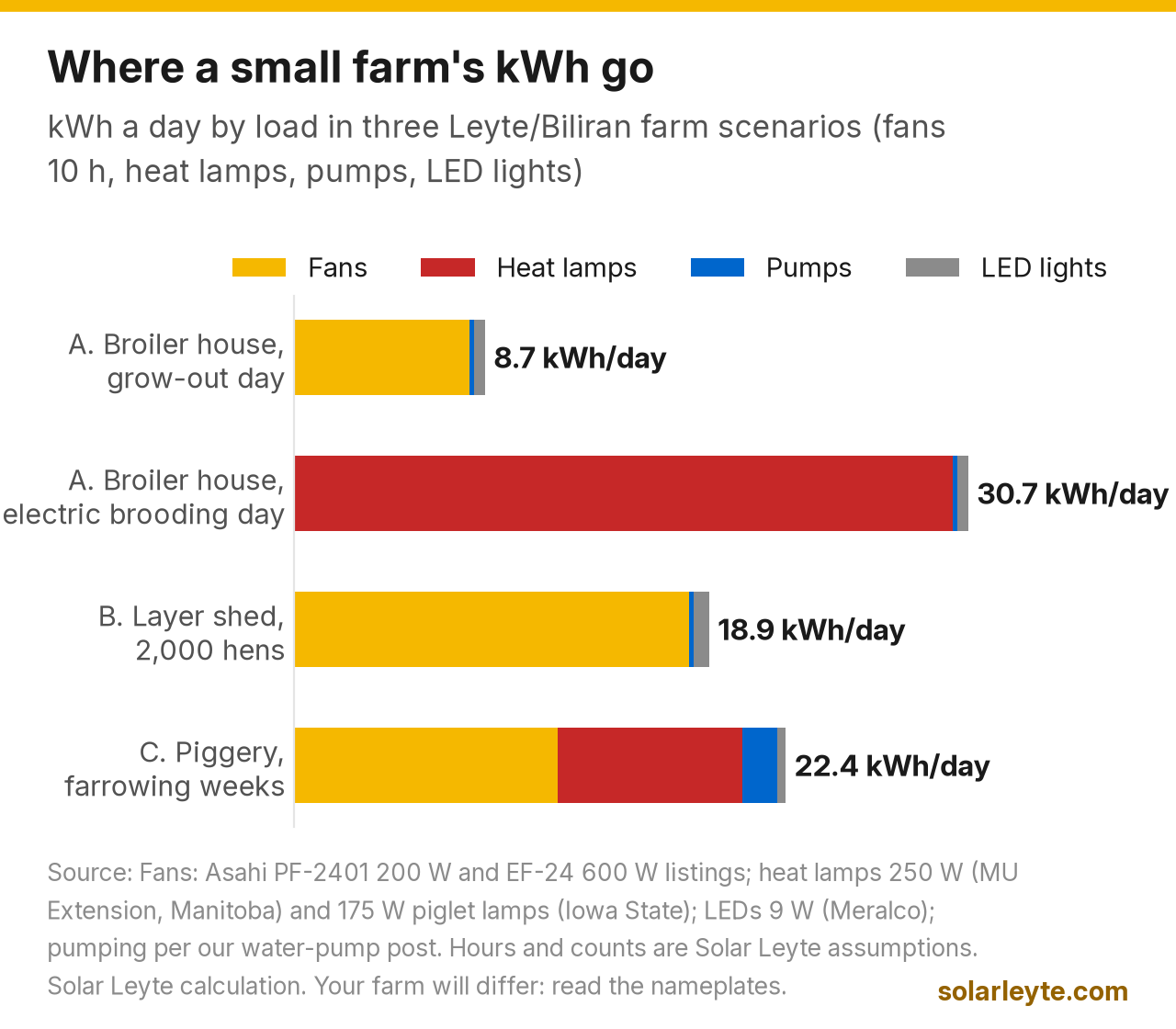
Solar Leyte calculation. A month is 365 ÷ 12 days. Scenario C's month assumes two litters under heat lamps for 14 days of the month.
Where the hours come from:
- Broiler lighting. Aviagen's Ross broiler guide gives chicks 23 hours of light at first, then 4 to 6 hours of darkness a day after day 7. With about 12 hours of daylight in an open house, that's roughly 6 to 8 hours of bulbs; we used 7.
- Brooding heat. Aviagen recommends 30 °C for whole-house brooding, or 32 °C at the edge of a spot brooder. At one 250 W lamp per 100 chicks (Manitoba's upper figure), 1,000 chicks need 10 lamps. We assumed they run 12 hours a night for the first 10 days. Missouri's 50–75 chicks per lamp would mean 13 to 20 lamps.
- Layer lighting. Hy-Line's Brown guide holds open-sided pullets at 12 hours of light, then steps layers up to 14–15 hours, with 16 hours as the maximum. We used 4 hours of bulbs on top of daylight.
- Piglet heat. The DA's pig welfare code (Administrative Order 41, series of 2000) says the creep area should be at 32 °C up to three weeks of age, with artificial heating for at least the first 7 to 14 days. We used 14 days at full lamp power, which is a high-side figure. Iowa State found 175 W lamps saved about 360 kWh per crate a year compared with 250 W lamps.
- Pig water. AO 41 lists 6–8 litres a day for 51–120 kg pigs, 5–10 L for pregnant sows and 15–30 L for lactating sows. Drinking water for our piggery comes to about 0.5 m³ a day at the top of those ranges. The rest of the 3 m³ is our allowance for washing pens.
The surprise is brooding. In Scenario A, the 10 brooding days use about 307 of the batch's 481 kWh, or 64%. Brood with LPG or charcoal instead of electric lamps and the batch drops to about 181 kWh. Solar barely touches the brooding load, because 99% of it is at night.
What a tunnel-ventilated house uses
Big contract-growing houses are another scale. The Environmental Impact Statement for a proposed tunnel-ventilated broiler farm in Barangay Tinghub, Villaba, Leyte (submitted to EMB Region 8 in December 2024) describes 12 sheds of about 210 × 18 m, each holding 40,000 birds. Each shed lists 8 ventilation fans at 1.5 HP, 4 feeder motors at 1.0 HP and cooling pads. Its summary table estimates power use at 20,000 kWh per cycle (it doesn't say whether that's per shed or for the whole farm). It plans co-op power plus an emergency standby diesel generator.
At the 1,240 W BESS Lab measured for a 1.5 HP tunnel fan, eight of them draw about 9.9 kW together (our calculation). That's a commercial system, and a different backup problem, covered below.
What it costs at BILECO and LEYECO rates
Many backyard farms share the house meter and pay the residential rate. A farm with its own service may be billed commercial or low-voltage. Read the rate class printed on your bill. These are the rates used in the table below, checked 13 October 2026:
- BILECO: residential ₱18.93/kWh in September 2026 on PRESYO-PH (ICSC's tracker, compiled from co-op rate disclosures). BILECO's own latest post is still July 2026: residential ₱18.3407, commercial ₱16.8353, VAT included.
- LEYECO II (Tacloban, Palo, Babatngon): residential ₱14.0488/kWh in September 2026 (our LEYECO II tracker). LEYECO II's sheet doesn't say whether VAT is included. Its October 2026 sheet cuts the generation charge to ₱6.3099/kWh, from ₱9.8192 in September, so October bills should come in lower; the scenarios below still use September.
- LEYECO IV (Baybay, Hilongos and southern Leyte): September 2026 residential ₱16.9708 plus ₱5.00 a month; low voltage ₱15.6838 plus ₱68.87, VAT included.
- LEYECO V (Ormoc and western Leyte): September 2026 residential ₱16.3837 plus ₱5.00; commercial ₱15.4753 plus ₱78.86, before distribution VAT.
Scenario | kWh | BILECO res (₱18.93) | BILECO comm (₱16.8353 + ₱71.94) | LEYECO II res (₱14.0488) | LEYECO IV LV (+₱68.87) | LEYECO V comm (+₱78.86) |
|---|---|---|---|---|---|---|
A. Broiler batch, electric brooding | 481 per batch | ₱9,108 | ₱8,100 | ₱6,759 | ₱7,546 | ₱7,445 |
A. Broiler batch, LPG/charcoal brooding | 181 per batch | ₱3,429 | ₱3,049 | ₱2,545 | ₱2,841 | ₱2,803 |
B. Layer shed, 2,000 hens | 575 a month | ₱10,900 | ₱9,761 | ₱8,086 | ₱9,096 | ₱8,986 |
C. Small piggery | 542 a month | ₱10,270 | ₱9,201 | ₱7,618 | ₱8,574 | ₱8,471 |
Solar Leyte calculation: kWh × rate, plus the monthly fixed charge for B and C (₱5.00 on BILECO residential; ₱71.94 on BILECO commercial, from the July sheet: ₱42.82 + ₱29.12; ₱68.87 and ₱78.86 where shown). Batch figures for A are energy charges only. LEYECO II figures exclude any fixed charge, and its sheet doesn't say whether VAT is included. Sources: PRESYO-PH; BILECO July 2026 rate post; LEYECO IV September 2026 rates; LEYECO V September 2026 rate sheet. Rates move every month, so track them on our BILECO and LEYECO IV and V pages.
Two things stand out. Electric brooding nearly triples a small broiler batch's bill. And a layer shed or piggery that runs its fans all day pays about as much as a busy water refilling station, roughly ₱9,000 to ₱11,000 a month, most of it in daylight hours.
Brownouts: why fans are the critical load
When the power goes, fans stop. How bad that is depends on the house.
- Tunnel-ventilated, closed houses: minutes. Auburn University's poultry engineering newsletter warns that if power fails in hot weather and no standby generator takes over, "birds will begin dying within minutes". Mississippi State Extension says fifteen minutes is all it takes to lose a house of broilers near harvest age if conditions are right. Auburn's advice is a standby generator with an automatic transfer switch, plus a battery-powered alarm that goes off whether the generator starts or not.
- Open-sided houses: some natural airflow is left. Auburn notes curtain drops are the only backup in a curtain-sided house without a generator. An open shed still breathes, but on a still, hot afternoon heavy birds and finishing pigs struggle.
- Pigs. The DA's pig welfare code says farms must have other means of heating, lighting, ventilation, feeding and watering in case of power failure, and calls an alarm with a battery backup "desirable". It also says sprinklers should be considered where heat stress is a regular problem. During the 2024 El Niño, the National Federation of Hog Farmers told the Philippine Star that pigs were suffering heat stroke, with market weights falling from 115–120 kg to 90–100 kg.
The Visayas grid has had repeated yellow and red alerts in 2026. On 26 August 2026, NGCP flagged possible rotating brownouts from 5 pm to 9 pm across BILECO, LEYECO II to V and the Samar co-ops (GMA News). Grid-tie solar won't help then. It shuts off when the co-op line goes dead. Only a hybrid system with a battery, or a generator, keeps fans turning.
Battery for a four-hour evening brownout
What stays on for 4 hours | kWh | With 1.5× margin |
|---|---|---|
A. Broiler grow-out: 4 stand fans + 8 LEDs | 3.5 | 5.2 |
A. Broiler brooding: 10 heat lamps + LEDs | 10.3 | 15.4 |
B. Layer shed: 1 exhaust fan + 20 LEDs | 3.1 | 4.7 |
B. Layer shed: all 3 exhaust fans + 20 LEDs | 7.9 | 11.9 |
C. Piggery: 2 fans + 2 piglet lamps + LEDs | 3.4 | 5.0 |
C. Piggery: all 6 fans + 2 lamps + LEDs | 6.6 | 9.8 |
Tunnel house: 8 × 1.5 HP fans (Villaba design) | 39.7 | 59.5 |
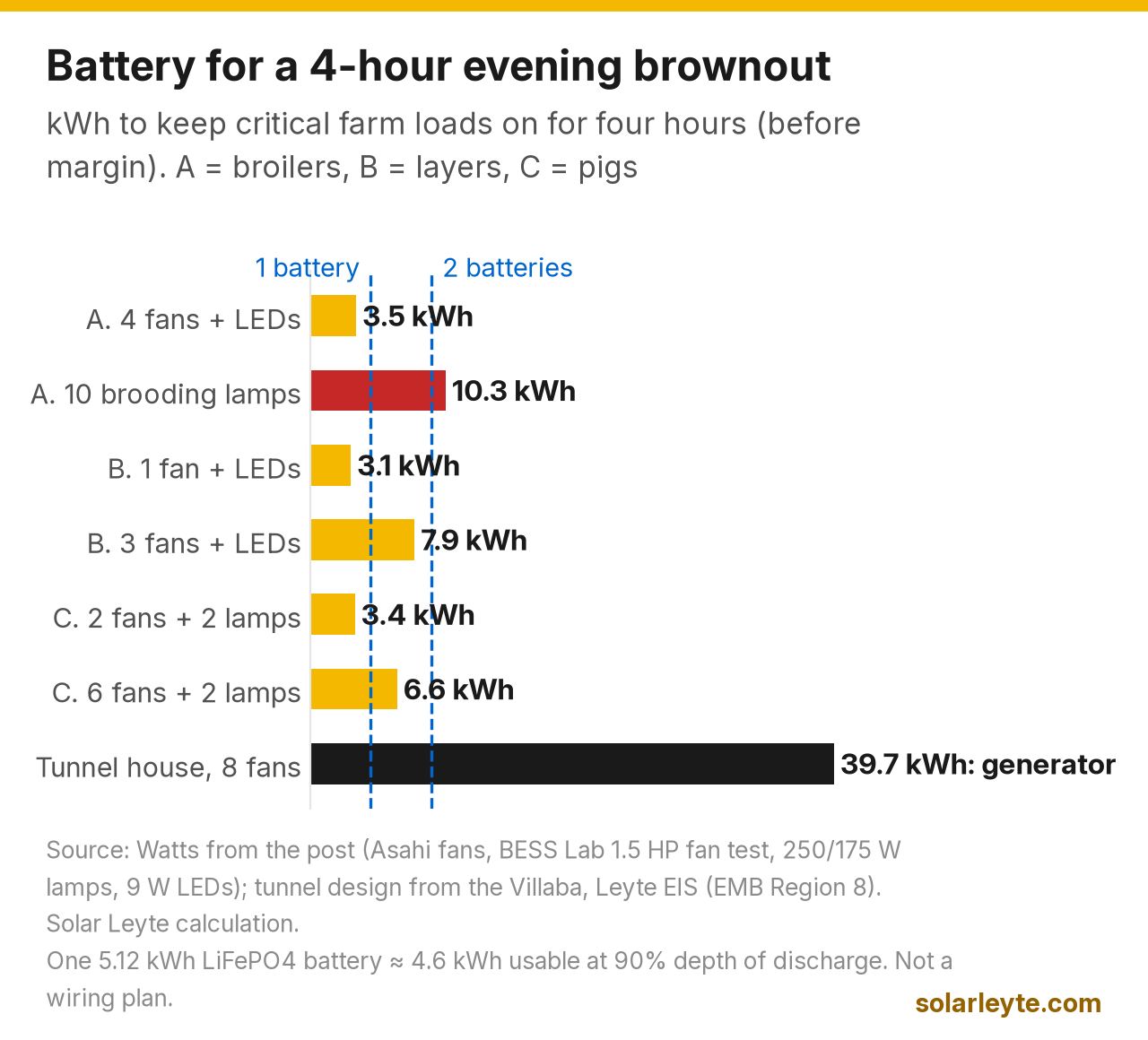
Solar Leyte calculation at the watts in the first table. Philippine sellers we checked in October 2026 listed 5–6 kWh LiFePO4 batteries at ₱42,000 to ₱67,800 and 11–16 kWh units at ₱70,000 to ₱147,000 (solar battery prices). A 5.12 kWh battery gives about 4.6 kWh at 90% depth of discharge.
What that means in practice:
- Small open-sided farms can ride out an evening outage on one or two batteries, if you put only the critical fans, lights and piglet lamps on the backup circuit. A 5 kWh battery covers the reduced lists for B and C (3.1 to 3.4 kWh) with a little room to spare. A 10 kWh battery covers all of A's grow-out fans with margin.
- Don't run brooding heat lamps from a battery. Ten lamps would empty a 10 kWh battery in four hours. Keep an LPG or charcoal brooder ready for brownouts during the first week or two.
- Tunnel houses need a generator. About 40 kWh for four hours is eight or nine 5 kWh batteries per shed, and outages can last longer than that. Solar can still cut the daytime bill there, but the generator stays.
- Motor starting. Fans and pumps draw a surge when they start. The 5 kW Deye and Solis hybrids in our Deye vs Solis vs SRNE comparison are rated for 2× output for 10 seconds. Have your installer stagger fan starts on the backup circuit, and check each motor's starting current.
How much solar fits
We ran an hour-by-hour model with PVGIS hourly data for Naval, Biliran (2023 weather, panels tilted 11° facing south, 14% system losses; 1 kWp made 1,479 kWh that year). The system is zero-export: solar the farm can't use at that moment is lost, not sold. Loads follow the hours in the scenario table.
Scenario | Solar size | Solar used a month | Share of farm kWh | Solar not used |
|---|---|---|---|---|
A. Broiler, grow-out days only | 2 kWp | 185 kWh | 70% | 62 kWh |
B. Layer shed | 3 kWp | 337 kWh | 59% | 32 kWh |
B. Layer shed | 4 kWp | 394 kWh | 68% | 99 kWh |
B. Layer shed | 5 kWp | 421 kWh | 73% | 195 kWh |
C. Piggery, no heat lamps | 3 kWp | 305 kWh | 72% | 65 kWh |
C. Piggery, farrowing weeks | 3 kWp | 350 kWh | 51% | 20 kWh |
C. Piggery, no heat lamps | 4 kWp | 330 kWh | 78% | 163 kWh |
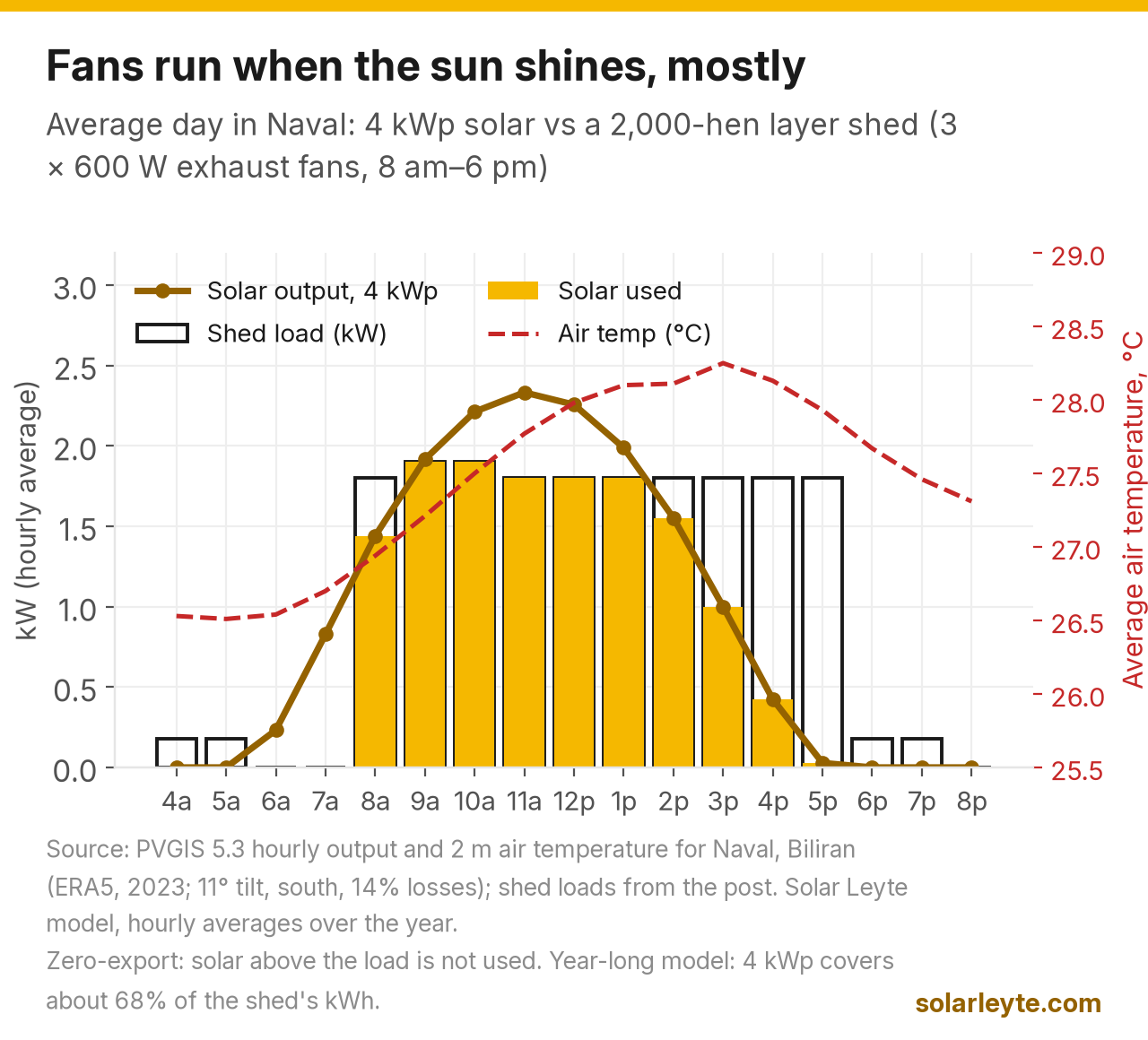
Solar Leyte model: PVGIS 5.3 hourly output for Naval (ERA5, 2023) and our scenario loads, hour by hour. Scenario A's month assumes the house is full and fans run every day, which isn't true between batches (see payback below).
A simple rule falls out of this: start with about 2 to 2.5 kWp of panels for every 1 kW of fans you run through the day. Past that, extra panels mostly make power at times the farm can't use it, unless you add a battery or export under net metering.
One catch: heat and sun don't peak together. In the same PVGIS weather file, Naval's warmest hours were 1 pm to 5 pm (about 28.1 to 28.3 °C on average), while panel output peaked from 11 am to noon. From 3 pm a panel makes less than half its late-morning peak, and by 4 pm under a fifth, just when the fans work hardest. The grid or a battery covers that tail.
Leyte sites get a little less sun than Naval in PVGIS. In our 600 W panel post, 1 kWp made about 1,413 kWh a year in Tacloban and 1,481 in Ormoc, against 1,487 in Naval (multi-year averages). Tacloban farms should expect about 5% less.
A rough starting point for a small farm:
Piece | Rough size | Notes |
|---|---|---|
Panels | 2 to 5 kWp (four to nine 550–600 W panels) | Match to daytime fan load; see 550–620 W panel prices |
Inverter | grid-tie, or a 5–8 kW hybrid for backup | Surge headroom for fan and pump motors; see hybrid inverter prices |
Battery (hybrid only) | 5 to 10 kWh LiFePO4 | Four-hour outage for critical fans, lights and piglet lamps |
Backup circuit | critical fans, LEDs, piglet lamps, water pump | Not brooding lamps; keep the rest on the grid |
Generator | for tunnel houses and long outages | Battery can't carry 10 kW of tunnel fans for hours |
Payback: rough numbers
Monthly savings are solar used × your rate. The cost basis is ₱42.20 to ₱50.00 per watt installed, the range sellers listed for 5 to 5.5 kW grid-tie packages in our 5kW solar system price check (7 October 2026). Smaller systems usually cost more per watt.
Scenario and size | Saved a month at LEYECO IV LV | at BILECO residential | Simple payback, grid-tie |
|---|---|---|---|
B. Layer shed, 4 kWp | ₱6,181 | ₱7,460 | about 1.9 to 2.7 years |
C. Piggery, 3 kWp (no heat lamps) | ₱4,787 | ₱5,777 | about 1.8 to 2.6 years |
A. Broiler, 2 kWp, about 7 batches a year | ₱1,113 (averaged) | ₱1,343 (averaged) | about 5.2 to 7.5 years |
Solar Leyte calculation. Scenario A: 2 kWp covers about 122 kWh during the 20 grow-out days of each batch. The Villaba EIS describes 28–32 days of birds plus 14 days of cleaning and rest, and 6 to 7 cycles a year; we used 7. During brooding nights and empty weeks the panels save nothing, unless the house shares the meter.
Those fast paybacks for B and C come from daytime fans at ₱15 to ₱19 a kWh. Be careful with them:
- Our fan hours are assumptions. If your fans run 6 hours on an average day instead of 10, the savings fall by a similar share.
- Rates move. BILECO's commercial rate was ₱11.4404 in May 2026 and ₱16.8353 in July, per BILECO's rate posts. A lower rate means a slower payback.
- Hybrid costs more. In our 5 kW check, parts for a hybrid with a 5–6 kWh battery came to ₱154,000 to ₱221,000, against ₱83,000 to ₱142,000 for grid-tie. The battery buys brownout protection, not faster payback. Its value is the flock or the litter it saves.
- Simple payback leaves things out: permits, an inverter replacement over the system's life, panel ageing and cleaning (farm dust and feed dust on panels), and the cost of money. Our is solar worth it post walks through those.
Cut the load before you size the solar
Cheaper than any panel:
- Brood with gas or charcoal, or use lower-watt lamps. In Scenario A that's 300 kWh a batch. For piglets, Iowa State found 175 W lamps beat 250 W lamps on energy (about 360 kWh per crate a year) with lower piglet mortality, and heat mats use 60–100 W per crate.
- Buy fans on cfm per watt, not diameter. Look for independent test data (BESS Lab) and keep blades, shutters and belts clean. Iowa State says dirty shutters and blades can cut airflow by as much as 40%.
- Run sprinklers in short cycles. AO 41 recommends sprinklers for pigs in regular heat stress. Short cycles keep the pump load small.
- Put a timer or thermostat on fans, so they run when it's hot, not all day by habit.
Permits for a farm system
- Zero-export (own use only): under DOE Department Circular DC2026-08-0017, you need a building permit (unless the LGU confirms your existing building permit covers it) and, for a grid-connected system, a notice to your co-op after installation. The ERC Certificate of Compliance (COC) exemption covers households, clinics and hospitals, so a farm business generally still needs a COC. If your farm shares the house's residential meter, ask the co-op whether the household exemption applies; we haven't seen a ruling either way. Details are in our plug-and-play and zero-export rules post.
- Net metering (up to 100 kW): unused solar is exported and credited at roughly the generation charge (LEYECO IV's was ₱9.5635/kWh in September 2026), well below the ₱15 to ₱19 you save by using it yourself. Steps: BILECO and LEYECO II net metering guides.
- Electrical permit and CFEI: for net metering, the co-op needs the CFEI from your town hall, and you can't get one without the electrical permit. For zero-export, DOE's circular asks for a building permit, not a CFEI. Ask your municipal engineering office whether it also wants an electrical permit for the new wiring. Steps and fees: our electrical permit and CFEI guide.
Before you ask for a quote
- Your last 12 bills (or at least three), with the rate class.
- The nameplate watts or HP of every fan, pump, heat lamp and mat, and how many you run.
- Fan hours on a hot day and a cool day, or a timer setting.
- How you brood chicks or heat piglets (electric, LPG, charcoal).
- What must stay on in a brownout, and whether you already have a generator.
- Roof size and material over the sheds or the house, and who owns it.
Licences and paperwork checks are in how to choose a solar installer in Leyte and Biliran. For a separate well or irrigation pump, see our solar water pump price guide. Smaller business loads are in our sari-sari store post.
FAQ
How much electricity does a small poultry farm use? In our scenarios, a 2,000-hen open-sided layer shed with three 600 W exhaust fans uses about 575 kWh a month. A 1,000-bird broiler batch uses about 181 kWh with gas brooding, or about 481 kWh if you brood with ten 250 W heat lamps (Solar Leyte estimates from product and extension figures).
Can solar run poultry house fans? Yes, during the day. Fans line up well with solar: in our Naval model, 4 kWp covered about 68% of the layer shed's kWh. Afternoon heat outlasts peak sun, though, and grid-tie solar shuts off in a brownout. For backup you need a hybrid inverter with a battery, or a generator.
How big a battery do I need for a brownout on a farm? For a four-hour evening outage, about 3 to 5 kWh usable keeps one or two fans, LEDs and piglet lamps on in a small open-sided farm. A tunnel-ventilated house with eight 1.5 HP fans would need about 40 kWh, so it needs a generator.
Is solar worth it for a piggery? Often, if your fans run through the day. In our 10-sow, 50-grower example, 3 kWp saved about ₱4,800 to ₱5,800 a month at LEYECO IV low-voltage and BILECO residential rates, roughly a 2 to 3 year simple payback on grid-tie. Night-time heat lamps and short fan hours make it slower.
Do heat lamps make sense on solar? Not really. Brooding and creep lamps run mostly at night, so panels don't help without a large battery. Use LPG or charcoal brooders, lower-watt lamps or heat mats, and put the solar on the fans.
Solar Leyte is run by MACC Systems & Energy Solutions Inc., a solar installer in Naval, Biliran.
Get a free solar quote for your poultry or piggery farm from MACC
Send us a photo of your last BILECO or LEYECO bill, the nameplates of your fans, pumps and heat lamps, and what must stay on in a brownout. We'll size the panels, inverter and any battery around your fan hours, give you every model number and datasheet, and show you the math, with no obligation.
- Call/Text: 0955 723 5093
- Email: official@macc-inc.com or benjie@macc-inc.com
- Website: www.macc-inc.com
- Request a quote online: solarleyte.com/quote
- Office: Brgy. Talustusan, Naval, Biliran 6543
Sources (all checked 13 October 2026)
- Fans: Winland Depot, Asahi 24" industrial stand fan PF-2401 and Asahi 24" industrial exhaust fan EF-24; Asahi, EF-24 product page; Iowa State University Extension, Energy efficient fans for poultry production (PM 2089H); University of Illinois BESS Lab, fan test report 21082; Mississippi State University Extension, Fan Selection for Poultry Housing
- Heat and lighting: Iowa State University Extension, Conserving energy by using localized heating in swine housing (PM 2089V); University of Missouri Extension, Brooding and Growing Chicks (G8351); Manitoba Agriculture, Brooding temperatures for small poultry flocks; Aviagen, Ross Broiler Pocket Guide; Hy-Line, Managing Hy-Line Brown varieties
- Pigs: Department of Agriculture, Administrative Order 41, s. 2000, Code of Practice and Minimum Standards for the Welfare of Pigs (copy hosted by PAWS); Philippine Star, Heat causing stroke, weight loss in pigs (24 May 2024)
- Tunnel-ventilated farm: EMB Region 8, EIS for the WLS tunnel-vent poultry farm, Villaba, Leyte (December 2024)
- Power-failure risk: Auburn University, Alabama Poultry Engineering and Economics newsletter no. 18, alarms and backups; Mississippi State University Extension, Maintenance critical to backup generator reliability
- Rates: PRESYO-PH / ICSC, national rates (September 2026); BILECO, power rate posts; LEYECO IV, September 2026 rates; LEYECO V, power rates; Solar Leyte, LEYECO II rate tracker
- Brownouts and climate: GMA News, Rotating brownouts may hit Visayas consumers on Aug. 26, 2026; PAGASA, climate outlook; Solar Leyte, Visayas grid alerts
- Solar output: European Commission JRC, PVGIS 5.3 hourly series for Naval (ERA5, 2023) and yearly totals for Naval, Tacloban and Ormoc
- Rules: DOE, Department Circular DC2026-08-0017, as summarised in our plug-and-play post
- Prices, pumps and inverter surge: Solar Leyte, solar battery price, hybrid inverter price, 5kW solar system price, solar water pump price and Deye vs Solis vs SRNE