
On 6 October 2026, Philippine sellers listed DC solar water pumps from ₱9,250 for a 1 HP submersible to ₱50,490 for a LORENTZ PS2-100 pump and controller. Deep-well pump sets that come with solar panels ran from ₱46,200 to ₱102,300. Small 12 V hobby pumps start at about ₱1,000. The price matters less than the fit: the right pump depends on how much water you need each day and how high it has to be lifted, and the panel watts follow from those two numbers.
Hulaw na pud? PAGASA expects the El Niño to become "very strong" by the end of 2026 and to last into the first half of 2027. Its 23 September outlook puts Leyte under potential drought by the end of October 2026, and Biliran by the end of December (PAGASA climate outlook). If you're planning to pump for vegetables, a fishpond or a house tank, this post gives you real prices, the sizing math with worked examples, and a checklist. For the short version of when a solar pump makes sense, see the pump section of our solar generators and portable power guide.
Prices checked 6 October 2026 (Philippine time) on each seller's own website. They change often, and some items are pre-order. Check the seller's page before you buy. Listing a product isn't an endorsement, and Solar Leyte earns nothing from these links.
Solar water pump prices in the Philippines (October 2026)
These are listed prices for the pump with its controller, without panels unless the row says so. Head and flow are the maximums the seller or maker states. A pump never gives its maximum flow at its maximum head (more on that below).
Pump (as listed) | Type | Rated power / voltage | Max head | Max flow | Seller | Listed price |
|---|---|---|---|---|---|---|
160 W DC brush-motor submersible | Submersible, 12 V | 160 W, 12 V | Not stated | Not stated | Solar Hub PH | ₱1,000 |
180 W DC brush-motor surface pump | Surface, 12 V | 180 W, 12 V | Not stated | Not stated | Solar Hub PH | ₱1,200 |
250 W DC submersible | Submersible | 250 W, 24 V | Not stated | Not stated | Solar Hub PH | ₱5,200 |
Wadfow WWPQDC03 (1 HP) | Submersible, with control box and float switch | 750 W, 72 V | 24 m | 233 L/min (about 14 m³/h) | Goldpeak Tools PH | ₱9,250 (was ₱18,500) |
1 HP DC solar pump submersible | Submersible | 750 W, 96 V | 90 m | 3.5 m³/h | Solar Hub PH | ₱14,500 (pre-order) |
Difful 2" 1 HP hybrid AC/DC surface pump | Surface, solar or AC input | 750 W | 14 m | Not stated | LakaSolar | ₱20,000 |
Difful 3" 2 HP hybrid AC/DC surface pump | Surface, solar or AC input | 1,500 W | 17 m | Not stated | LakaSolar | ₱22,000 (was ₱26,000) |
Dayuan 3SWC4-42-24-300 | Deep-well submersible + control box | 300 W, 24 V | 42 m | 4 m³/h | Goldpeak Tools PH | ₱33,000 |
Dayuan 3SC3.5-35-24-300 | Deep-well submersible | 300 W, 24 V | 35 m | 3.5 m³/h | KHM Megatools | ₱35,000 |
Dayuan 4SWC5-81-48-750 | Deep-well submersible + control box | 750 W, 48 V | 81 m | 5 m³/h | Goldpeak Tools PH | ₱38,500 |
Dayuan 4SC7-45-48-600 | Deep-well submersible | 600 W, 48 V | 45 m | 7 m³/h | KHM Megatools | ₱40,000 |
Dayuan 4SWC5-164-96-1500 | Deep-well submersible + control box | 1,500 W, 96 V | 164 m | 5 m³/h | Goldpeak Tools PH | ₱49,500 |
LORENTZ PS2-100 (AHRP-07S, -14S or -23S) | Helical-rotor submersible + controller | About 100 W class, one PV module | 40 m (07S), 27 m (14S), 18 m (23S) | 1.1, 1.9 or 2.8 m³/h | Sunelec (LORENTZ PH partner) | ₱50,490 |
Adelino 4TYG24.8-43 | 4" submersible, AC/DC | 3.4 kW, 300–405 V | 43 m | 24.8 m³/h | KHM Megatools | ₱67,000 |
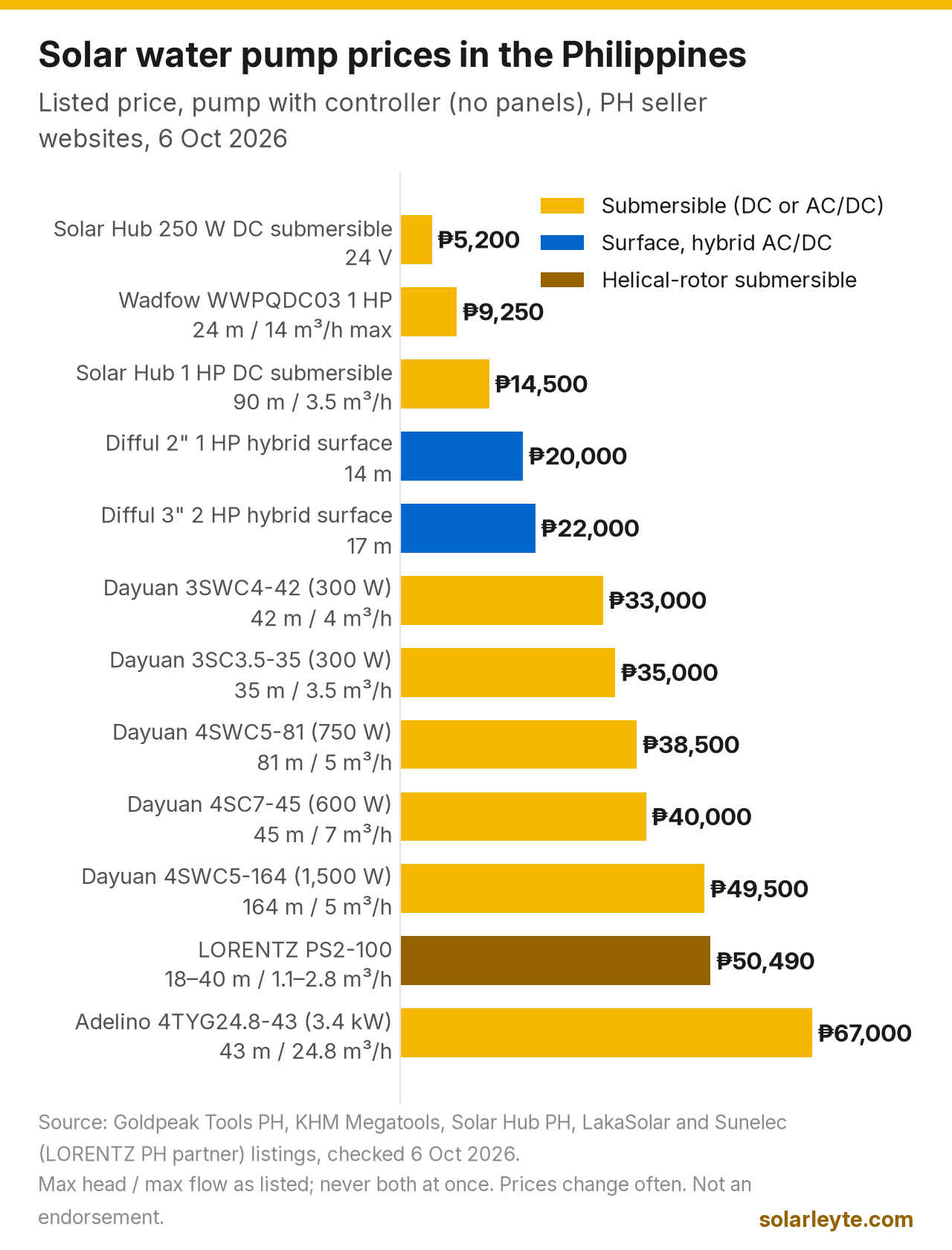
Sets with solar panels. Goldpeak lists the same Dayuan SWC pumps as sets with panels: ₱46,200 for the 300 W, 24 V pump; ₱60,500 to ₱64,900 for the 500 W and 750 W, 48 V pumps; ₱84,950 for the 1,100 W, 72 V pump; and ₱99,000 to ₱102,300 for the 1,500 W, 96 V pumps. Each set costs exactly one, two, three or four times ₱13,200 more than the pump alone, which is the price KHM Megatools lists for a 415 W, 30 V panel. So the sets appear to include one 415 W panel per 24 V of pump voltage. That's our reading of the two price lists, so confirm the panel count with the seller.
What else to know about these listings:
- The cheap 12 V pumps use brushed motors, as the listings say. They suit a garden or a small tank, not daily irrigation from a deep well.
- The LORENTZ PS2-100 is a helical-rotor pump from German maker LORENTZ, designed for self-installation, sold in a box with the controller and a 15 m motor cable. LORENTZ says it "provides over 20,000 liters of water per day and pumps up to 40 meter heads" (the most water comes at low lifts, per its chart), typically on one 180 to 260 Wp panel, with a 50 V maximum input (LORENTZ PS2-100 brochure). Sunelec is LORENTZ's Philippine distribution partner.
- "Max head" figures need care. LakaSolar lists its 4" 2 HP hybrid submersible (₱22,000) with a 200 m maximum head. We left it out of the table because that's far above every comparable pump we found. Ask for the pump curve before buying any pump.
- Grundfos SQFlex pumps are sold in the Philippines by dealers such as East Solar Works, but we couldn't find a current Philippine price online, so they're not in the table.
- Where they ship from. Goldpeak, KHM and Sunelec all list Metro Manila addresses, and KHM's flat-rate shipping is for Metro Manila only. Ask about freight to Biliran or Leyte, and about who services the pump locally.
Step 1: Work out how much water you need per day
Everything starts with cubic metres per day (1 m³ = 1,000 litres). Use your peak dry-season need, not an average.
- Household: the UN and WHO guidance is 50 to 100 litres per person per day for basic needs (OHCHR, The Right to Water). A family of five at 100 L uses 0.5 m³. Add your garden, laundry or animals.
- Vegetables and other crops: for humid climates above 25°C, FAO gives reference crop water use (ETo) of 5 to 6 mm a day. Crops like eggplant and tomato use up to 1.15 times that at mid-season (FAO irrigation manual, Ch. 3). That's about 5.8 to 6.9 mm a day. Because 1 mm over 1 m² is 1 litre, a 1,000 m² plot with no rain needs up to about 7 m³ a day.
- Fishponds: after the first fill, you're mostly topping up seepage and evaporation. FAO's aquaculture site guide treats 1 to 2 cm a day of seepage as acceptable (FAO, Site selection for aquaculture). Your pond's real loss is easy to measure: mark a stake at the water line and check it after 24 dry hours.
- Rice: FAO puts paddy rice at 450 to 700 mm of crop water per season. Flooded fields also lose water to the soil, so rice needs much more pumping than vegetables. That's why most solar rice irrigation in Eastern Visayas is built as community projects (see below).
Step 2: Work out the total dynamic head (TDH)
Total dynamic head is the height the pump really has to push against:
TDH = static lift + pipe friction (+ pressure, if you feed sprinklers or drip lines directly)
- Static lift runs from the water level while pumping up to the highest point the water reaches, usually the tank inlet. Water levels drop while you pump (drawdown) and in a dry year, so measure in the dry season if you can.
- Pipe friction depends on flow, pipe size and pipe length. The table below shows how fast it grows.
- Pressure: 1 bar of pressure equals about 10.2 m of head. Pumping into an elevated tank and letting gravity feed the drip lines avoids that.
Friction loss per 100 m of smooth plastic pipe, in metres of head. This is our calculation with the Hazen-Williams formula (C = 140) and approximate inside diameters (Engineering ToolBox):
Pipe (approx. inside diameter) | 1 m³/h | 2 m³/h | 4 m³/h | 8 m³/h |
|---|---|---|---|---|
1" (25 mm) | 1.9 m | 6.7 m | 24.2 m | 87.5 m |
1¼" (32 mm) | 0.6 m | 2.0 m | 7.3 m | 26.3 m |
1½" (38 mm) | 0.2 m | 0.9 m | 3.2 m | 11.4 m |
2" (50 mm) | 0.1 m | 0.2 m | 0.8 m | 3.0 m |
The lesson: a thin hose can cost you more than the lift. At 4 m³/h, 100 m of 1" pipe adds 24 m of head, while 2" pipe adds less than 1 m. Bigger pipe is usually cheaper than a bigger pump plus more panels.
Surface pump or submersible? A pump on the ground has to suck water up. In theory, that's limited to about 9.9 m for water at 30°C, and real pumps manage significantly less (Engineering ToolBox). Check the suction lift on the pump's spec sheet. If your dry-season water level is near that limit or deeper, use a submersible. Surface pumps suit creeks, ponds and shallow wells.
Step 3: Turn water and head into panel watts
Lifting 1 m³ of water by 1 m takes 2.725 Wh of energy (1,000 kg × 9.81 m/s² × 1 m = 9,810 joules). Panels, controller, motor and pump all lose some energy along the way.
GIZ's Solar Powered Irrigation Systems (SPIS) toolbox gives a worked example: 30 m³ a day lifted 50 m at 5 kWh/m² of sun per day needs a 2,400 Wp array (GIZ SPIS Toolbox). Working backwards, that means about 34% of the panels' rated output ends up as lifted water. That gives a rule of thumb (our calculation from the GIZ example):
Panel watts (Wp) ≈ 8 × m³ per day × TDH in metres ÷ daily sun in kWh/m²
Which sun figure? NASA's POWER data for Naval, Biliran averages 4.95 kWh/m² a day over the year. It ranges from 3.86 in December and 3.95 in January to 6.13 in April (NASA POWER). PAGASA's drought months for Leyte and Biliran run through December to March, which includes the least sunny months. Sizing for January instead of the annual average means about 25% more panel, and it's the safer choice for a dry-season pump.
Also match the pump's voltage. The panel string has to reach the controller's working voltage. Goldpeak lists Dayuan SWC pumps with a "best MPPT voltage" of 24–36 V for the 24 V models and 48–72 V for the 48 V models. That fits the two-panel reading of the 48 V sets above (two 30 V panels in series). LORENTZ's PS2-100 runs on a single panel. In practice, the voltage often sets the minimum number of panels, even when the math says fewer watts would do.
Worked examples for Leyte and Biliran
These are examples with assumed site numbers. Swap in your own well depth, tank height and pipe run. All sizing uses January sun in Naval (3.95 kWh/m²/day) and the rule of thumb above, so they're estimates, not designs.
Example | Water per day | TDH | Panel watts (Jan sun) | Pump flow needed | Pumps from the table that fit |
|---|---|---|---|---|---|
A. House deep well, Naval | 1 m³ | 22 m | about 45 Wp | under 0.5 m³/h | LORENTZ PS2-100 AHRP-07S; Dayuan 3SWC4-42-24-300 set |
B. 1,000 m² vegetables | 7 m³ | 9 m | about 130 Wp | about 1.5–2 m³/h | LORENTZ PS2-100 AHRP-23S; Dayuan 4SC7-45 |
C. 1,000 m² fishpond top-up | 16 m³ | 4.5 m | about 150 Wp | about 3–4 m³/h | Dayuan 4SC7-45 (7 m³/h); Wadfow 1 HP (24 m, 14 m³/h max) |
D. 1 ha rice, crop water only | 60 m³ | 8 m | about 970 Wp | 12 m³/h or more | A designed system, often a community project |
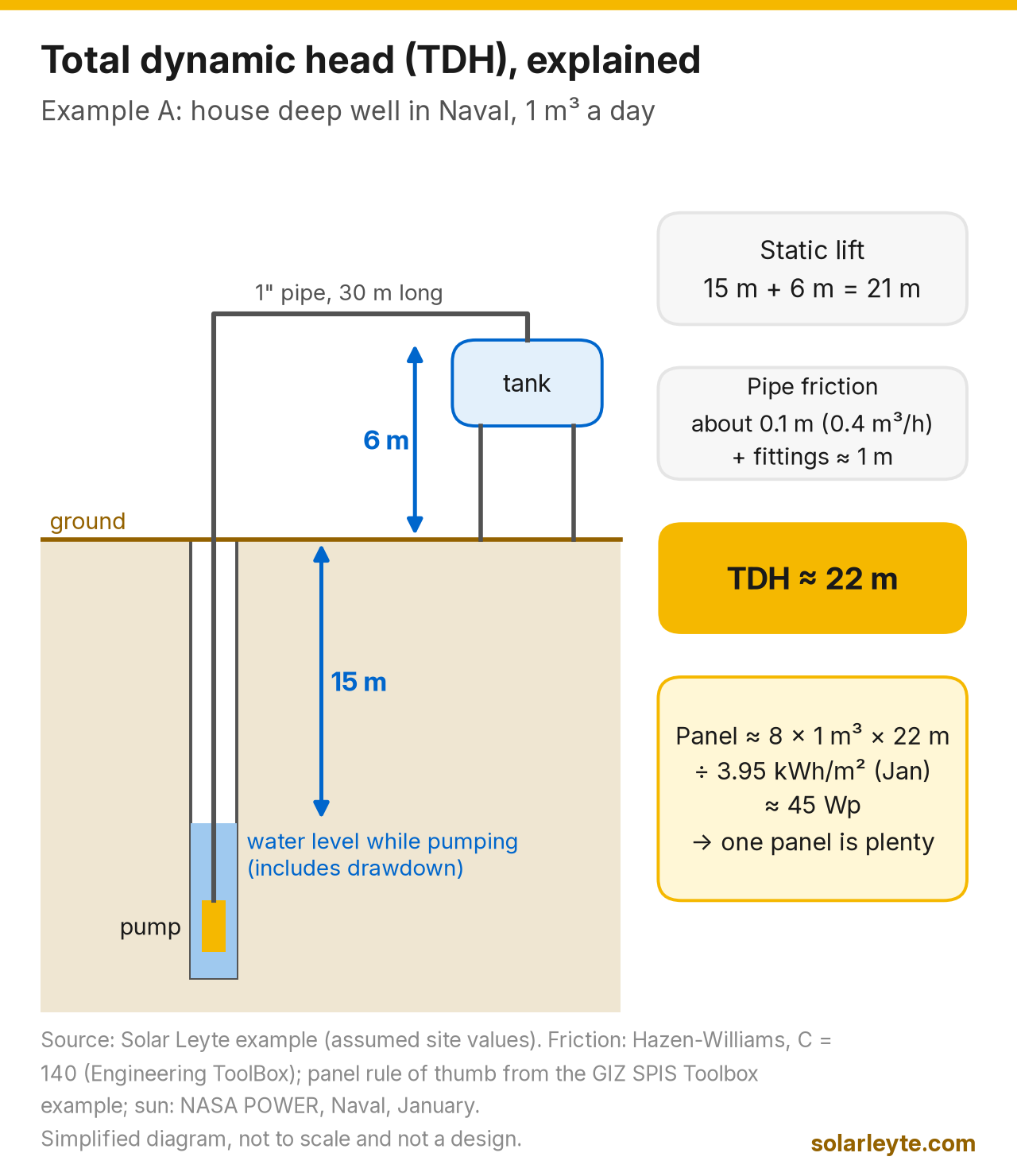
A. House deep well in Naval. Family of five plus garden: 1 m³ a day. Assumed water level 15 m below ground while pumping, and the tank top 6 m above ground, so the static lift is 21 m. Thirty metres of 1" pipe at 0.4 m³/h adds only about 0.1 m, so call it 22 m with fittings. Panel: 8 × 1 × 22 ÷ 3.95 = about 45 Wp. One standard panel is more than enough, and the spare capacity covers cloudy days. That's exactly the job the single-panel LORENTZ PS2-100 is built for. The cheapest complete set in our table is the Dayuan 300 W pump with one panel, at ₱46,200.
B. 1,000 m² of vegetables. Up to 7 m³ a day in a rainless dry spell (FAO figures above). Assumed water level 5 m down and the tank top 3 m up, so the static lift is 8 m. With 50 m of 1¼" pipe at 2 m³/h, friction adds about 1 m, so the TDH is about 9 m. Panel: 8 × 7 × 9 ÷ 3.95 = about 130 Wp. With 1" pipe instead, friction rises to about 3.4 m and the panel to about 160 Wp, 27% more for the same water.
C. 1,000 m² fishpond. Top-up of 1.6 cm a day: 1 cm of seepage (the low end of FAO's acceptable range) plus about 0.6 cm of evaporation (our assumption, based on FAO's upper ETo figure). That's 16 m³ a day. The lift from the creek over the dike is 4 m, plus about 0.3 m of friction in 40 m of 2" pipe. Panel: 8 × 16 × 4.5 ÷ 3.95 = about 150 Wp. The catch is the first fill: 1,000 m² at 1 m deep is 1,000 m³, which would take this pump about 60 days. Fill from rain, a creek or a borrowed engine pump, and use solar for the daily top-ups. For shallow lifts and big volumes like this, East Solar Works (a Philippine Grundfos dealer) favours a centrifugal pump over a thin helical-rotor one (East Solar Works).
D. One hectare of rice. At about 6 mm a day of crop water, 1 ha needs about 60 m³ a day before the field's own seepage. Even at a modest 8 m of head, that's about 1 kWp of panels, plus pipes, canals and a reservoir. That's why solar rice irrigation here is mostly built by the DA and NIA for farmer associations.
DC or AC, submersible or surface: which type?
- DC solar-direct pumps (most of the table) run straight from the panels through their controller, with no battery. Water in a tank is your storage. LORENTZ markets its pumps this way: "no batteries, no fuel" (LORENTZ PS2-100 product brochure).
- Helical-rotor vs centrifugal. Helical-rotor pumps (LORENTZ PS2-100) push a small, steady flow to a high head. Multi-stage centrifugal pumps (the Dayuan models list their impeller stages) move more water at lower heads. East Solar Works says the helical type is "much better" past about 150 to 200 ft (46 to 61 m), while centrifugal pumps suit shallow wells.
- Hybrid AC/DC pumps. The Difful pumps at LakaSolar take solar input at 80–430 V or AC at 80–280 V. They can pump from a generator or the grid at night or on cloudy days.
- Solar plus generator or grid. Sunelec lists "solar and generator" and "solar and grid" switching as options for LORENTZ PS2 systems (Sunelec).
- Will your casing fit? The PS2-100 pump unit is 88 mm in diameter. East Solar Works warns that Philippine 4" plastic casing is measured on the outside, so a "4-inch" pump may not fit inside it. Measure the inside diameter of your casing first.
Solar pump vs grid pump: the honest money math
If your pump already runs on BILECO or LEYECO power, a solar pump rarely pays for itself on electricity alone. Example A lifts 1 m³ by 22 m, which is 60 Wh of hydraulic energy a day. Even if an AC pump did that at only 30% efficiency (our assumption), it would use about 6 kWh a month. At BILECO's July 2026 rate of ₱18.3407/kWh (our BILECO rate tracker), that's about ₱110 a month. The fishpond in example C works out to about ₱360 a month on the same basis.
So the case for solar pumping is usually something else:
- Water during brownouts. A grid-tie rooftop system shuts down in a brownout (grid-tie vs hybrid), and the Visayas grid has had repeated yellow and red alerts this year (what the alerts mean). A solar-direct pump keeps filling the tank on any sunny day, grid or no grid.
- Fields far from a power line. No line extension and no wiring run to the field.
- Replacing a gasoline or diesel engine pump. Compare against your own fuel receipts. That's where solar pumps tend to look best.
Powering a pump from a power station or a home battery? Motors can draw 2 to 4 times their rated power when they start, so check the unit's surge rating (solar generator price comparison). Battery storage costs far more per kWh than water storage in a tank (solar battery prices).
El Niño 2026–27: what PAGASA expects for Leyte and Biliran
PAGASA's seasonal outlook says El Niño is expected to reach "very strong" during October to December 2026 and "persist until at least the first quarter of 2027." For that season it forecasts "generally below-normal conditions over most parts of the country" (PAGASA Jul–Dec 2026 outlook). Its climate forum outlook, updated 23 September 2026, adds this for our provinces (PAGASA):
Province | By end of Oct 2026 | By end of Nov 2026 | By end of Dec 2026 | By end of Jan to Mar 2027 |
|---|---|---|---|---|
Biliran | Dry spell | Dry spell | Drought | Drought |
Leyte | Drought | Drought | Drought | Drought |
Southern Leyte | Dry spell | Dry spell | Drought | Drought |
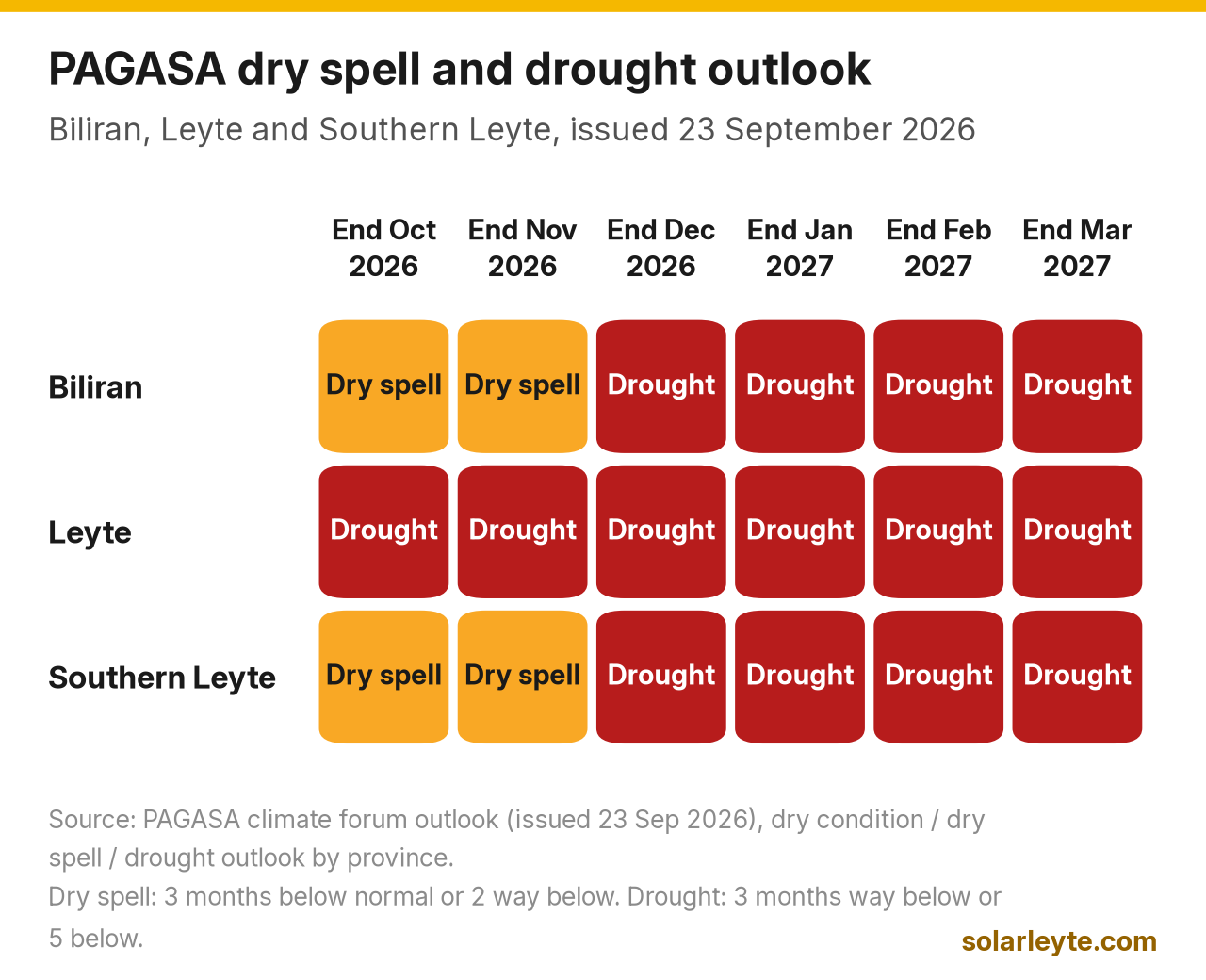
PAGASA defines a dry spell as three months in a row of below-normal rain (21% to 60% below average), or two months way below normal (more than 60% below). A drought is three months in a row way below normal, or five months below normal. The same outlook forecasts more dry days than normal in Biliran: 19 in December against a normal 14, and 22 in February against 16.
What that means for a pump:
- Size for the dry season. Water levels in shallow wells usually fall in a dry spell, which raises your TDH. Measure your well now and again in the dry months, and leave head margin.
- Check the well's yield. A pump that empties the well faster than it refills will run dry. Pumps with dry-run protection (the LORENTZ controller has a dry-run input for a well probe) and a float switch (included with the Wadfow) protect the motor.
- Order early. Most stock is in Metro Manila, and freight to the islands takes time.
Government solar irrigation projects in Eastern Visayas
These programs are for farmer associations and irrigators' groups, not individual buyers, but they're worth knowing about:
- DA Small-Scale Irrigation Projects: in April 2026, DA Eastern Visayas turned over a ₱7 million Solar-Powered Irrigation System to the Sitio Tambis Farmers Association in Brgy. Ugbon, Leyte, Leyte, funded under the Rice Program (DA RFO 8). The municipal agriculture office and the Bureau of Soils and Water Management provide training and monitoring.
- NIA solar pump irrigation projects (SPIP): NIA Region VIII's bid notices list solar-powered pump irrigation contracts in Samar, such as Sta. Catalina SPIP in Mondragon, Northern Samar (₱37.6 million) and Rawis Small Irrigation Project (two solar pump stations, ₱3.03 million) (NIA Region VIII). In July 2026 the NIA Leyte office also tendered solar pump irrigation for Cabadsan and Sirab in Alangalang, Leyte (tender notice).
- How to ask: start with your municipal agriculture office (MAO) or the NIA irrigation management office for your province, through your farmers' or irrigators' association.
Before you buy: a checklist
- Get three numbers first: water per day (m³), TDH (m), and your well's inside diameter and dry-season water level.
- Ask for the pump curve, not just max head and max flow, and check the flow at your TDH.
- Match the panels to the controller voltage, and ask how many panels a "set" includes.
- Check the water source. The Wadfow listing says "for clean water." Sand, silt or brackish water near the coast needs a pump rated for it. Ask the seller.
- Protect against dry running with a well probe or a low-water switch, and fit a float switch in the tank.
- Mount the panels for typhoons and add lightning protection on exposed farmland (typhoon guide).
- Ask about the warranty and local service. LORENTZ's Philippine partner says its pumps "could last up to 8 years before needing replacement" and panels "at least 20 years" (Sunelec).
FAQ
How much is a solar water pump in the Philippines? On 6 October 2026: about ₱1,000 to ₱5,200 for small 12–24 V pumps, ₱9,250 to ₱14,500 for 1 HP DC submersibles, ₱33,000 to ₱49,500 for Dayuan deep-well pumps with controller, and ₱50,490 for a LORENTZ PS2-100. Goldpeak's Dayuan sets with panels cost ₱46,200 to ₱102,300.
How many solar panels do I need for a water pump? Use panel watts ≈ 8 × m³ per day × TDH (m) ÷ daily sun (kWh/m²). For 1 m³ a day lifted 22 m in Naval's January sun, that's about 45 Wp, so one panel. For 7 m³ a day at 9 m, it's about 130 Wp. The pump's voltage may still require two or more panels in series.
Can a solar pump work without a battery? Yes, and most are designed that way. The pump runs while the sun shines and fills a tank, and the tank stores the water for night use.
Can I run my existing AC jetmatic or booster pump on solar? Only with a system that can supply its starting surge, such as a hybrid solar system with a battery or a large power station. For new installations, a DC solar-direct pump is usually simpler.
Does a solar pump work during a brownout? A solar-direct pump does, in daylight, because it doesn't depend on the grid. A pump powered by a grid-tie rooftop system doesn't, because grid-tie inverters shut down in a brownout.
Solar Leyte is run by MACC Systems & Energy Solutions Inc., a solar installer in Naval, Biliran.
Get a free solar water pump quote from MACC
Tell us your water source, how deep the water is in the dry season, the tank height, and how much water you need each day. We'll size the pump and panels with the math, with no obligation.
- Call/Text: 0955 723 5093
- Email: official@macc-inc.com or benjie@macc-inc.com
- Website: www.macc-inc.com
- Office: Brgy. Talustusan, Naval, Biliran 6543
Sources (all checked 6 October 2026)
- Seller listings: Goldpeak Tools PH, Wadfow WWPQDC03 and Dayuan SWC deep-well pumps and sets; KHM Megatools, Dayuan SC deep-well pumps (and 415 W panel) and Adelino AC/DC deep-well pumps; Solar Hub PH, solar pump category and 1 HP DC submersible; LakaSolar, 2" 1 HP hybrid surface pump, 3" 2 HP hybrid surface pump and 4" 2 HP hybrid submersible; Sunelec, LORENTZ PS2-100 pump and controller, PS2 systems and solar-powered pumping FAQ
- LORENTZ, PS2-100 partner brochure and PS2-100 product brochure; model head and flow for AHRP-07S/14S/23S from LORENTZ dealer Irrigear
- East Solar Works, Grundfos SQFlex notes for the Philippines
- PAGASA, Climate forum outlook, Oct 2026–Mar 2027 (issued 23 Sep 2026) and Seasonal climate outlook Jul–Dec 2026
- NASA, POWER climatology API (all-sky surface solar radiation, 2001–2020, Naval, Biliran: 11.56°N, 124.40°E)
- GIZ, SPIS Toolbox: Estimate system size and costs
- FAO, Irrigation Water Management, Ch. 3: Crop water needs and Site selection for aquaculture: water supply
- OHCHR/WHO, The Right to Water, Fact Sheet 35
- Engineering ToolBox, Hazen-Williams friction loss and NPSH and suction lift
- DA Regional Field Office 8, Solar Powered Irrigation System fuels farmers' hope in Leyte (17 Apr 2026); NIA Region VIII, bid and award notices; Tender Impulse, Cabadsan SPIP, Alangalang (NIA Leyte IMO, Jul 2026)
- Rates and backup context: Solar Leyte, BILECO rate tracker, Visayas grid alerts, solar generator prices, solar battery prices