Yes, solar can run a washing machine. The energy per load is small, so the real question is whether your inverter or power station can handle the watts, especially the kick when the motor starts. Washing machines on the DOE's June 2026 energy label list use 0.48 to 51.04 kWh a month on the label's 16 loads, and 82 of the 124 use 0.2 kWh per load or less. A twin tub running wash and spin at the same time draws 580 to 710 W on the maker's spec. Samlex, an inverter maker, recommends an inverter rated three times a clothes washer's running watts. That's roughly 1,700 to 2,100 W.
So pwede, but don't plug a twin tub into a small 500 W power station and expect it to start. And skip the hot-water program on battery: in a front-loader, the heater is what pulls 1,000 to 1,500 W.
Last checked 31 October 2026. Watts and prices come from the makers' and sellers' pages and the DOE energy label list linked in the Sources. The worked examples are Solar Leyte calculations with the assumptions stated, not a MACC quote.
Watts vs kWh: the two numbers that matter
- Watts (W) is how hard the machine pulls at any moment. Your inverter or power station must supply this, plus the start-up surge.
- kWh is the total energy for one load. Your battery and panels must supply this.
A washing machine is the opposite of a ref. A ref uses little power but runs all day. A washer pulls a lot for a short time, then stops. That's why the inverter, not the panel, is usually the problem.
Real watts of washing machines sold in the Philippines
Here are the ratings published by makers and sellers for common types (prices as listed on 31 October 2026):
Model (type) | Wash motor | Spin motor | Together | Listed price |
|---|---|---|---|---|
Eureka EWM-750D (twin tub, 7.5 kg) | 300 W | 180 W | 480 W | ₱6,687 (Mabces) |
Markes MWT-75HBL (twin tub, 7.5 kg) | 400 W | 180 W | 580 W | ₱7,350 (Markes) |
Panasonic NA-W75XG2 (twin tub, 7.5 kg) | 500 W | 210 W | 710 W | ₱7,800 (Mabces) |
Markes MWTL-8PHDG (fully automatic top-load, 8 kg) | 400 W | 300 W | runs one at a time | ₱14,250 (Markes) |
Front-loaders, cold wash (LG Philippines' general figure) | 200–400 W | |||
Front-loaders, heater on (LG Philippines' general figure) | 1,000–1,500 W |
A twin tub has two motors, and many people wash in one tub while spinning the last batch in the other. Markes lists a "Total Rated Power Input" of 580 W for its twin tub, the figure to plan for if both tubs run together. An automatic machine washes and spins in turn, so its highest figure is the one to plan for.
Front-loaders are different. LG Philippines says the motor uses relatively little, and 80 to 90% of a washing machine's energy goes into heating water. On solar or battery, use the cold or "eco" program.
How much energy one load uses (DOE energy labels)
Washing machines are covered by the DOE's Philippine Energy Labeling Program, so models get an energy label. The label shows "monthly estimated electricity consumption", which DOE works out as the energy per cycle × 16 cycles a month. Divide by 16 to get the kWh per load.
Model on the DOE list (type, capacity) | Label kWh a month | kWh per load | BILECO cost per load |
|---|---|---|---|
Panasonic NA-FD85X1 (top-load, 8.5 kg) | 0.64 | 0.04 | ₱0.73 |
Panasonic NA-W7023B (twin tub, 7 kg) | 0.96 | 0.06 | ₱1.10 |
Panasonic NA-V90FA1 (front-load, 9 kg) | 2.08 | 0.13 | ₱2.38 |
Panasonic NA-W75XG2BPH (twin tub, 7.5 kg) | 2.56 | 0.16 | ₱2.93 |
Midea MF100W70B (front-load, 7 kg) | 7.52 | 0.47 | ₱8.62 |
Midea MF200D100B (washer with dryer, 10 kg) | 13.92 | 0.87 | ₱15.96 |
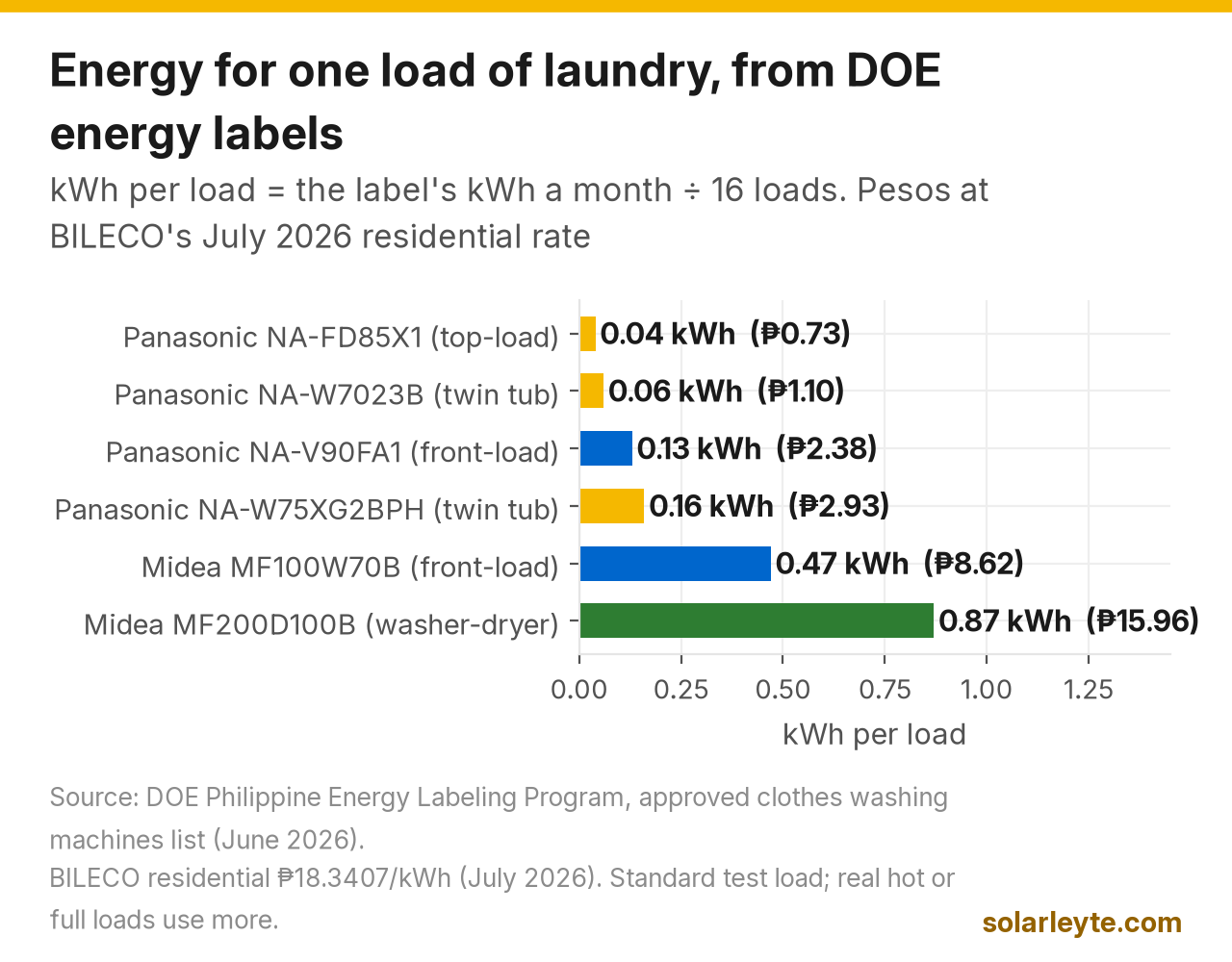
Cost per load: kWh per load × BILECO's July 2026 residential rate of ₱18.3407/kWh. Your co-op's rate will differ; use the rate on your bill.
Across all 124 active labels on DOE's June 2026 list, the monthly figure runs from 0.48 to 51.04 kWh, and 82 of the 124 are at 3.2 kWh a month (0.2 kWh per load) or less. The highest are two large Samsung models (WD16T6300GP at 51.04 and WD19T6500GV at 48.16 kWh a month), and the high end is a mix of brands and types, so check the label on the exact model you're buying. The label uses a standard test, so a long, hot or very full real-world load will use more.
For comparison, our appliance kWh guide shows a ref or an aircon using many times more each month. The washing machine is rarely the reason a BILECO or LEYECO bill is high.
Surge: why the inverter must be bigger than the washer
An electric motor draws a burst of extra current for a moment when it starts, and a washer stops and restarts its motor many times as the pulsator or drum changes direction. Samlex's inverter manual gives a sizing factor of 3 for a "Dishwasher / Clothes Washer". Multiply the machine's running watts by 3 to get the continuous rating the inverter should have. (For comparison, it uses 5 for a compressor ref or aircon and 3 for a well pump.)
Machine and how you run it | Running watts | Inverter rating to look for (× 3) |
|---|---|---|
Eureka twin tub, wash only | 300 W | 900 W |
Markes top-load, wash | 400 W | 1,200 W |
Markes twin tub, wash + spin together | 580 W | 1,740 W |
Panasonic NA-W75XG2, wash + spin together | 710 W | 2,130 W |
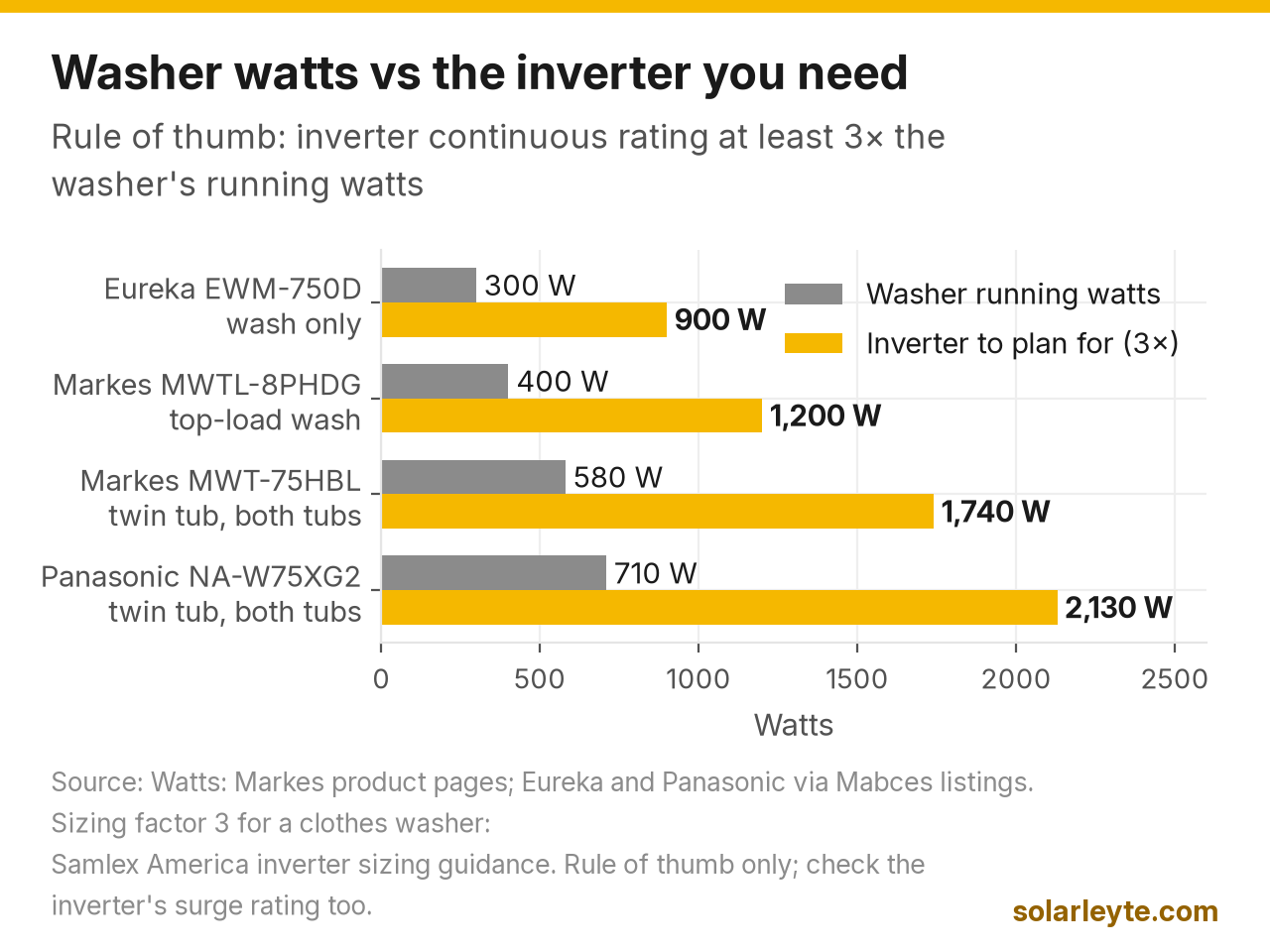
That's a rule of thumb, not a law, so check the inverter's surge (peak) rating as well. Two easy ways to shrink the number:
- Don't run wash and spin together. On a twin tub that drops you from 580–710 W to 300–500 W.
- Switch off the heater or dryer. A front-load on a cold program is in the 200–400 W range, according to LG.
Use a pure sine wave inverter. Samlex says motors run "faster, quieter and cooler" on pure sine wave, and warns that motor speed controls may not work properly on modified sine wave. Our inverter + battery backup guide explains the difference.
Worked examples
Example A: laundry day in a brownout on a power station
Assumptions: Panasonic NA-W75XG2BPH twin tub (0.16 kWh per load on its DOE label), 4 loads, wash and spin run one after the other, 90% inverter efficiency (our assumption).
- Energy: 4 × 0.16 = 0.64 kWh. From the battery at 90%: about 0.71 kWh.
- Watts: the 500 W wash motor × 3 = 1,500 W.
A 1 kWh power station has enough energy. The question is its rated output. In our EcoFlow and power station price list, the 960–1,024 Wh models are rated from 500 W to 2,000 W of AC output. A 1,800 to 2,000 W unit fits this job. A 500 W unit doesn't, even though it holds as much energy.
Example B: how many panels for the washer alone?
Assumptions: same twin tub at 2.56 kWh a month (16 loads), NASA POWER's December average of 3.86 kWh/m² a day for Naval, and a 0.75 allowance for heat, wiring and dust.
- One kWp of panels makes about 3.86 × 0.75 = 2.9 kWh a day in December.
- The washer averages 2.56 ÷ 30 = 0.085 kWh a day.
- That's about 29 W of panel on average. One small panel covers it.
The panel isn't the hard part. Even if you do all 16 loads on a single sunny day, that's 2.56 kWh. If you're building a system mainly for laundry, put your money into the inverter and battery.
Example C: washer-dryer on a rooftop system
Assumptions: Midea MF200D100B washer with dryer at 13.92 kWh a month on its DOE label; 1 kWp gives about 89.7 kWh in a 31-day December (2.9 × 31).
- The washer-dryer uses about 15.5% of that December output, about ₱255 a month at BILECO's July rate.
- Run it at midday on a hybrid or grid-tied system so the panels cover it directly, not the battery.
Grid-tied, hybrid or power station?
- Grid-tied rooftop: runs your washer from the panels while the grid is up, but switches off in a brownout. Our grid-tie vs hybrid guide explains why.
- Hybrid with a battery: keeps the washer going in a brownout if the inverter has the watts. A 3 to 5 kW hybrid comfortably covers every washer in our tables on a cold program.
- Power station or small off-grid kit: fine for a twin tub if the rated AC output is high enough (Example A). Our solar generators and portable power guide covers the basics.
One more catch on small DIY kits: current. At 2,000 W, a 12 V battery has to deliver about 167 A, against about 83 A at 24 V and 42 A at 48 V (watts ÷ volts). That's why washer-sized inverters are usually 24 V or 48 V. See our 12V vs 24V vs 48V guide.
And if your water comes from an electric pump, the pump runs while the tub fills. Add its watts to the total, or fill the tub first. Our solar water pump guide covers pump sizing.
Bisaya quick take
Pwede ra ang washing machine sa solar. Gamay ra ang kWh matag laba, mga 0.04 hangtod 0.16 kWh sa mga modelo sa among lamesa. Ang problema kay ang watts: ang twin tub nga dungan ang laba ug spin mokuha og 580 hangtod 710 W, ug mas maayo nga ang inverter mga tulo ka pilo niana. Ayaw gamita ang hot wash kung battery ra.
FAQ
Can a 1,000 W inverter run a washing machine?
Sometimes. By Samlex's ×3 rule, a 1,000 W inverter suits a washer running at about 330 W or less, like a twin tub's wash tub alone (300 W on the Eureka). Don't run wash and spin together on it, and never a heated wash.
How many solar panels do I need for a washing machine?
For the energy alone, very little. A twin tub at 2.56 kWh a month needs about 29 W of panel on average, using December sun in Naval. The inverter (1,500 to 2,100 W for a twin tub) and battery matter more than the panel count.
Is a twin tub or an automatic better on solar?
On energy, they're close: the DOE labels above show 0.04 to 0.16 kWh per load for both types. On watts, an automatic that washes and spins in turn (400 W for the Markes top-load) is easier on the inverter than a twin tub running both tubs (580–710 W).
Can I run my washing machine straight from the panels without a battery?
Not on a plain grid-tied system during a brownout, because it shuts down. A hybrid inverter runs it from the panels plus the grid on normal days. To keep it going in a brownout, plan on a battery, because a passing cloud can drop panel output below what the washer needs mid-cycle.
Related guides
- Solar generators and portable power stations
- How many kWh your appliances use
- Inverter + battery backup without solar
- EcoFlow and power station prices
- BILECO rate per kWh in 2026
Solar Leyte is run by MACC Systems & Energy Solutions Inc., a solar installer in Naval, Biliran.
Get a free solar quote from MACC
Want your washing machine, ref and fans to keep running in a brownout? Send us the models (or the watts on their stickers) and your latest BILECO or LEYECO bill, and we'll suggest a system, with no obligation.
- Call/Text: 0955 723 5093
- Email: official@macc-inc.com or benjie@macc-inc.com
- Website: www.macc-inc.com
- Request a quote online: solarleyte.com/quote
- Office: Brgy. Talustusan, Naval, Biliran 6543
Sources (all checked 31 October 2026)
- DOE, List of active energy labels for clothes washing machines as of 30 June 2026 (PDF): 124 labels; monthly kWh for Panasonic NA-FD85X1 0.64, NA-W7023B 0.96, NA-V90FA1 2.08, NA-W75XG2BPH 2.56; Midea MF100W70B 7.52, MF200D100B 13.92; range 0.48–51.04.
- DOE PELP approved-product page (example label): "Monthly Energy Consumption = Energy Consumption x N, where N is assumed to be 16 cycles per month".
- Markes MWT-75HBL twin tub: wash 400 W, spin 180 W, total 580 W; ₱7,350.
- Markes MWTL-8PHDG fully automatic top-load: rated input 400 W, spin 300 W; ₱14,250.
- Eureka EWM-750D twin tub (Mabces): wash 300 W, spin 180 W; ₱6,687.
- Panasonic NA-W75XG2 twin tub (Mabces): 710 W (wash 500 W, spin 210 W); ₱7,800.
- LG Philippines, How many watts does a washing machine use: front-loaders 1,000–1,500 W with the heater on, 200–400 W on a cold wash; 80–90% of energy from heating water.
- Samlex SWI series inverter manual (PDF), Table 2.1: inverter sizing factor 3 for a clothes washer, 5 for compressor appliances, 3 for well pumps.
- Samlex, Advantages of pure over modified sine wave inverters (PDF): motors run "faster, quieter and cooler" on pure sine wave.
- BILECO, July 2026 effective rates: residential ₱18.3407/kWh, VAT inclusive.
- NASA POWER monthly API, Naval (11.56° N, 124.40° E), 2001–2025: December mean 3.86 kWh/m² a day (our average of the monthly values).