If your barangay hall doubles as an evacuation center, the solar system has to keep working when the grid is down. That means panels plus a battery and a hybrid or off-grid inverter, sized for the few loads that matter during a typhoon: lights, phone charging, the radio, fans and maybe a water pump. A plain grid-tied system lowers the electric bill, but it switches off in a brownout, which is exactly when the hall fills up.
In our worked example for 150 evacuees in Biliran, the essentials (lights, phone charging and a radio) come to about 3.5 kWh a day. Adding fans and a Starlink brings it to about 7.3 kWh, and a small water pump takes it to about 7.8 kWh. Sized for December's weaker sun, that's roughly 4 panels and one 5 kWh battery for the essentials, or 7 panels and two batteries for everything.
Last checked 31 October 2026. Laws, circulars and PhilGEPS notices are linked in the Sources. Appliance watts are from makers' spec pages. The sizing is a Solar Leyte worked example with the assumptions stated, not an engineering design or a MACC quote.
Grid-tied or battery: the first question to ask
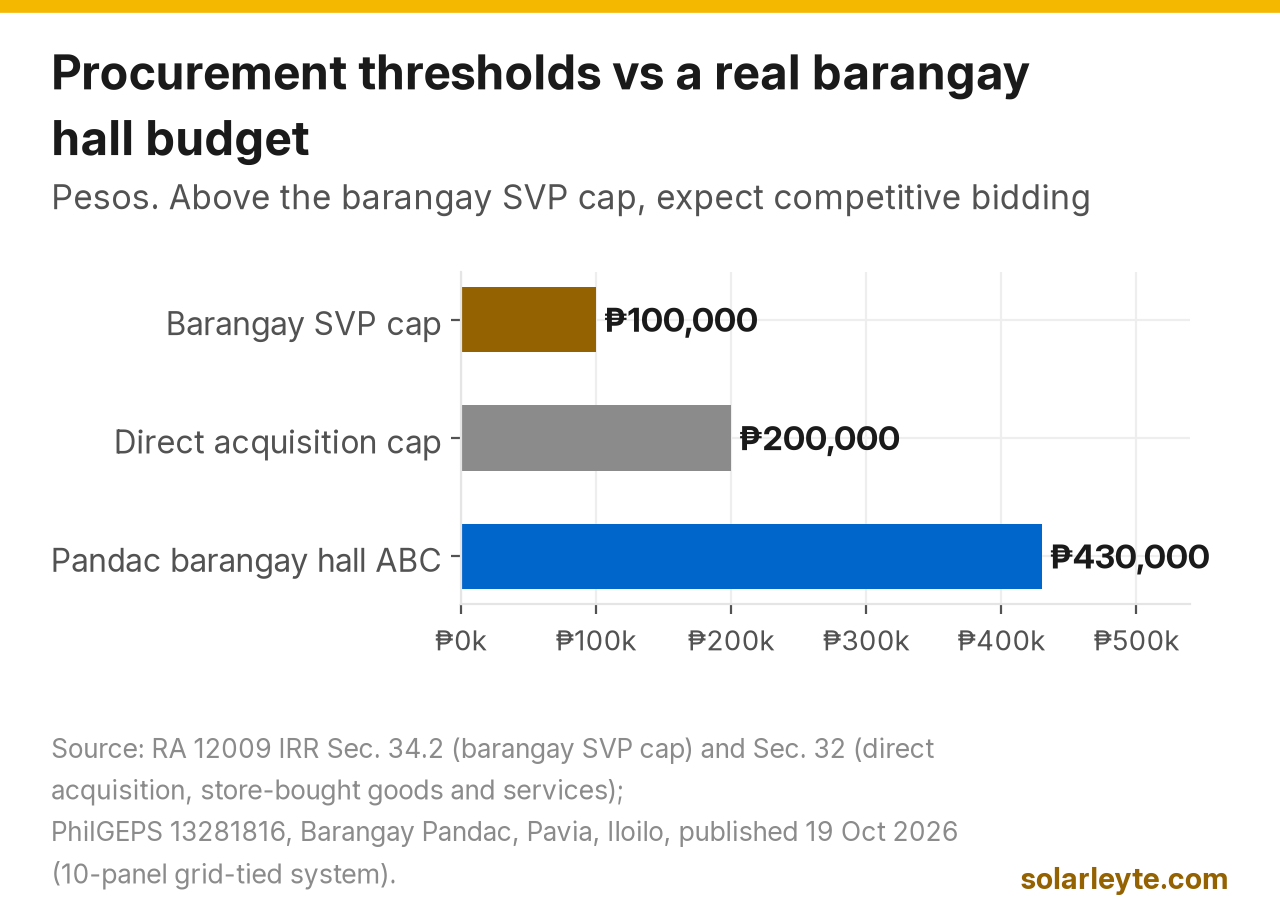
Many barangay solar projects are grid-tied. A 19 October 2026 PhilGEPS notice from Barangay Pandac in Pavia, Iloilo, for example, describes "Installation of 10 solar Panels Grid tied Solar system" at the barangay hall, with an approved budget (ABC) of ₱430,000.
Grid-tied inverters are built to shut down when the grid fails, so line workers aren't hurt by power flowing back into the lines. Fine for a lower bill, useless for an evacuation center during a typhoon, when the lines may be down for days.
For an evacuation center, ask for one of these:
- Hybrid (grid plus battery): runs on solar and the grid on normal days and switches to the battery in a brownout. Best if the hall also has daily office loads.
- Off-grid: panels and batteries only. Simpler, and it suits halls in barangays with weak or no grid service.
Our grid-tie vs hybrid guide explains the difference in more detail.
What the law expects an evacuation center to power
The Ligtas Pinoy Centers Act (RA 12076, approved 6 December 2024) requires an evacuation center in every city and municipality. The centers must be built to withstand winds of at least 300 kph. Among the minimum facilities, the law lists:
- "Standby power for lighting, and operation of medical and communication equipment"
- a powerhouse and stand-alone water pumping facilities
- rainwater harvesting and collection facilities
The law doesn't say the standby power has to be solar. A diesel generator also counts. Solar with a battery is one way to meet it, and it doesn't depend on fuel deliveries after a storm. The DILG-LGA disaster preparedness manual for LGUs (2018) lists "Portable generator, solar-powered generator, flashlights" among the items to stockpile.
Worked example: critical loads for a 150-person evacuation center
Example only. Picture a barangay hall in Biliran used by 150 evacuees. DILG Memorandum Circular 2018-122 sets an average of 1.33 m² per person, so that's about 200 m² of floor space, plus at least 8 toilets at one per 20 people. We split the loads into three tiers so a barangay can start small and add more later.
Tier | Load (example) | Watts each | Hours a day | kWh a day |
|---|---|---|---|---|
1. Essentials | 15 LED bulbs | 9 W | 12 | 1.62 |
1. Essentials | Phone charging, 60 full charges | about 20 Wh each | n/a | 1.20 |
1. Essentials | Radio base station and chargers | 30 W average (assumed) | 24 | 0.72 |
2. Comfort and contact | 4 stand fans, 16-inch | 65 W | 10 | 2.60 |
2. Comfort and contact | Starlink Standard | 75 W (top of 50–75 W) | 16 | 1.20 |
3. Water | Small water pump | about 500 W running | 1 | 0.50 |
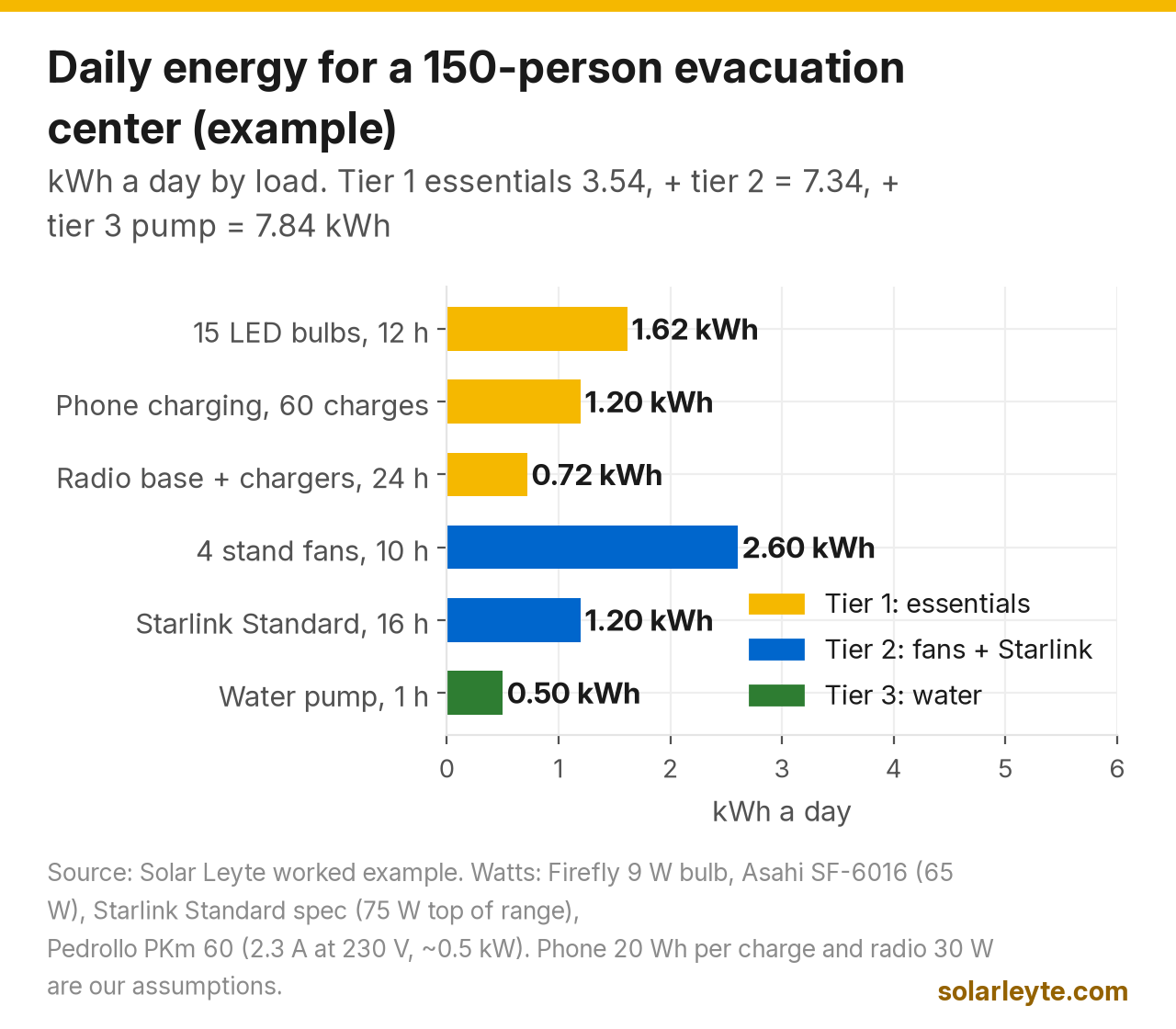
Watts: Firefly 9 W LED bulb, Asahi SF-6016 stand fan (65 W), Starlink Standard spec sheet (50–75 W average), Pedrollo PKm 60 datasheet (0.30 kW, 2.3 A at 230 V). The phone figure assumes a 5,000 mAh battery (about 19 Wh) plus charging losses. The radio figure is our assumption; check your own equipment.
Running totals: 3.54 kWh a day for tier 1, 7.34 kWh with tier 2, and 7.84 kWh with the pump.
Fans are the biggest single load. Four fans use more energy than all the lights and phone charging combined, so start with tier 1 if the budget is tight.
Size the panels for December
Typhoon season is also the low-sun season. NASA's POWER satellite data for Naval averages 3.86 kWh/m² a day in December (2001–2025), against 6.09 in April. We use the same rule as in our off-grid solar guide:
Minimum panel kW = daily kWh ÷ (3.86 × 0.75)
The 0.75 covers heat, dirt, wiring and battery losses. Then we add 50% so the batteries can refill after a grey day.
Tier (cumulative) | kWh a day | Minimum panels | With 50% margin | Example build | Battery (51.2 V, 5.12 kWh each) |
|---|---|---|---|---|---|
1. Essentials | 3.54 | 1.22 kW | 1.83 kW | 4 × 600 W (2.4 kW) | 1 (5.12 kWh) |
2. + fans and Starlink | 7.34 | 2.54 kW | 3.80 kW | 7 × 600 W (4.2 kW) | 2 (10.24 kWh) |
3. + water pump | 7.84 | 2.71 kW | 4.06 kW | 7 × 600 W (4.2 kW) | 2 (10.24 kWh) |
Solar Leyte calculation. Battery count: one day's use divided by 90% usable depth for LiFePO4, rounded up to whole 5.12 kWh modules.
The inverter and the pump
Everything in tiers 1 and 2 running at once is only about 0.6 kW. The pump changes things. A motor draws several times its running current for a moment when it starts, so the inverter needs surge headroom well above the pump's 0.5 kW. If the pump is part of the plan, tell bidders the pump model so they can size for its starting current.
A storm-proof install matters as much as the numbers: panel clamps rated for the wind, the battery and inverter on a raised wall away from flood water, and a written plan for shutting down before the eye passes. Our typhoon checklist covers this.
What barangays and towns budgeted on PhilGEPS
These are approved budgets (ABCs) from PhilGEPS notices we opened on 31 October 2026. An ABC is a ceiling, not the winning price.
Notice | Who | What | ABC | Dates |
|---|---|---|---|---|
13300684 | Municipality of Caibiran, Biliran | Solar power system: 176.80 kWp with inverter and battery, plus a battery enclosure (civil works, 120 days) | ₱25,000,000 | Published 22 Oct 2026, bids close 16 Nov 2026 |
13281816 | Barangay Pandac, Pavia, Iloilo | 10-panel grid-tied system at the barangay hall | ₱430,000 | Published 19 Oct 2026, closes 6 Nov 2026 |
The Caibiran budget works out to about ₱141 per watt of panels. That figure includes batteries, an enclosure and civil works, so don't compare it with a home system price. For smaller public lighting jobs, our solar street light guide lists Leyte and Biliran barangay street light ABCs. For parts prices, see our solar battery price guide and hybrid inverter prices.
Procurement basics under RA 12009
The New Government Procurement Act (RA 12009, approved 20 July 2024) and its IRR replaced RA 9184. These are the points that come up most for a barangay solar project. Always confirm with your BAC and your municipal accountant.
- The barangay BAC. Under the IRR, the barangay Bids and Awards Committee is made up of Sangguniang Barangay members, not including the Punong Barangay.
- Small Value Procurement (SVP) is capped at ₱100,000 for barangays (IRR Section 34.2). Municipalities get ₱200,000 to ₱400,000 depending on income class. RFQs above ₱200,000 must be posted on PhilGEPS for 3 calendar days.
- Direct acquisition is allowed for goods and services with an ABC of up to ₱200,000 (Section 32). It is meant for store-bought items, not a designed and installed system.
- Above those amounts, expect competitive bidding. Both notices above went to public bidding.
- No brand names in the specs, except for technical compatibility, servicing or warranty reasons (Section 11). Specify performance instead: battery kWh and chemistry, inverter kW and surge rating, panel watts and certifications.
- Warranty security: the IRR requires at least 1 year for non-expendable goods. It can be retention money or a bank guarantee of 1% to 5%. Batteries and inverters often carry longer maker warranties, so ask for those in writing.
- Emergency purchases: negotiated procurement is allowed in case of imminent danger to life or property during a state of calamity (Section 35). That's for real emergencies. It isn't a shortcut for a project you could have planned.
Where the money can come from
- LDRRMF: RA 10121 sets aside at least 5% of an LGU's estimated regular revenue. 30% of it is a Quick Response Fund and the rest goes to prevention and preparedness.
- DILG MC 2018-122 urges LGUs to use part of that 70% to build and upgrade evacuation centers. The project must be in the Local DRRM Plan and the approved Annual Investment Program.
- 20% Local Development Fund: the same circular also allows it for evacuation center construction and rehabilitation.
A barangay resolution can start the request. We don't publish sample resolutions; ask your municipal DRRM office or DILG field officer for the format they accept.
Biliran and Leyte context
Eastern Visayas is already studying this. In September 2024, Visayas State University in Baybay signed an agreement with Germany's GIZ for the Solar-Safe Project. The project is a feasibility study of battery-backed off-grid solar for evacuation centers across the region. We didn't find published results as of 31 October 2026.
For how often the Visayas grid goes on yellow and red alert, see our grid alert explainer. For a fuel-based backup, compare our generator vs solar guide.
Bisaya/Tagalog quick take
Bisaya: Kung ang barangay hall gamiton nga evacuation center, kinahanglan solar nga naay battery, dili lang grid-tied, kay mo-off ang grid-tied kung brownout. Para sa 150 ka tawo, mga 3.5 kWh kada adlaw para sa suga, charging sa cellphone ug radyo.
Tagalog: Kapag evacuation center din ang barangay hall, kailangan ng solar na may battery. Ang grid-tied ay namamatay kapag brownout. Magsimula sa ilaw, charging at radyo, saka magdagdag ng bentilador at water pump.
FAQ
Does a grid-tied solar system work during a brownout?
No. Grid-tied inverters shut down when the grid fails. You need a hybrid or off-grid inverter with a battery to keep power on.
How many solar panels does an evacuation center need?
It depends on the loads. In our 150-person example, the essentials need about 4 × 600 W panels and one 5 kWh battery. Adding fans, Starlink and a pump needs about 7 panels and two batteries.
Can a barangay buy a solar system through small value procurement?
Only if the ABC is ₱100,000 or less, the SVP cap for barangays under the RA 12009 IRR. Most battery-backed systems will cost more and go to competitive bidding.
Can the disaster fund (LDRRMF) pay for solar at an evacuation center?
DILG MC 2018-122 allows part of the 70% LDRRMF to be used for building and upgrading evacuation centers, if the project is in the Local DRRM Plan and the AIP. Check with your municipal accountant and the COA auditor before you commit.
Related guides
- Solar and typhoons: preparing your system
- Off-grid solar for Leyte and Biliran homes
- Solar street light prices and barangay budgets
- Solar subsidies and government programs
- Wi-Fi and Starlink backup in a brownout
Solar Leyte is run by MACC Systems & Energy Solutions Inc., a solar installer in Naval, Biliran.
Get a free solar quote from MACC
Planning backup power for a barangay hall or evacuation center? Send us a list of what you want to run and for how many hours, and we'll suggest a system, with no obligation.
- Call/Text: 0955 723 5093
- Email: official@macc-inc.com or benjie@macc-inc.com
- Website: www.macc-inc.com
- Request a quote online: solarleyte.com/quote
- Office: Brgy. Talustusan, Naval, Biliran 6543
Sources (all checked 31 October 2026)
- Republic Act No. 12076, Ligtas Pinoy Centers Act (Lawphil): 300 kph design wind speed; minimum facilities including standby power, water pumping and rainwater harvesting.
- Republic Act No. 12009, New Government Procurement Act (Lawphil): brand-name rule (Sec. 11), direct acquisition up to ₱200,000 (Sec. 32), negotiated procurement in emergencies (Sec. 35).
- Implementing Rules and Regulations of RA 12009 (GPPB, PDF): SVP thresholds (Sec. 34.2, ₱100,000 for barangays), RFQ posting, barangay BAC, warranty security (Sec. 90.1).
- Republic Act No. 10121, Philippine DRRM Act (Lawphil): LDRRMF of at least 5% of estimated regular revenue; 30% Quick Response Fund (Sec. 21).
- DILG Memorandum Circular 2018-122, Strengthening of evacuation systems using the LDRRMF (full text via Legaldex): 70% LDRRMF use, LDRRM Plan and AIP condition, 20% Development Fund, 1.33 m² per person, 1:20 toilets.
- DILG-LGA Operation L!STO Disaster Preparedness Manual for City and Municipal LGUs (2018, PDF): stockpile list including "Portable generator, solar-powered generator, flashlights".
- PhilGEPS notice 13300684, Caibiran, Biliran: Installation of Solar Power System: ABC ₱25,000,000; 176.80 kWp with inverter and battery.
- PhilGEPS notice 13281816, Barangay Pandac, Pavia, Iloilo: Solar Panel System at the Barangay Hall: ABC ₱430,000; 10-panel grid-tied system.
- NASA POWER monthly API, Naval (11.56° N, 124.40° E), 2001–2025: December mean 3.86 and April 6.09 kWh/m² a day (our average of the monthly values).
- Firefly Electric, 9 W LED bulb (E27): 9 W bulb.
- Asahi SF-6016 16-inch stand fan: 65 W.
- Starlink Standard kit specifications (PDF): average power 50–75 W.
- Pedrollo PKm 60 datasheet, 50 Hz (PDF): 0.30 kW motor, 2.3 A at 230 V.
- Visayas State University: VSU to work with German federal enterprise for Solar-Safe Project (24 Sep 2024): GIZ-funded feasibility study of off-grid solar with batteries for Eastern Visayas evacuation centers.