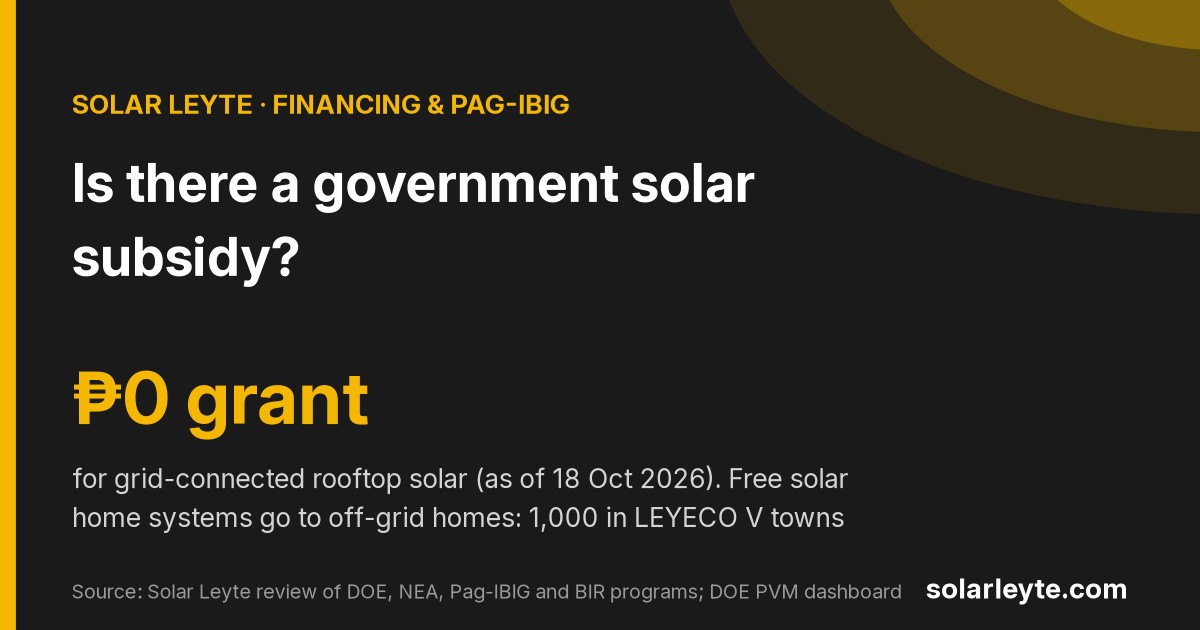
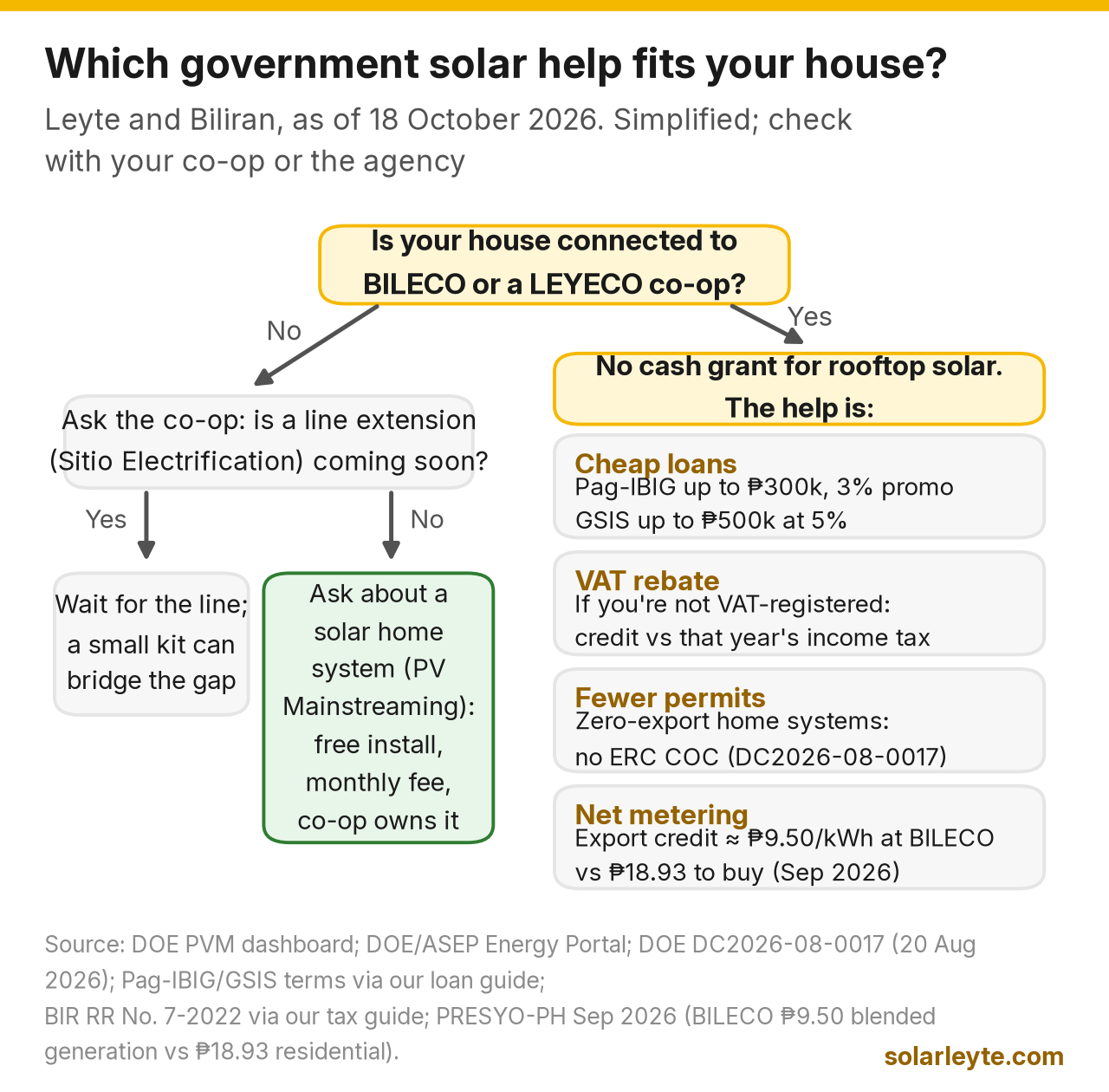
Short answer: if your house is already on the BILECO or LEYECO line, there's no government subsidy that pays part of a rooftop solar system. We looked for one and didn't find it, as of 18 October 2026. Free or subsidised solar does exist, but it goes to off-grid households that the power lines won't reach for years. They get a small solar home system (about four LED bulbs, a radio and phone charging) that the electric co-op installs, owns and maintains. In Leyte, LEYECO V has handed out 1,000 of these. The DOE's list shows none in BILECO's area.
For a grid-connected home, the real help is smaller and less flashy: a low-interest Pag-IBIG or GSIS loan, a possible VAT rebate if you aren't VAT-registered, fewer permits and fees for zero-export systems, and net metering credits. None of these is free money, but together they can take a real bite out of the cost.
Last checked: 18 October 2026. This is a plain-English summary of the programs and rules listed under Sources, not legal or tax advice. Programs change, so confirm with your co-op, your LGU or the agency before you plan around one.
Government solar help at a glance
Program | Who it's for | What you actually get | In Leyte and Biliran? |
|---|---|---|---|
PV Mainstreaming / NEA solar home systems | Off-grid households not expected to get a line within a few years | A small solar kit installed free; you pay a monthly service fee; the co-op owns it | LEYECO V: 1,000 units in 12 towns. BILECO, LEYECO II, III, IV: none on the DOE list |
Sitio Electrification and household connection programs | Unlit sitios and unconnected houses near the grid | Government-funded line extensions and house connections, not solar | Ask your co-op; LEYECO V lists 42 sitios and 998 households under SEP 2021 (bidding ongoing, awaiting NEA funds) |
Pag-IBIG Short-Term Loan for Home Improvement | Pag-IBIG members who own the house | Loan up to ₱300,000, 3% a year promo for the first 10,000 qualified members | Yes |
GSIS Ginhawa Solar Energy Loan | Government employees | Loan up to ₱500,000 at 5% a year over 5 years | Yes |
VAT rebate on RE equipment (RR No. 7-2022) | Home buyers who aren't VAT-registered | Credit for the VAT you paid, against that year's income tax | Yes, through the BIR |
DOE own-use solar rules (DC2026-08-0017) | Homes with zero-export or small plug-and-play solar | No ERC certificate for qualifying home systems; no co-op pre-installation clearance or inspection fees | Yes, nationwide |
Net metering (RA 9513) | Grid homes that export daytime surplus | Bill credits for exported power | Yes. Co-ops must offer it under RA 9513. |
ER 1-94 host-community funds | LGUs and barangays near power plants | Money for local projects, sometimes solar streetlights; can lower local rates | Ormoc, Kananga and Leyte province (geothermal) |
Sources for every row are in the sections below and the Sources list.
Free solar for off-grid homes: the PV Mainstreaming program
This is the closest thing the Philippines has to "libreng solar", and it's worth understanding how it really works.
Under the DOE's PV Mainstreaming program, the government buys solar home systems through competitive bidding, has them installed, and then hands ownership to the electric cooperative (ERC rules on solar home system tariffs, 2017). The program targets households with no grid access that aren't expected to be reached by line programs like the Sitio Electrification Program within a few years (DOE/ASEP Energy Portal). Each unit can run four LED bulbs and a radio and charge phones (DOE via PowerPhilippines, 30 July 2025).
What the household gets and pays:
- Installation is free. In its July 2025 update the DOE said installation is fully subsidised and beneficiaries cover only the operation and maintenance costs.
- There's a monthly fee. The ERC sets a benchmark solar home system tariff, and that is the maximum the co-op may charge. It covers the co-op's visits, insurance and a ring-fenced fund for replacing the panel, controller and battery.
- The co-op owns the system. Bulbs and appliances are the household's responsibility; the major parts are the co-op's.
- Example only, from Mindanao: when SUKELCO signed up households in 2020, the package carried a fee described as ERC-mandated, ₱7.40 a day, plus a one-time ₱255 membership fee (Mahintana Foundation, March 2020). That works out to about ₱222–225 a month (our calculation). Your co-op's fee can be different.
So it's not a dole-out. Think of it as a tiny solar "utility service" for houses the lines can't reach yet.
How many are in Eastern Visayas?
Very few. The DOE's PV Mainstreaming dashboard counts 95,081 solar home systems nationwide, but only 3,667 in the Visayas, against 79,163 in Mindanao (data updated 3 October 2026) (DOE PVM dashboard). That means the Visayas has under 4% of them (our calculation).
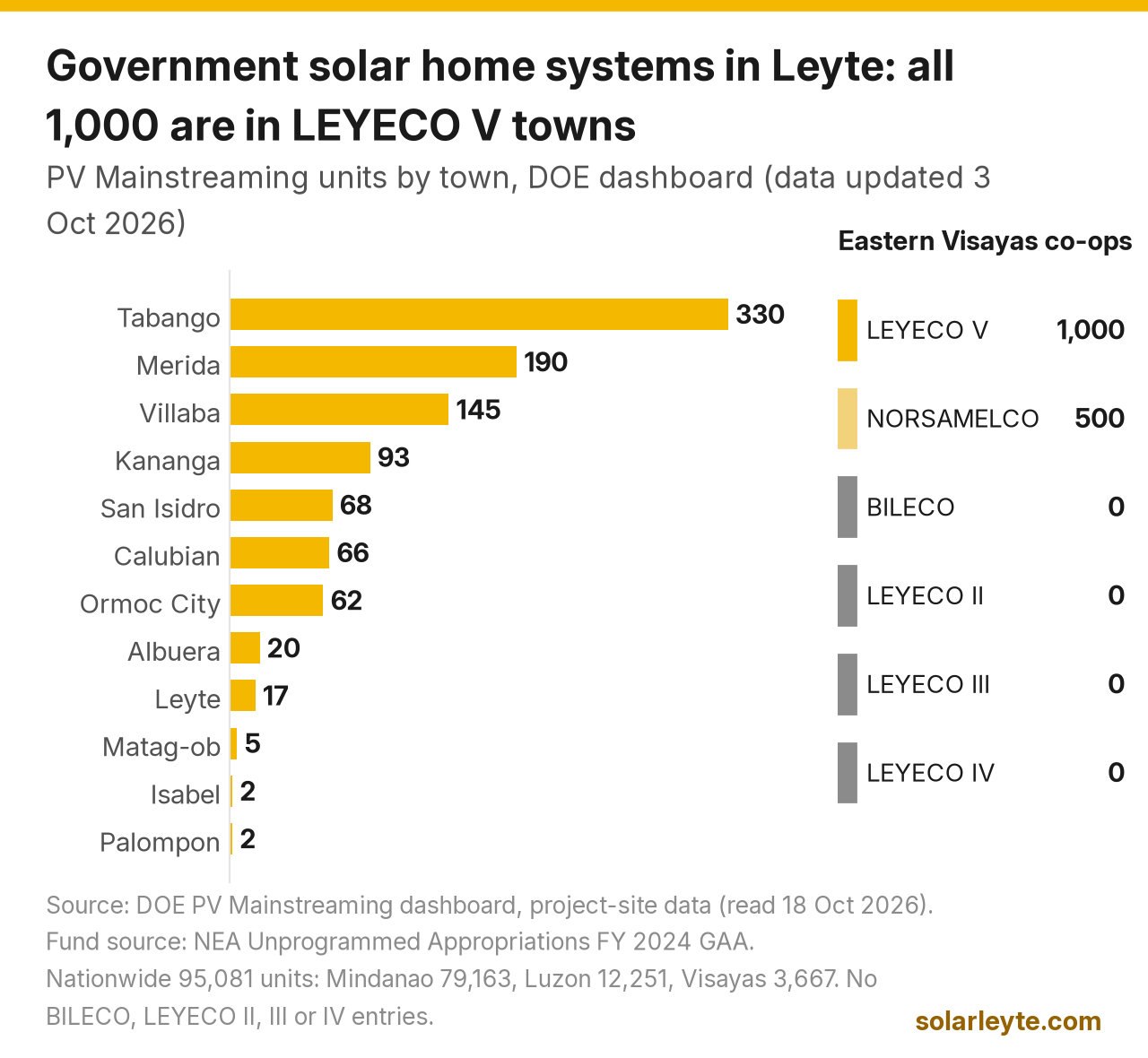
In Eastern Visayas, only two co-ops appear on the list: LEYECO V with 1,000 units and Northern Samar's NORSAMELCO with 500. BILECO, LEYECO II, LEYECO III, LEYECO IV and SOLECO don't appear at all. LEYECO V's 1,000 units were all paid for from NEA's 2024 unprogrammed appropriations and are marked completed.
LEYECO V town | Solar home systems |
|---|---|
Tabango | 330 |
Merida | 190 |
Villaba | 145 |
Kananga | 93 |
San Isidro | 68 |
Calubian | 66 |
Ormoc City | 62 |
Albuera | 20 |
Leyte | 17 |
Matag-ob | 5 |
Isabel | 2 |
Palompon | 2 |
Total | 1,000 |
Source: DOE PV Mainstreaming dashboard, project-site data, read 18 October 2026.
For Biliran, the gap is mostly lines, not solar kits. BILECO reports all barangays energized but not every sitio and house yet. Our off-grid solar guide has those numbers and the island details.
What's coming next
NEA keeps buying more. On 2 October 2026 it posted a re-bid for 12,000 solar home systems with an approved budget of ₱349,514,563.11, for nine Mindanao co-ops; bids close 27 October 2026 (PhilGEPS ref. 13260724). That's about ₱29,100 per installed unit (our calculation), which gives you a sense of what the government is paying for each household.
The DOE has also said it will tender microgrids for about 12,000 off-grid households in seven provinces, Samar among them. None in Leyte or Biliran was named (PowerPhilippines, 30 July 2025).
If your house is off-grid, go to your co-op's office (member services) or your barangay captain and ask two things: is your sitio scheduled for a line extension, and is it on a solar home system list? If a line is coming within a year or two, a small kit of your own may only need to bridge the gap.
Already on the grid? What actually helps
For the roughly 95% of Filipino households already connected (94.75% at the end of 2024, per the DOE as reported by PowerPhilippines), help comes as loans, tax treatment and lighter rules, not grants.
Low-interest loans
- Pag-IBIG: the Short-Term Loan for Home Improvement covers solar panel installation, up to ₱300,000 over five years, at a 3% promo rate for the first 10,000 qualified members. No mortgage needed. Details and a BILECO example are in our Pag-IBIG solar loan guide.
- GSIS Ginhawa Solar Energy Loan: for government workers, up to ₱500,000 at 5% over five years (same guide).
- Banks: BPI, Security Bank and others lend for solar, but at market rates and with higher minimums. See our bank solar loan comparison.
A VAT rebate most people miss
You normally pay 12% VAT on panels from a VAT-registered seller. A 2022 BIR regulation lets a home buyer who isn't VAT-registered claim that VAT back as a credit against the same year's income tax. The catch: if your income tax that year is smaller than the VAT, the rest is lost. The full rules and examples are in our solar panel tax guide.
Fewer permits and fees for zero-export systems
Since 5 August 2026, DOE Circular DC2026-08-0017 waives the ERC Certificate of Compliance (COC) for qualifying zero-export systems in homes (and in clinics and hospitals). You still need a building permit unless your LGU confirms your existing one is enough. Grid-connected systems need a written notice to the co-op, and co-ops may not require pre-installation clearances or inspection fees (DC2026-08-0017; DOE media release, 20 August 2026; PowerPhilippines, 6 August 2026). Plug-and-play kits (panels up to 1 kW, with a micro-inverter of 0.8 kW AC or less with anti-islanding, plugged into a standard outlet) need only a notice: no building permit and no COC. It's not cash, but it cuts real costs. Our plug-and-play and zero-export guide explains what qualifies.
Net metering is a credit, not a subsidy
Net metering under RA 9513 lets you send daytime surplus to BILECO or your LEYECO co-op and get a bill credit. That credit is roughly the co-op's blended generation rate, not the full retail rate. In September 2026 that was ₱9.50/kWh at BILECO against a residential rate of ₱18.93/kWh (PRESYO-PH, ICSC). So 100 kWh you use yourself saves about ₱1,893, while 100 kWh exported earns about ₱950 (our calculation). The net metering guide covers the application.
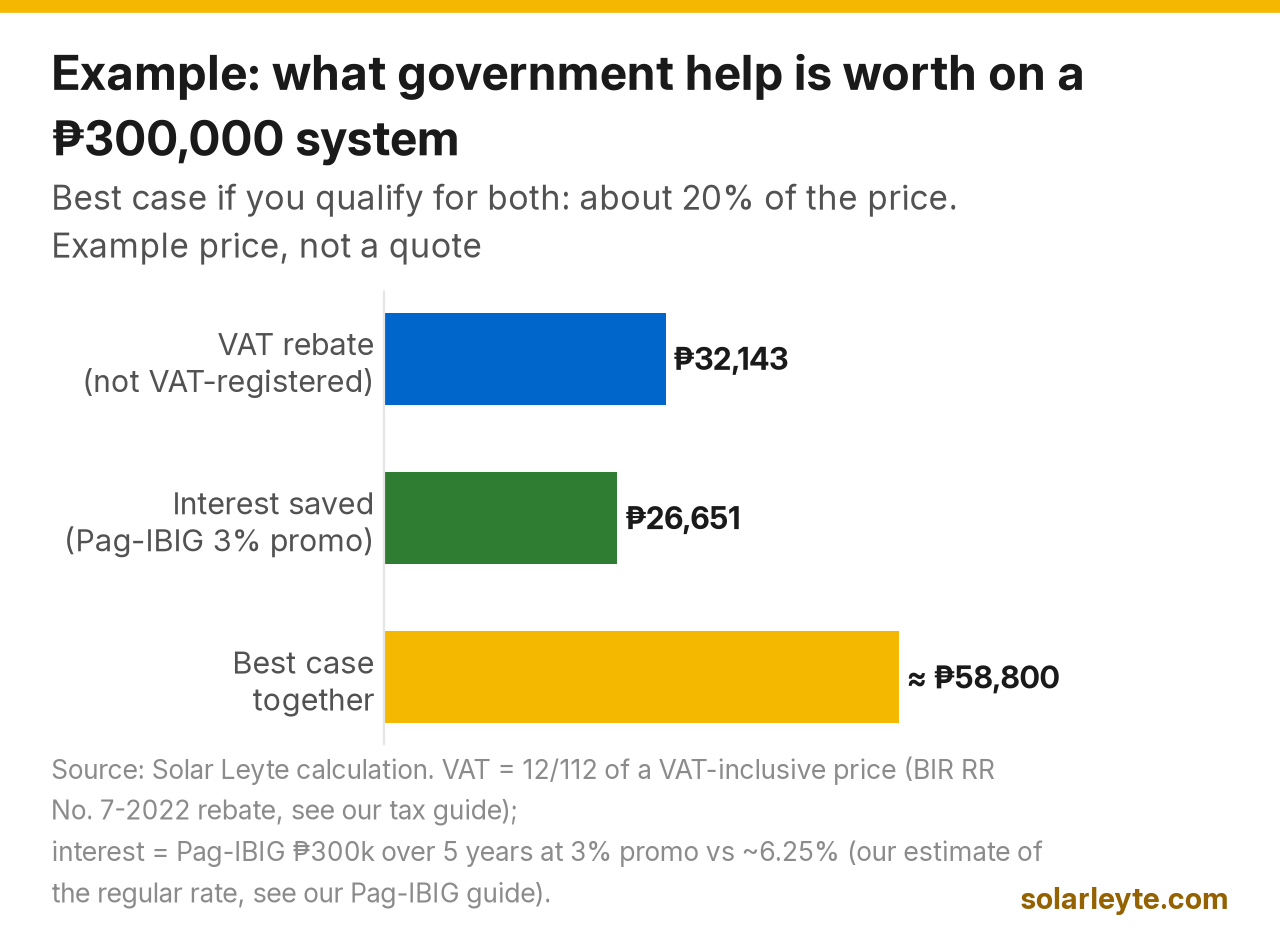
Worked example: what the help adds up to on a ₱300,000 system
Example only. The ₱300,000 price is an illustration, not a quote. It uses figures worked out in our tax and Pag-IBIG guides.
Help | Value on ₱300,000 | Condition |
|---|---|---|
VAT rebate | Up to ₱32,143 (the VAT inside a VAT-inclusive price) | Not VAT-registered, and income tax that year at least that much |
Pag-IBIG 3% promo vs about 6.25% | About ₱26,651 less interest over 5 years (₱23,436 vs ₱50,087) | Among the first 10,000 qualified members; 6.25% is our estimate of the regular rate |
Best case together | About ₱58,800, or roughly 20% of the price | Both conditions met |
For a salaried worker whose employer withholds enough tax, both can apply. For a minimum-wage earner who pays no income tax, the VAT rebate is worth nothing. That's why it's worth asking before you count on it.
LGU and barangay money: mostly streetlights and public buildings
ER 1-94 funds. Communities that host power plants get a share of each kilowatt-hour sold. From January 2026 the DOE tripled it from ₱0.01 to ₱0.03 per kWh: ₱0.025 for livelihood, environment, health and education projects, and ₱0.005 for connecting households. LGUs may also use the money to lower local power rates, and must do so if the funds sit unused for two years (Philstar, 23 October 2025). In Leyte, EDC, which runs the geothermal plants there, released ₱20.38 million for the first quarter of 2026 to Leyte province, Ormoc City, Kananga and host barangays. Ormoc is using part of it for solar streetlights in Barangay Catmon (Leyte Samar Daily News, 28 July 2026). The money goes to the LGU, not to individual homes. If you live in Ormoc or Kananga, your barangay assembly is where to ask how it's spent.
Barangay solar projects. Local solar spending we found is for public use. For example, Barangay Anislagan in Naval put out a ₱100,000 bid for solar light installation in September 2026 (PhilGEPS ref. 13225503). We found no Leyte or Biliran LGU program that gives homeowners rooftop panels. If your municipality starts one, it'll be announced through the LGU, not by a private seller. For public lighting, see our solar street light guide.
Farmers' groups are a separate case. The DA and NIA build solar irrigation for associations; our solar water pump guide lists recent Eastern Visayas projects.
Bills in Congress: not law yet
- Sariling Kuryente Act (House Bill 10431). Filed in early August 2026 after the President's SONA, it would stop co-ops from demanding prior approval, studies, meter replacements or extra fees for non-exporting home systems (GMA News, 2 August 2026). The House energy committee approved a substitute bill on 12 October 2026 (The Insider News PH). It cuts red tape; it doesn't give money.
- Free Electricity for Low-Consumption Households Act (House Bill 2700). It would pay the bills of homes using up to 135 kWh a month or ₱2,000, whichever is lower (GMA News, 17 February 2026). It's a bill subsidy, not a solar one.
Until they pass, the existing bill discounts are the lifeline rate and the senior citizen discount. Our lifeline and senior discount guide shows who qualifies.
Watch out for "libreng solar" offers
Because real programs exist for off-grid homes, the word "free" gets used loosely. A few checks, based on how the real programs work:
- Real solar home systems come through your co-op, after your household is listed. You don't buy a slot from a Facebook page or an agent.
- The co-op owns the unit and charges a regulated monthly fee. Anyone selling you a "government" kit outright isn't running the government program.
- There's no national rooftop grant for grid-connected homes that we could find. If someone says the government will refund your system, ask for the program name and check it with your co-op, the DOE or NEA before you pay anything.
FAQ
Is there free solar panel installation from the government in the Philippines? Only for off-grid households, through NEA and DOE solar home systems that the co-op installs and owns. You still pay a monthly service fee. Homes already on the grid don't get free rooftop systems.
Can BILECO give me a solar home system? BILECO doesn't appear on the DOE's solar home system list as of October 2026. If your house in Biliran has no connection, ask BILECO whether your sitio is due for a line extension first.
Does Pag-IBIG have a solar subsidy? No. It's a loan, but a cheap one: up to ₱300,000 at a 3% promo rate for the first 10,000 qualified members. See our financing guide for the other options.
Is net metering a government subsidy? No. Your co-op credits the power you export at roughly its generation rate, which is about half the retail rate at BILECO. It rewards self-use more than export.
Will the Sariling Kuryente Act pay for my solar? No. As filed, it removes approvals, studies and fees for non-exporting systems. It has no cash grant. It also isn't law yet.
Solar Leyte is run by MACC Systems & Energy Solutions Inc., a solar installer in Naval, Biliran.
Get a free solar quote from MACC
Planning solar without a subsidy? Send us a recent electric bill and a photo of your roof. We'll get back to you with a free, no-obligation written quote you can also use for a Pag-IBIG application.
- Call/Text: 0955 723 5093
- Email: official@macc-inc.com or benjie@macc-inc.com
- Website: www.macc-inc.com
- Office: Brgy. Talustusan, Naval, Biliran 6543
- Or use the site quote form: /quote
Related guides
- Solar financing and Pag-IBIG
- Pag-IBIG solar loan
- Bank solar loans compared
- Solar panel tax: VAT, rebate and real property tax
- Off-grid solar for island and farm homes
Sources (all checked 18 October 2026)
- Department of Energy, PV Mainstreaming dashboard (data last updated 3 October 2026): 95,081 solar home systems nationwide (Luzon 12,251, Visayas 3,667, Mindanao 79,163); LEYECO V 1,000 units in 12 towns (project-site data; fund source NEA Unprogrammed Appropriations FY 2024 GAA, status completed); NORSAMELCO 500; no BILECO, LEYECO II, III or IV entries
- Energy Regulatory Commission, Rules governing the setting of the regulated solar home system tariff (Pasig City, 18 July 2017; text via Legaldex): DOE capital subsidy and transfer of ownership to the co-op; benchmark tariff is the maximum; equipment fund for replacing module, controller and battery; bulbs and appliances are the customer's
- DOE/ASEP, Energy Portal: Total Electrification Program: PV Mainstreaming targets households not expected to be energized by SEP, BLEP or NIHE within a few years; SEP funds lines and house wiring
- PowerPhilippines, DOE moves to power last-mile homes, schools with solar (30 July 2025): household electrification 94.75% (December 2024); four LED bulbs, radio, phone charging; installation fully subsidised, beneficiaries cover operation and maintenance; NEA target 100,000 households by Q1 2026 plus 54,000 for 2026; microgrid tender for ~12,000 households in seven provinces including Samar
- Mahintana Foundation, SOLARES social marketing and SUKELCO member-consumer sign-up (5 March 2020): fee described as ERC-mandated, ₱7.40 a day; one-time ₱255 membership fee
- PhilGEPS, NEA PB No. 2026-05, 12,000 solar home systems (re-bid) (published 2 October 2026): approved budget ₱349,514,563.11; nine Mindanao co-ops; closing 27 October 2026
- LEYECO V, About us: PVM-SHS distribution; SEP 2021: 42 sitios / 998 households (bidding ongoing, awaiting NEA funds)
- Department of Energy, DOE simplifies rules for own-use solar (media release, 20 August 2026) and DC2026-08-0017 (effective 5 August 2026): ERC COC waived for qualifying zero-export systems in homes, clinics and hospitals; building permit still needed unless the LGU confirms the existing one is enough; written notice to the co-op for grid-connected systems; co-ops may not require pre-installation clearances, technical permits or inspection fees (Sec. 6.1); meter costs follow ERC rules (Sec. 6.7); plug-and-play kits (up to 1 kW of panels, micro-inverter 0.8 kW AC or less with anti-islanding, standard outlet) need only a notice
- PowerPhilippines, DOE cuts red tape for own-use rooftop solar systems (6 August 2026): coverage of DC2026-08-0017's COC waiver, notice-only plug-and-play kits and limits on co-op requirements
- ICSC, PRESYO-PH national electricity rates, September 2026: BILECO residential ₱18.93/kWh, blended generation ₱9.50/kWh
- Philstar, LGUs' revenue share from gencos tripled (23 October 2025) and BusinessWorld, Communities hosting power facilities granted P0.03 per kWh revenue share (22 October 2025): ER 1-94 ₱0.01 → ₱0.03/kWh from January 2026; ₱0.025 / ₱0.005 split; rate reduction option
- Leyte Samar Daily News, EDC releases P20.38 million in power-generation benefits to Leyte host communities (28 July 2026): Q1 2026 ₱20.38 million; solar streetlights in Brgy. Catmon, Ormoc
- PhilGEPS, Barangay Anislagan, Naval: Installation of solar light, ITB 2026-05 (published 5 September 2026): ₱100,000 approved budget
- GMA News, Sariling Kuryente Act filed at House (2 August 2026); BusinessWorld, House measures target lower electricity costs, rooftop solar (2 August 2026); The Insider News PH, House panel backs bills (12 October 2026)
- GMA News, 'Free electricity' proposed for low-consumption households (17 February 2026): HB 2700, 135 kWh or ₱2,000 threshold
- Reuters via Rappler, Philippines leads the world in rush to solar as power prices soar (29 June 2026): the Philippines has "barely any power subsidies"
- Loan, VAT and tax figures: our Pag-IBIG solar loan guide and solar panel tax guide, which list their primary sources (Pag-IBIG reports, BIR RR No. 7-2022, RA 9513)