Yes, you can get a bank loan for solar panels in the Philippines, but in 2026 most bank solar loans are really home loans with solar as the purpose. BPI and Security Bank each have a named "Solar Mortgage". BDO finances solar under its regular Home Loan, with your property as collateral. RCBC offers home loans, personal loans and credit card instalments for solar. Landbank has no solar loan for individual homeowners: its renewable energy program lends to businesses, cooperatives and LGUs.
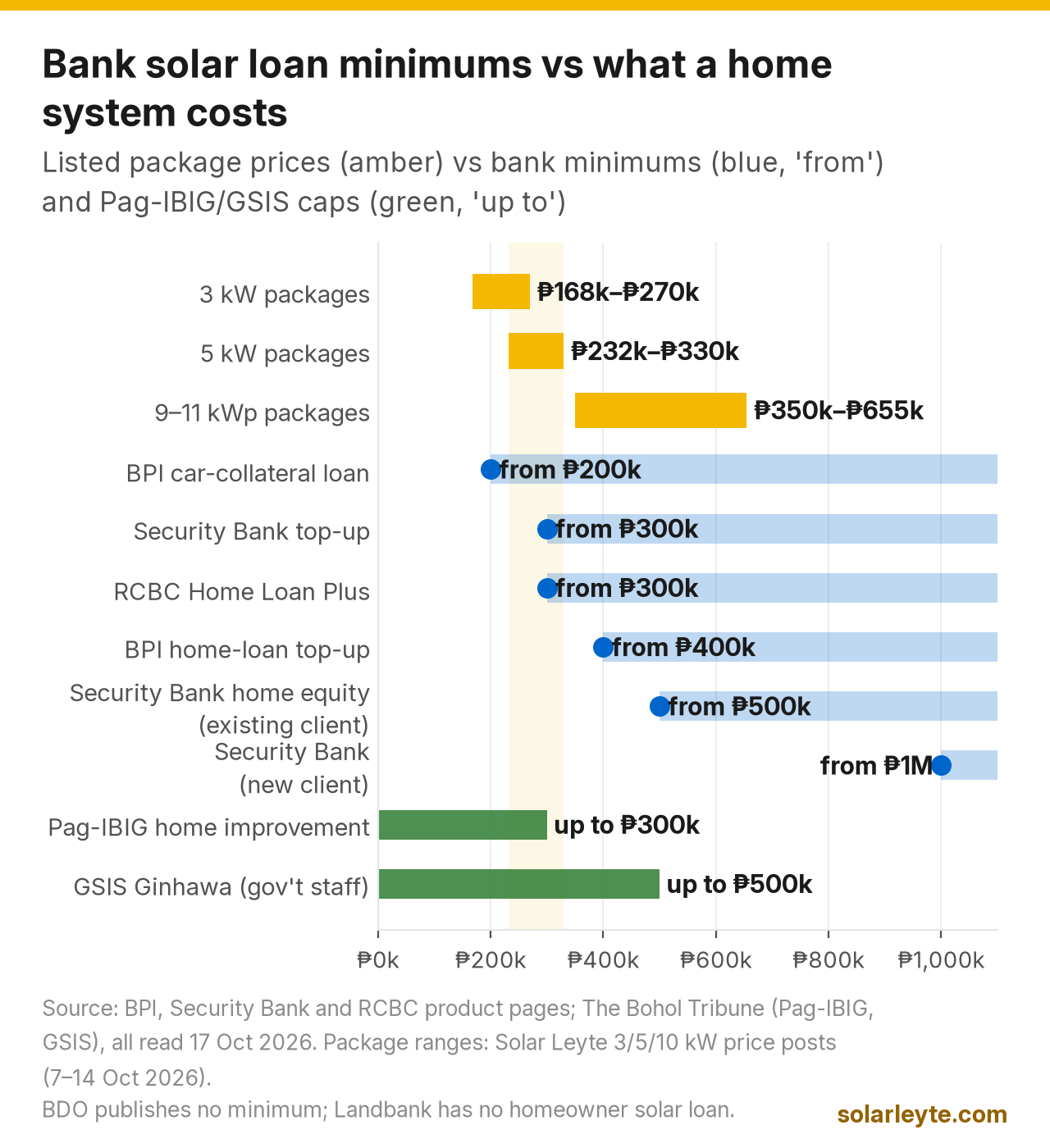
The catch for families in Leyte and Biliran is size. Bank minimums start at ₱200,000 (BPI, with a car as collateral) and go up to ₱1,000,000 (Security Bank, new clients). Listed 3 kW packages in our price research ran ₱168,000 to ₱270,000, and 5 kW packages ₱232,000 to ₱330,000. So for a typical home system, Pag-IBIG's home improvement loan (up to ₱300,000, no mortgage) is often the easier fit, and a bank makes more sense for bigger systems or if you already have a home loan with that bank.
Last checked: 17 October 2026. We read each bank's own product page that day. Rates and promos change often, so treat this as a starting point and confirm with the bank before you sign anything with an installer.
Bank solar loans at a glance (October 2026)
Bank | Solar route | Minimum loan | Longest term | Rate published? | Collateral | Accredited solar partner listed |
|---|---|---|---|---|---|---|
BPI | Solar Mortgage: Top-Up Equity Loan | ₱400,000 | 20 years | Promo "as low as 5.99%" fixed for the first year (July 2026 reports) | Your existing BPI-financed home (at least ₱400,000 already paid) | Helios |
BPI | Solar Mortgage: Multi-Purpose Loan | ₱200,000 | 5 years | Not on the page | A car no older than 5 years when the loan ends | Helios |
BDO | Home Loan, "Personal Expenses" purpose (solar named) | Not stated on the page | 25 years | Not on the page | Property, up to 80% of appraised value | None listed |
Security Bank | Solar Mortgage | ₱300,000 top-up; ₱500,000 home equity (existing clients); ₱1,000,000 (new clients) | 20 years (25 for house and lot, per its FAQ) | 7.00% (1-yr fixed), 7.50% (3-yr), 8.00% (5-yr) | Property | Helios |
RCBC | Home loan bundle, top-up or home equity; Home Loan Plus | ₱300,000 (Home Loan Plus) | 30 years (Regular Home Loan) | Not on the solar pages | Property | Helios (promo partner) |
RCBC | Personal loan or credit card instalment | – | 60 months (loan); 36 months (card) | Card: 0% at participating merchants | None | Card merchants |
Landbank | No homeowner solar loan; REAL Energy Plus for businesses, co-ops, LGUs | – | – | – | Project-based; private borrowers up to 80% of project cost | – |
Compare: Pag-IBIG | Short-Term Loan for Home Improvement | Up to ₱300,000 (maximum) | 5 years | 3% promo for the first 10,000 borrowers | No mortgage | – |
Compare: GSIS | Ginhawa Solar Energy Loan (government employees) | Up to ₱500,000 (maximum) | 5 years | 5% | – | – |
Sources: each bank's product page (links at the end), Context.ph and PowerPhilippines (BPI promo, July 2026), The Bohol Tribune (Pag-IBIG and GSIS, 6 September 2026). "–" means not applicable or not published.
BPI Solar Mortgage
BPI's Solar Mortgage page is the clearest of the five. It lists two routes with published numbers:
- Top-Up Equity Loan. For people who already have a BPI housing loan. Minimum loan ₱400,000, terms of 1 to 20 years, and you must have paid at least ₱400,000 on your existing housing loan. You can fold the top-up into one new housing loan account so you only make one monthly payment.
- Multi-Purpose Loan. Uses a fully paid car as collateral. Minimum ₱200,000, up to 5 years, and the car must not be older than five years when the loan ends.
The FAQ also mentions a Property Equity Loan (your house as collateral, without an existing BPI home loan) and a Mortgage Switch (moving a home loan from another bank to BPI). For every route, BPI asks for proof of loan purpose, which means a quotation for the solar panels from your provider.
Rate: the product page shows no interest rate. In July 2026, news reports quoting BPI said qualified borrowers get fixed rates "as low as 5.99 percent for the first year", a free first appraisal worth ₱5,000, and up to ₱50,000 in waived bank fees (Context.ph; PowerPhilippines). BPI's own example: ₱1,000,000 over 10 years at 5.99% comes to about ₱11,090 a month. (Our calculation gives ₱11,097.) After the first year the rate reprices, so ask what the second-year rate would be.
BPI said its solar financing grew 89% in 2025, to about ₱100 million in outstanding balances (Philstar). That's growing fast, but it's still a small book for a bank that size.
BDO: solar under the regular Home Loan
BDO doesn't have a product called a solar loan. Its Home Loan page says you can "get flexible financing for your solar panel installation with BDO Home Loan", and its FAQ lists "Personal Expenses: access funds for purchase and installation of solar panels ... using your property as collateral."
What the page does publish:
- Borrow up to 80% of the appraised property value, payable up to 25 years.
- Age 21 to 70 at the end of the loan, and a minimum gross family income of ₱50,000 a month. Spouse or co-borrower income can be combined.
- Employed at least 2 years with your current company, or 2 consecutive profitable years if self-employed.
- A 60-day grace period, or interest-only payments for the first six months.
- A home loan promo with waived fees and free fire insurance, "extended until Dec. 31, 2026". The page doesn't say whether it applies to the personal-expenses purpose.
It doesn't publish an interest rate or a minimum loan amount. BDO's page has its own payment estimator, which is useful once a loan officer gives you a rate. In a Philstar report in May 2026, BDO's CEO said "we've seen an uptick in EV loans and solar panels, but not yet material" (Philstar).
BDO is the one bank that lists its fees in full. Here they are for a home loan:
BDO home loan fee | Amount (from BDO's page) |
|---|---|
Appraisal fee | ₱5,000 if the property is within 30 km of any BDO branch; ₱5,500 if farther |
Handling fee (after approval) | ₱3,000 |
Notarial fee | ₱200 per document |
Registration fee | Varies |
Documentary stamp tax | ₱1.50 for every ₱200 of the loan |
Credit life insurance premium | ₱4.75 per ₱1,000 of the loan (borrowers up to 49); ₱6.50 per ₱1,000 (ages 50–69) |
Fire insurance | Based on the appraised value of the house |
Pre-termination | No penalty, but a one-time ₱3,500 processing fee |
Worked example (Solar Leyte calculation, not a BDO quote): on a ₱500,000 loan, the fees BDO lists add up to about ₱14,300 to ₱14,800: appraisal ₱5,000 or ₱5,500, handling ₱3,000, documentary stamp tax ₱3,750, first-year credit life insurance ₱2,375 for a borrower under 50, plus ₱200 for each notarised document. That's before registration fees and fire insurance, which depend on your property. BDO lets you pay the yearly insurance premiums in 12 monthly instalments at 0% interest.
Security Bank Solar Mortgage
Security Bank's Solar Mortgage works like BPI's but publishes its rates: 7.00% fixed for one year, 7.50% for three years, 8.00% for five years. Minimums depend on whether you already bank with them:
- ₱1,000,000 for new-to-bank clients (purchase, construction, refinancing or home equity)
- ₱500,000 for home equity if you're an existing Security Bank client
- ₱300,000 to top up an existing Security Bank home loan
Terms start at 1 year. The page headline says up to 20 years, and its FAQ says up to 25 years for a house and lot. You need a combined monthly income of ₱50,000, must be 21 to 65 years old when the loan ends, and need two years in your job (or three profitable years in business). You also submit "a formal quotation for the solar package" from your chosen provider. Security Bank's home loan FAQ says home equity loans go up to 60% of appraised value (Security Bank). Its accredited solar provider is Helios.
RCBC: home loans, personal loans and card instalments
RCBC describes several ways to pay for solar (RCBC):
- a housing loan that bundles a home purchase with solar, a top-up on an existing RCBC housing loan, or a home equity loan;
- Home Loan Plus for renovations, with a lower minimum of ₱300,000 (RCBC);
- an unsecured personal loan of up to ₱5 million, payable over up to 60 months;
- credit card instalments over up to 36 months at 0% through participating merchants.
RCBC's solar pages don't publish loan interest rates. Its latest solar card promo with Helios (10% off, 0% for 3 to 36 months) ran from 20 April to 31 July 2026, so it has ended (RCBC Credit Cards). The same terms say that if you pay a 0% instalment off early, RCBC charges ₱500 or 5% of the unpaid principal, whichever is higher.
Landbank: no homeowner solar loan
If you searched for "Landbank solar loan requirements", here's what we found. Landbank doesn't publish a solar loan for individual homeowners. Its REAL Energy Plus lending program does finance solar, including "roof top solar energy systems" for a borrower's own use. But the eligible borrowers are sole proprietorships, partnerships, corporations, cooperatives, LGUs, government agencies and corporations, financial institutions, distribution utilities and power aggregators. Private borrowers can borrow up to 80% of the total project cost (Landbank REAL Energy Plus program sheet).
So a registered business, such as a resort, rice mill, water refilling station or sari-sari store run as a sole proprietorship, can ask a Landbank branch about it. A household can't. Landbank's MSME program, LIFTING MSMEs, also lists "sustainable/green projects" among its loan purposes, for registered businesses.
The "Citicore Landbank" headlines from July 2026 are about something else: a ₱4.05-billion project loan for two 41 MWp solar plants with batteries in Pampanga and Nueva Ecija (GMA News). It's not a homeowner product.
If your business is thinking about solar, our guides to solar for sari-sari stores and solar for beach resorts in Biliran show how to size it first.
The catch for Leyte and Biliran: loan minimums vs system prices
Put the bank minimums next to the system prices from our own research and the problem is clear.
What you're comparing | Amount |
|---|---|
Listed 3 kW packages (our 3 kW price post) | ₱168,000–₱270,000 |
Listed 5 kW packages (our 5 kW price post) | ₱232,000–₱330,000 |
Listed 9–11 kWp packages (our 10 kW price post) | ₱350,000–₱655,000 |
BPI minimum (car collateral / home loan top-up) | ₱200,000 / ₱400,000 |
Security Bank minimum (top-up / existing-client home equity / new client) | ₱300,000 / ₱500,000 / ₱1,000,000 |
RCBC Home Loan Plus minimum | ₱300,000 |
Pag-IBIG home improvement loan maximum | ₱300,000 |
What that means in practice:
- A 3 kW system usually doesn't reach the property-backed minimums. BPI's car route (₱200,000) could cover the top end of the range. Otherwise it's Pag-IBIG, GSIS, a personal loan or a card instalment.
- A 5 kW system sits right on the edge. It can fit a Security Bank top-up or RCBC Home Loan Plus, but only if you already have that kind of loan.
- A 10 kW hybrid system, or solar bundled with a renovation, is where bank home loans make the most sense: bigger amounts and longer terms.
Second catch: the accredited partner. BPI and Security Bank both list Helios as their solar partner. RCBC's card promo listed Helios's service areas as Metro Manila, Luzon from Tarlac to Batangas, "and mainly Cebu in Visayas", with "other areas subject for assessment". Neither BPI's nor Security Bank's page says you must use an accredited installer, since both ask for a quotation from your chosen provider. Still, ask the loan officer before you pay a deposit whether they'll accept a quotation from a local installer in Leyte or Biliran.
Worked example 1: a ₱300,000 system
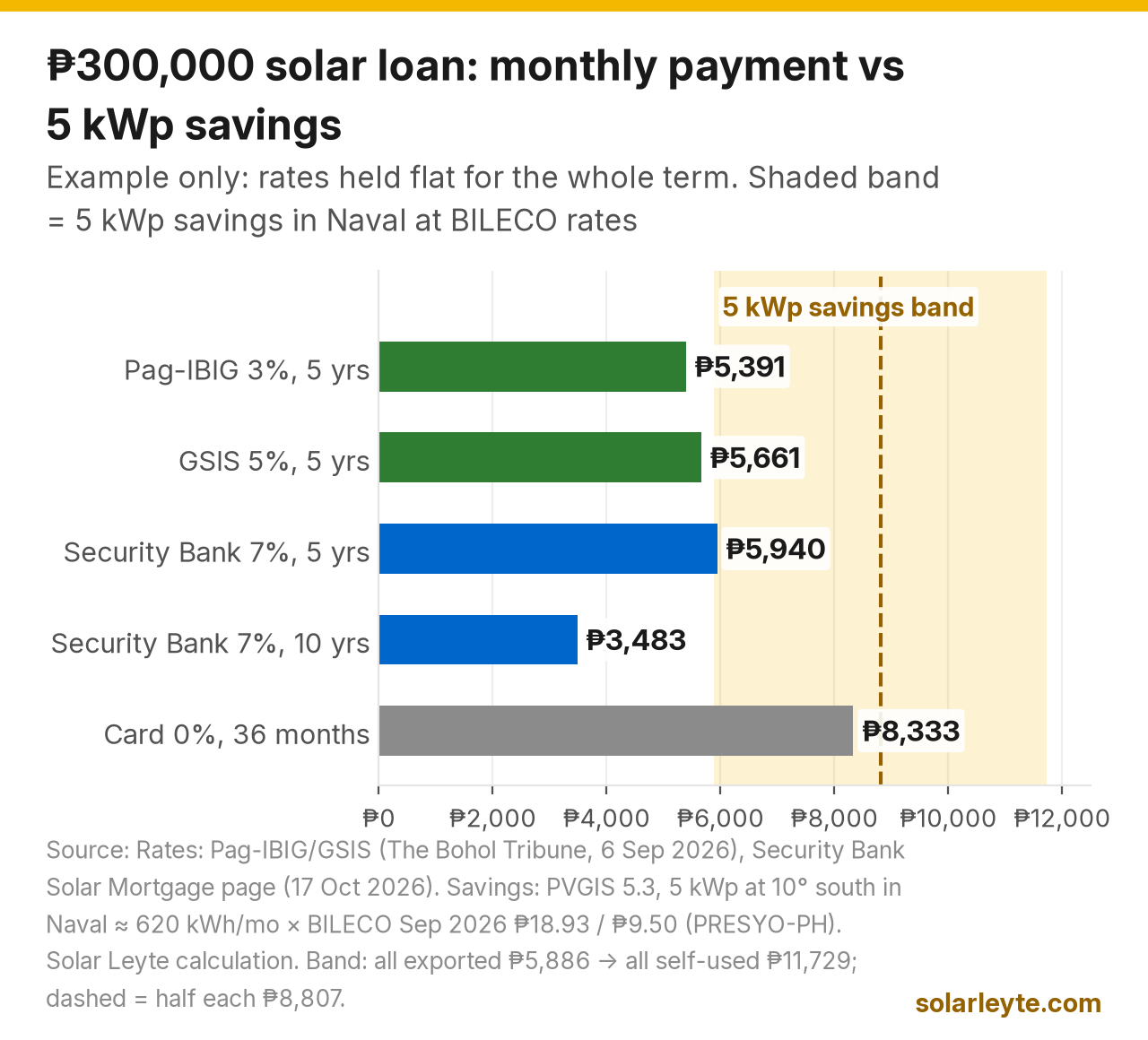
Example only, using our assumptions: you borrow ₱300,000, about the top of the listed 5 kW package range. Monthly payments use equal amortisation, and each rate is held for the whole term. In real life a bank rate reprices after its fixed period.
Route (who can use it) | Rate used | Term | Monthly | Total interest |
|---|---|---|---|---|
Pag-IBIG home improvement loan (members; promo for the first 10,000) | 3% | 5 years | ₱5,391 | ₱23,436 |
GSIS Ginhawa (government employees) | 5% | 5 years | ₱5,661 | ₱39,682 |
Security Bank top-up (existing Security Bank home loan) | 7.00% | 5 years | ₱5,940 | ₱56,422 |
Security Bank top-up, longer term | 7.00% | 10 years | ₱3,483 | ₱117,991 |
Credit card instalment at 0% (if a merchant offers it) | 0% | 36 months | ₱8,333 | ₱0 |
Solar Leyte calculation (derived.json). Pag-IBIG's own reported figure for ₱300,000 at 3% is ₱5,390 a month (The Bohol Tribune). Bank fees and insurance are extra.
How does that compare with what a 5 kW system saves? In our tilt and direction post, PVGIS puts a 5 kWp system in Naval at 10° facing south at about 7,435 kWh a year, or about 620 kWh a month. At BILECO's September 2026 residential rate of ₱18.93/kWh and its blended generation rate of ₱9.50/kWh (PRESYO-PH):
- if you use all of it yourself: about ₱11,700 a month
- half used, half exported under net metering: about ₱8,800 a month
- all exported under net metering: about ₱5,900 a month
Under net metering, exported power is credited at roughly the co-op's blended generation rate, not the full retail rate, which is why the export-heavy case saves less. You only save on power you would otherwise buy, so a household using 300 kWh a month won't see the "all self-used" figure. See our net metering guide for how the credit works.
The point: on a 5-year term, every route except the card costs about ₱5,400 to ₱5,900 a month, roughly in line with the lower savings case. A 10-year bank term cuts the payment to about ₱3,500 but more than doubles the interest.
Worked example 2: why the term matters
Example only: a ₱500,000 loan (for a larger hybrid system, or solar plus a renovation), at the rates the banks publish or advertise. Each rate is held for the whole term for comparison.
Rate | 5 years | 10 years | 20 years |
|---|---|---|---|
5.99% (BPI's first-year promo rate) | ₱9,664/mo, ₱79,845 interest | ₱5,549/mo, ₱165,822 interest | ₱3,579/mo, ₱359,025 interest |
7.00% (Security Bank 1-year fixed) | ₱9,901/mo, ₱94,036 interest | ₱5,805/mo, ₱196,651 interest | ₱3,876/mo, ₱430,359 interest |
8.00% (Security Bank 5-year fixed) | ₱10,138/mo, ₱108,292 interest | ₱6,066/mo, ₱227,966 interest | ₱4,182/mo, ₱503,728 interest |
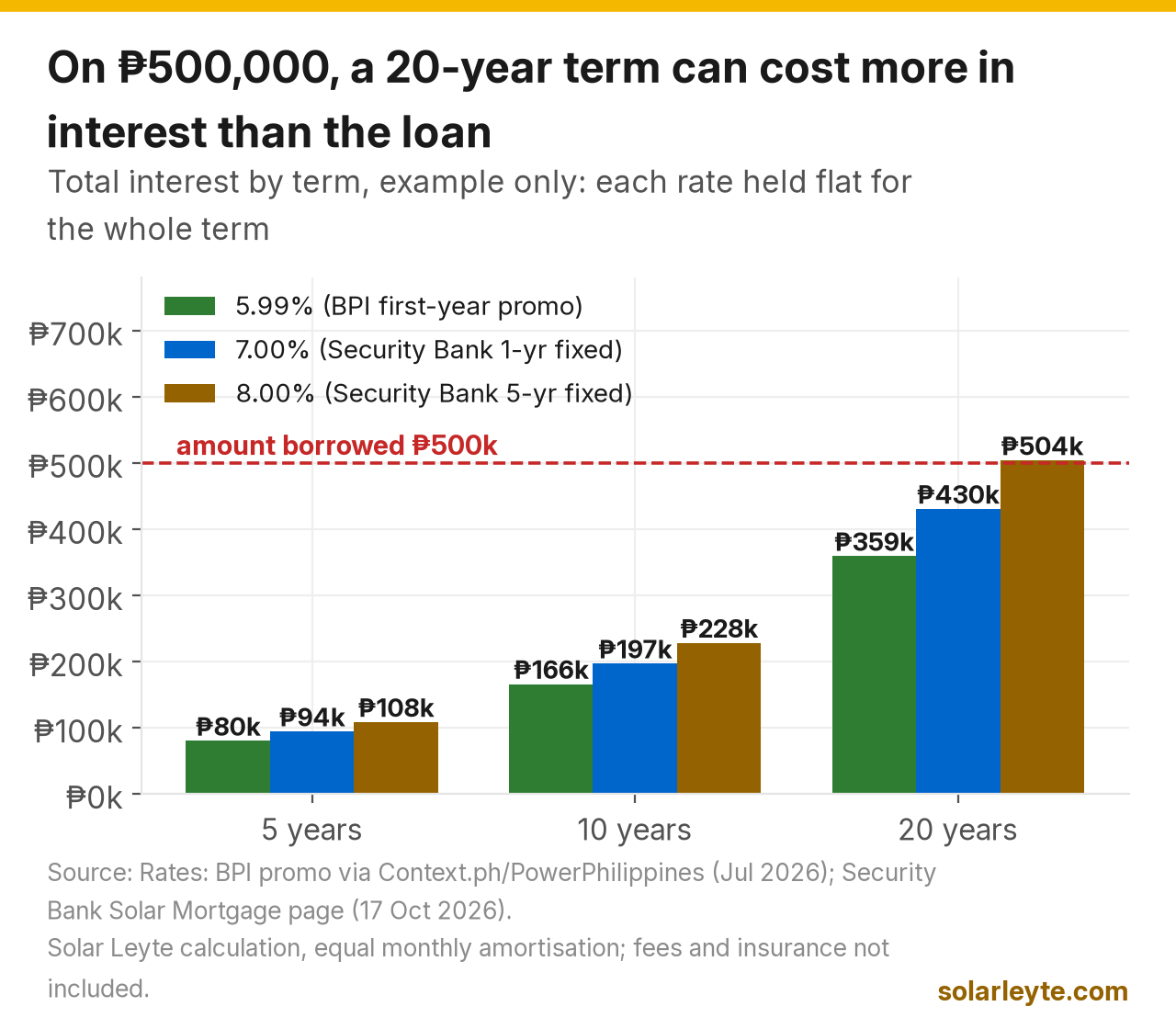
Solar Leyte calculation. At 8% over 20 years, you'd pay more in interest (₱503,728) than you borrowed. Panels carry 25- to 30-year power warranties, but hybrid inverter warranties are commonly 5 years and many battery warranties 5 to 10 years (see our lifespan and warranty post). A 20-year loan can outlast the warranty on the parts that fail first, so a 5- to 10-year term is easier to justify.
How to compare offers: ask for the disclosure statement
Under the Truth in Lending Act (RA 3765), a lender must give you, before you sign, a written statement showing the cash price, any down payment, the amount financed, the itemised charges, the finance charge in pesos and centavos, and that charge as a simple annual rate (RA 3765 Sec. 4). Use it to compare offers like for like:
- Total amount you'll pay, not just the monthly figure.
- Fixed period and repricing. A 5.99% or 7% rate fixed for one year can change in year two. Ask how the bank sets the new rate.
- Upfront fees: appraisal, handling, notarial, registration, documentary stamp tax, and the insurance premiums.
- Early payment: BDO charges a ₱3,500 processing fee to pay off in full. RCBC's card terms charge at least ₱500 to pay off a 0% instalment early.
- Whose quotation they accept, and whether the bank pays the installer directly or releases the money to you.
Also budget for the parts banks don't cover in their brochures: the LGU electrical permit and CFEI (our permit guide), 12% VAT on most quotes (our solar tax guide), and the co-op's net-metering paperwork if you plan to export.
Which route fits you?
- You're a Pag-IBIG member and the system costs ₱300,000 or less: start with the Pag-IBIG solar loan. There's no mortgage, and the 3% promo is the lowest rate here while slots last.
- You're a government employee: compare GSIS Ginhawa (up to ₱500,000 at 5%, 5 years) with Pag-IBIG.
- You already have a BPI, Security Bank or RCBC home loan: a top-up uses the collateral the bank already holds. Check the minimum (₱400,000 BPI, ₱300,000 Security Bank).
- You own a fully paid car that will still be under 5 years old when the loan ends: BPI's Multi-Purpose Loan starts at ₱200,000, the lowest bank minimum we found.
- You own your house outright and want ₱500,000 or more: BDO Home Loan, Security Bank or BPI property equity. Get a written rate and the full fee list from each.
- You run a registered business or co-op: ask Landbank about REAL Energy Plus, alongside your usual bank's business loans.
- None of these: a 0% card instalment only works if your limit covers the system and you can pay it off within 12 to 36 months. Otherwise, save up for a smaller system first.
Whichever route you take, get two or three itemised quotes first. Our guide to choosing a solar installer explains what a good quote shows, and the solar financing guide covers cash, Pag-IBIG and payment plans side by side.
FAQ
Does BPI have a solar loan? Yes. BPI's Solar Mortgage has a Top-Up Equity Loan (from ₱400,000, up to 20 years, for existing BPI housing loan clients with at least ₱400,000 paid) and a Multi-Purpose Loan secured by a car (from ₱200,000, up to 5 years). In July 2026 BPI advertised fixed rates as low as 5.99% for the first year.
What are the BDO solar loan requirements? BDO finances solar through its Home Loan, with your property as collateral. You need to be 21 to 70 at the end of the loan, have at least ₱50,000 gross family income a month, and have two years in your job or two profitable years in business. You'll also need an ID, proof of income, and the title and tax declaration of the property. Bring your installer's quotation too, since it shows what the money is for.
Does Landbank offer a solar loan for homes? Not for individual homeowners, as far as we could find on 17 October 2026. Landbank's REAL Energy Plus program finances solar for sole proprietorships, partnerships, corporations, cooperatives, LGUs and other institutions, up to 80% of project cost for private borrowers.
Is a bank loan cheaper than Pag-IBIG for solar? Usually not for a typical home system. Pag-IBIG's home improvement loan has a 3% promo rate for the first 10,000 borrowers and needs no mortgage. Published bank solar rates in October 2026 were 5.99% (BPI, first year only) to 8.00% (Security Bank, 5-year fixed). Banks win on amount and term: they lend well above Pag-IBIG's ₱300,000 cap and over up to 20 to 25 years.
Do I have to use the bank's accredited solar installer? BPI and Security Bank list Helios as their solar partner, but both ask for a quotation from "your provider" or "your chosen provider" and don't say an accredited installer is required. Ask the loan officer before you pay any deposit. That matters in Leyte and Biliran, which aren't among the Helios service areas listed on RCBC's promo page.
Solar Leyte is run by MACC Systems & Energy Solutions Inc., a solar installer in Naval, Biliran.
Get a free solar quote from MACC
Applying for a loan? Banks and Pag-IBIG ask for a written quotation. Send us a recent electric bill and a photo of your roof, and we'll give you a free written quote with the system size and model numbers that you can bring to your bank or Pag-IBIG branch. No obligation, and this article doesn't include any MACC prices.
- Call/Text: 0955 723 5093
- Email: official@macc-inc.com or benjie@macc-inc.com
- Website: www.macc-inc.com
- Office: Brgy. Talustusan, Naval, Biliran 6543
- Or use the site quote form: /quote
Sources (all checked 17 October 2026)
- BPI, Solar Mortgage: Top-Up Equity Loan (₱400,000 minimum, 1–20 years, ₱400,000 minimum paid-up), Multi-Purpose Loan (₱200,000 minimum, up to 5 years, car not older than 5 years at maturity), Property Equity Loan, Mortgage Switch, quotation required, accredited loan referrer Helios
- Context.ph, Lender's solar mortgage program posts 89% expansion (28 July 2026) and PowerPhilippines, BPI solar financing portfolio jumps 89%: 5.99% fixed for the first year, free ₱5,000 appraisal, up to ₱50,000 fees waived, ₱1,000,000 over 10 years ≈ ₱11,090 a month
- Philstar, EV, solar loans emerge as bright spots for banks (3 May 2026): BPI solar financing +89% in 2025, about ₱100 million outstanding; BDO CEO on solar loans "not yet material"
- BDO, Home Loan: solar under Personal Expenses, up to 80% of appraised value, up to 25 years, ₱50,000 minimum gross family income, ages 21–70, 60-day grace or 6 months interest-only, fees (appraisal ₱5,000/₱5,500, handling ₱3,000, notarial ₱200 per document, DST ₱1.50 per ₱200, credit life ₱4.75/₱6.50 per ₱1,000), ₱3,500 pre-termination processing fee, promo until 31 Dec 2026
- Security Bank, Solar Mortgage: 7.00% / 7.50% / 8.00% for 1 / 3 / 5-year fixing; minimums ₱1,000,000 (new-to-bank), ₱500,000 (home equity, existing clients), ₱300,000 (top-up); up to 25 years for house and lot; ₱50,000 combined monthly income; ages 21–65 at maturity; formal quotation; accredited provider Helios
- Security Bank, Home Loan Refinancing: home equity loans up to 60% of appraised value; Solar Mortgage rates table
- RCBC, How RCBC Supports Flexible Solar Panel Financing: bundled housing loan, top-up, home equity, personal loan up to ₱5 million over up to 60 months, card instalments up to 36 months at 0%, Helios partnership
- RCBC, Financing a Solar-Ready Home: Regular Home Loan ₱1,000,000 minimum, up to 30 years; Home Loan Plus ₱300,000 minimum
- RCBC Credit Cards, Special Installment Offers on Solar Panels: promo 20 April–31 July 2026; Helios service areas; ₱500 commitment fee; early payoff fee ₱500 or 5% of unpaid principal
- Landbank, REAL Energy Plus Lending Program: eligible borrowers, up to 80% for private borrowers, rooftop solar for own use as an eligible project; Landbank program FAQs (LIFTING MSMEs)
- GMA News, CREC inks P4.05-B loan deal with Landbank (July 2026)
- The Bohol Tribune, Pag-IBIG Fund sign deal to expand solar financing (6 September 2026): Pag-IBIG STL-HI up to ₱300,000, up to five years, 3% for the first 10,000 borrowers, ₱5,390 a month; GSIS Ginhawa up to ₱500,000 at 5% over five years
- Republic Act No. 3765 (Lawphil), the Truth in Lending Act, Sec. 4
- ICSC, PRESYO-PH national overview (September 2026): BILECO residential ₱18.93/kWh, blended generation ₱9.50/kWh
- Our own research: 3 kW, 5 kW and 10 kW package prices (7–14 October 2026); PVGIS 5.3 yield for 5 kWp in Naval from our tilt and direction post