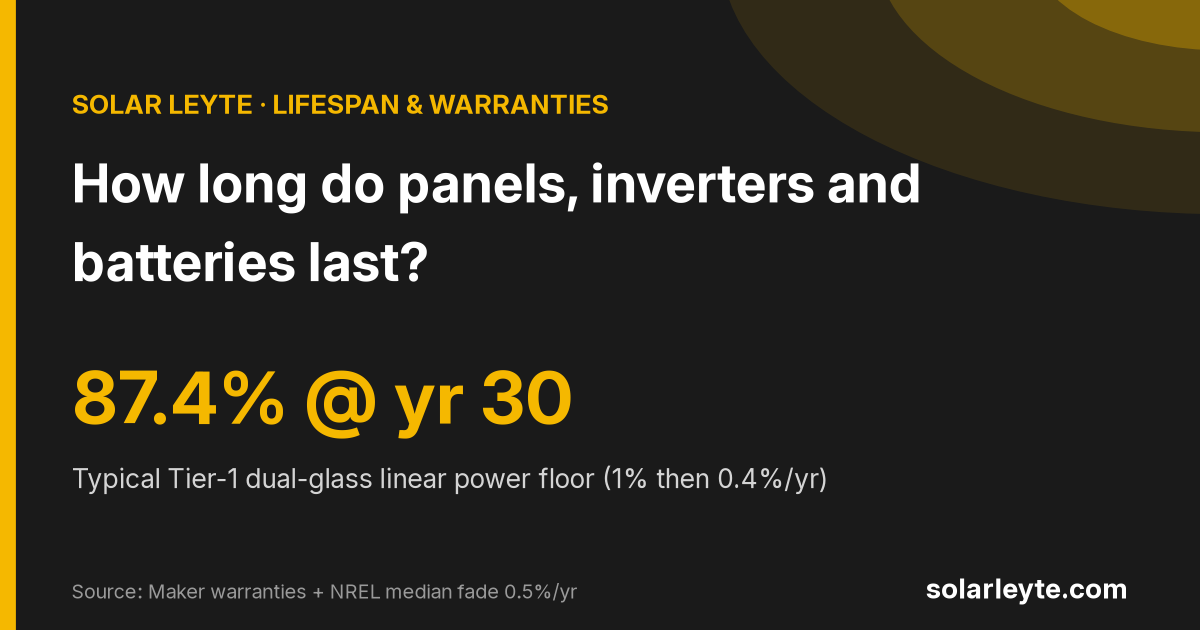
Solar panels are built to make power for decades. The inverter and battery in a hybrid system usually wear out first. That is normal. The confusing part is that installers say "25-year warranty" or "10-year warranty" without saying which part of the system, or whether they mean product defects, power fade, cycle life or calendar years.
For a Leyte or Biliran homeowner reading a quote, three clocks matter: how long the maker covers defects, how much power or capacity they promise over time, and what actually voids the claim in typhoon, heat and brownout country. This post walks through those clocks using manufacturer warranty documents and datasheets, not sales slides.
For brand-by-brand panel specs and peso prices, see our Jinko vs Trina vs LONGi comparison. For per-watt shopping, see 550W to 620W panel prices. For battery peso ranges, see solar battery prices. For how to read a whole quote, start with the solar panel price guide.
Warranty terms below come from each maker's limited-warranty PDF or datasheet, checked 13 October 2026. Some battery and panel statements are territory-specific (for example Australia or a CSI Solar global sheet that excludes Australia, New Zealand and China). Match the exact model and the warranty document that applies to your purchase. Listing a product is not an endorsement. Solar Leyte earns nothing from these links. Nothing here is a MACC installed price or a promise that a claim will be paid.
Lifespan vs warranty: they are not the same thing
Lifespan is how long the hardware still works usefully in the field. Warranty is the written promise the seller or maker will repair, replace or compensate if something goes wrong under stated conditions.
A National Renewable Energy Laboratory (NREL) review of nearly 2,000 published module and system degradation rates found a median long-term degradation of 0.5% per year (mean 0.8%/year), with 78% of reported rates below 1%/year (Jordan and Kurtz, Progress in Photovoltaics, NREL/JA-5200-51664). At 0.5%/year from nameplate, a panel would still be around 87–88% after 25 years before other losses — close to what many modern linear warranties guarantee at year 30 after a first-year step. That is field statistics across climates and eras, not a Leyte roof forecast.
Inverters and LiFePO4 batteries have shorter replacement cycles. Hybrid inverter warranties we read are commonly 5 years, with paid or optional 10-year paths. Battery datasheets often advertise 6,000+ cycles and 10–15 year design life, while the claimable warranty is often 5–10 calendar years plus a capacity or throughput floor. Count on the claimable term, not the marketing design life.
Panel warranties: product vs performance
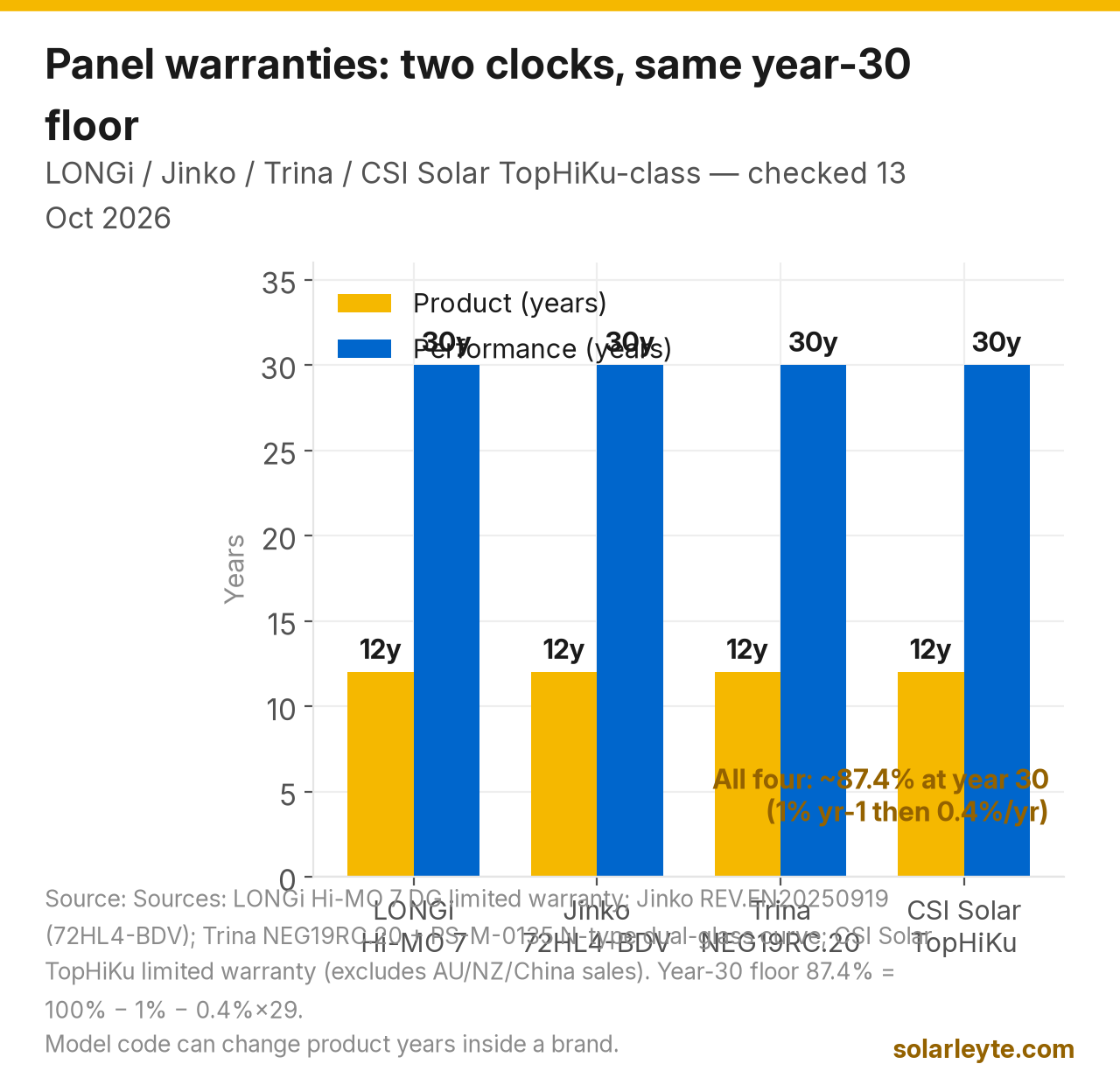
Every serious panel warranty has two clocks. Quotes that say only "30-year warranty" are skipping the split.
Clock | What it covers | Typical length on modern Tier-1 dual-glass N-type |
|---|---|---|
Product (materials / workmanship) | Defects that impair the panel: bad soldering, failed junction box, delamination that hurts generation, and (on dual glass) glass breakage that was not an outside hit | Often 12 years (some residential formats 15 or 25) |
Performance (linear power) | Measured front-side power at standard test conditions must stay above a published curve | Usually 25–30 years; 30 years near 87.4% on many glass-glass/bifacial lines, 25 years near 84–85% on many single-glass panels |
What the datasheets and limited warranties say (checked 13 Oct 2026)
Brand / family (examples) | Product warranty | Power warranty | First-year loss cap | Annual after year 1 | Guaranteed at year 30 |
|---|---|---|---|---|---|
LONGi Hi-MO 7 LR5-72HGD (distributed-generation limited warranty) | 12 years | 30 years linear | ≤1% | 0.4%/year | 87.4% |
Jinko Tiger Neo JKMxxxN-72HL4-BDV (Limited Warranty REV.EN20250919) | 12 years | 30 years linear | 1.00% | 0.40%/year | 87.40% |
Trina Vertex N TSM-…NEG19RC.20 (datasheet + Global Limited Warranty PS-M-0135 N-type dual-glass curve) | 12 years | 30 years | 1% | 0.40%/year | 87.4% |
CSI Solar / Canadian Solar TopHiKu-class (CSI Solar Limited Warranty; not for AU/NZ/China sales) | 12 years (25 on listed special models) | 30 years | ≤1% (99% remaining year 1) | 0.4%/year | 87.4% |
Sources: each maker's documents listed in Sources. The year-30 floor for the 1% / 0.4% curve is 100% − 1% − 0.4% × 29 = 87.4% (our arithmetic matching the PDFs).
Practical notes for Biliran and Leyte:
- Product cover ends long before the power curve. From about year 13 to 30 you are mainly covered for excess fade under the linear warranty, not for every materials defect. That is normal across these brands.
- Model code beats brand slogan. Jinko's own REV.EN20250919 table gives some Tiger Neo residential formats 15 or 25 years of product warranty, while the 72HL4-BDV utility-style bifacial rows are on 12. Always match the nameplate code to the warranty table.
- Power claims are tested at STC, not off your inverter app on a cloudy afternoon. Budget for a flash test if you ever need to prove fade.
- Brand comparison detail (prices, Imp/Isc, roof weight) lives in the Jinko vs Trina vs LONGi post so we do not repeat it here.
Inverter warranties: the shortest major clock
The hybrid inverter is the part most Leyte brownout homes replace first. From the makers' own warranty texts we used in our Deye vs Solis vs SRNE and hybrid inverter price posts:
Maker | Standard product warranty (document) | Extension / notes |
|---|---|---|
Deye (Warranty Terms V1.7.1) | 5 years from installation, and no more than 5.5 years from delivery; 10 years optional where the contract says so | Some Deye Philippines communications for 2026 serials have advertised 10 years — get the term for your serial in writing |
Solis / Ginlong (global limited warranty) | 5 years for grid-tied and RHI/RAI hybrids; accessories 2 years | Paid extensions to 10 / 15 / 20 years total if applied within 12 months of purchase |
SRNE (PV storage hybrid warranty description, Australia, Aug 2025) | 5 years, starting 6 months after the production date on the serial number | Exclusions for misuse, unauthorised repair, etc. Ask how PH claims are handled |
None of the service contacts we found for these brands sat in Eastern Visayas — they were Metro Manila or overseas paths. Ask on the quote: who files the claim, who pays freight to pull and return a failed hybrid from Naval, Ormoc or Tacloban, and whether labour to reinstall is included.
Datasheet "5 or 10 years depending on install site" language (seen on some Deye sheets) is not a substitute for a written PH term. See also the installer handover checklist in how to choose a solar installer.
Battery warranties: calendar years, cycles and throughput
LiFePO4 home batteries mix three ideas that sellers blur:
- Calendar (product) warranty — years from install or shipment.
- Performance / capacity floor — e.g. still X% of nominal energy at the end of the term.
- Cycle life or energy throughput — how many full cycles or megawatt-hours the warranty assumes.
Product (document) | Calendar / product term | Performance / capacity | Cycles or throughput | Notes |
|---|---|---|---|---|
Pylontech US5000 datasheet (EN-SD-250424) | Design life 15 years @ 25 °C (design life ≠ warranty) | — | Cycle life >6,000 @ 25 °C; DoD 95% | Spec sheet figures |
Pylontech US-series consumer warranty (Australia territory PDF; covers US5000 among others) | 10 years from install or 6 months after manufacture (earlier) | Minimum Capacity ≥ 60% of nominal energy during the warranty period | Daily-cycle ESS use | Territory = Australia in that PDF; ask your PH seller for the document that applies here |
Dyness B4850 limited warranty (202308 Australia terms) | 7 years product; 10 years if registered and approved on Dyness site | 70% of nominal energy for 10 years or 6.70 MWh minimum throughput, whichever comes first | Warranty sized around 1 full cycle per day | Without communications / RV-marine use often drops to 5 years |
Hopetrek 5.12 kWh wall units on PH seller pages (Beyond Hygiene Asia, checked for our battery post) | 5 years (LB5-W01) or 10 years (LB5-W05) | Per seller listing | LB5-W01 listed 6,000+ cycles | Cycle rating can outlast the claimable years — count the warranty |
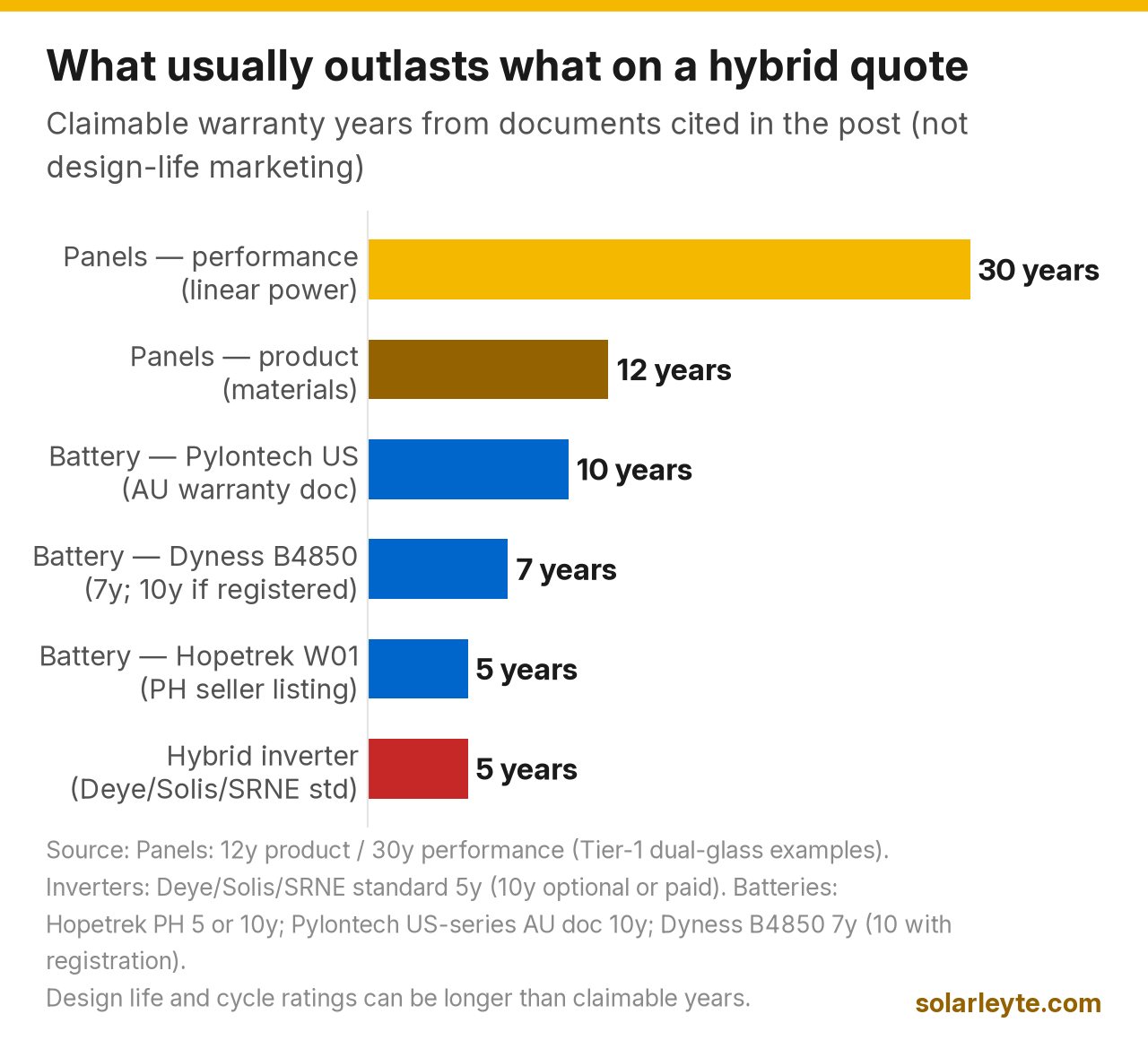
At one full cycle a day, 6,000 cycles is over 16 years on paper. That does not mean a 5-year warranty battery is free to claim in year 12. Our solar battery price post already stresses: count on the warranty, not the cycle marketing number.
Heat matters. Spec sheets quote design life and cycles at about 25 °C. A battery cupboard under a tin roof in Naval or Tacloban runs hotter. Keep packs indoors, shaded, dry and above flood level — IP20 rack batteries are not outdoor gear (typhoon preparedness guide).
What usually voids a warranty (or leaves you with insurance instead)
Reading the exclusion sections of the panel, inverter and battery PDFs, the same themes repeat:
Situation | Typical outcome |
|---|---|
Installed against the install manual (wrong clamps, walking on glass, wrong cable, constant shading from bad design) | Excluded from panel product/performance claims |
Unauthorised cleaning damage (abrasives, harsh chemicals, pressure washing, standing on modules) | Often voids or excludes; Canadian Solar's install manual states inappropriate cleaning can void warranty — see our cleaning post |
Lightning, flood, fire, typhoon debris, power surge called out as force majeure / external causes | Usually not a maker warranty — check home insurance for solar and typhoon endorsements |
Moved and reinstalled without maker authorisation | Commonly excluded |
Battery without BMS communication, wrong inverter pairing, outdoor install without a qualified enclosure | Common battery exclusions (Pylontech / Dyness texts) |
Serial number removed, purchase through unauthorised channel, missing invoice | Claim refused |
Brownouts themselves do not "use up" a panel warranty. They do stress inverters and batteries (deep cycles, surge loads). Visayas yellow/red alerts (grid alert post) are a sizing and hybrid issue, not a reason to skip paperwork.
Under the Consumer Act (RA 7394, Article 68), a written express warranty must identify who the warrantor is, what is covered, and the procedure to claim. Your receipt or warranty card is what you present — sellers should not demand a pile of extra papers. Details and the handover folder list are in the installer guide.
When warranties matter at quote time
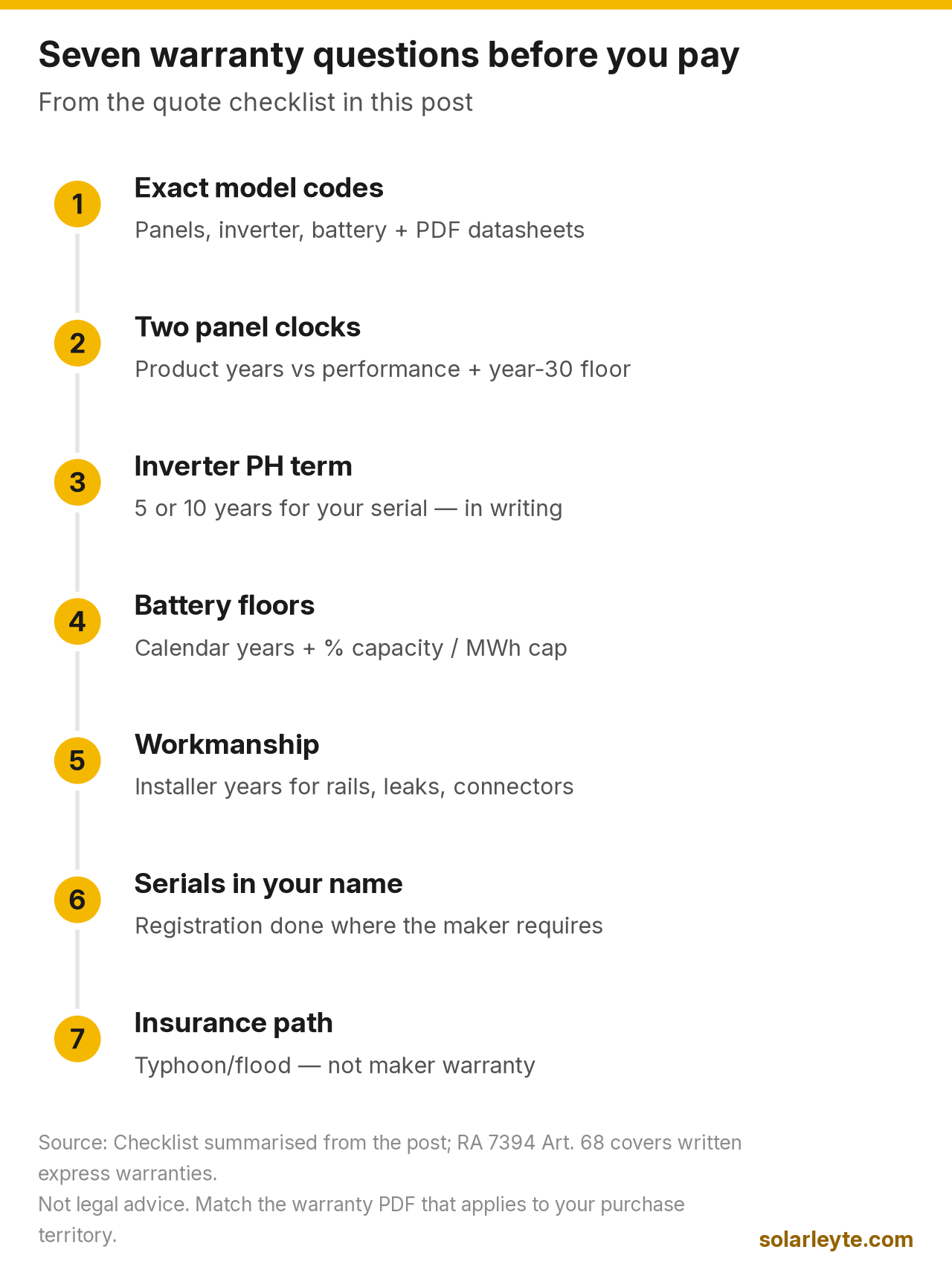
Before you sign a Leyte or Biliran quote, ask for this in writing:
- Exact model codes for panels, inverter and battery — with the PDF datasheet and limited-warranty document attached.
- Product vs performance years for the panels, and the year-25 or year-30 power floor for that code.
- Inverter term that applies in the Philippines for your serial range, plus who handles Eastern Visayas claims and freight.
- Battery calendar years, capacity floor (%), and any cycle or MWh throughput cap.
- Installer workmanship years (roof leaks, loose rails, connectors) — separate from maker product cover.
- Serial-number list and confirmation the sale was registered where the maker requires it.
- Insurance path for typhoon and flood — warranties will not replace broken glass from flying debris.
If two quotes use similar watts and pesos, pick the one that still answers the phone in year eight and keeps your folder tidy. The 5kW itemised price post shows how parts stack; warranties are another line item to compare, not a slogan.
FAQ
How long do solar panels last in the Philippines? Performance warranties typically run 25 to 30 years (30 years at about 87.4% is common on glass-glass/bifacial lines; many standard single-glass panels are 25 years at about 84–85%), with a shorter product term (often 12 years). Field literature reviewed by NREL shows a median degradation around 0.5%/year. Real output also depends on soiling, heat, shading and mounting — see the cleaning and typhoon posts.
What is the difference between product and performance warranty? Product covers manufacturing defects that impair the module. Performance promises the panel will not fade faster than a published curve when measured at STC. A "30-year warranty" without that split is incomplete.
How long do hybrid inverters last? Maker warranties we cited are commonly 5 years, with optional or paid paths to 10 years (and longer paid Solis extensions). Plan on the inverter being replaced before the panels are done.
How long do solar batteries last? Datasheets may show 6,000+ cycles and 10–15 year design life at 25 °C. Claimable warranties on documents and PH listings we checked are often 5–10 calendar years, sometimes with a 60–70% remaining capacity floor or an MWh throughput cap. Heat and daily deep cycling shorten real life.
Does a typhoon void my solar warranty? Storm damage from debris, flood or lightning is typically an exclusion under maker warranties and an insurance question instead. Improper mounting that fails in wind can also void cover — follow the install manual and the typhoon guide.
Will cleaning void my panel warranty? Cleaning by the manual should not. Walking on glass, abrasives, harsh chemicals or pressure washing often will. Keep the cleaning section of your panel manual.
What should I ask before I pay? Exact models, both panel warranty clocks, inverter and battery terms for the Philippines, who pays claim freight to Eastern Visayas, workmanship years, and serials in your name.
Solar Leyte is run by MACC Systems & Energy Solutions Inc., a solar installer in Naval, Biliran. This article does not invent MACC warranty lengths, prices, licences or service packages.
Get a free solar quote from MACC
Comparing warranties on a quote? Send a photo of your roof and your latest BILECO or LEYECO bill. We will list every part by brand and exact model with its datasheet and warranty PDF, and explain what is covered in writing — no obligation.
- Call/Text: 0955 723 5093
- Email: official@macc-inc.com or benjie@macc-inc.com
- Website: www.macc-inc.com
- Office: Brgy. Talustusan, Naval, Biliran 6543
- Or use the form: solarleyte.com/quote
Sources (all checked 13 October 2026)
- Panel limited warranties / datasheets: LONGi, Limited Warranty for Hi-MO 7 / Hi-MO 9 (distributed-generation market), LR5-72HGD 12-year product and 30-year performance at 1% / 0.4% / 87.4%; Jinko Solar, Limited Warranty REV.EN20250919 — Linear Bifacial Module (JKMxxxN-72HL4-BDV row); Trina Solar, Vertex N NEG19RC.20 datasheet warranty block and Global Limited Warranty PS-M-0135 (N-type i-TOPCon dual-glass 1.0% / 0.4% / 87.4%); CSI Solar Co., Ltd., Limited Warranty Statement for TopHiKu-class modules (12-year product / 30-year performance to 87.4%; statement does not apply to products sold to and installed in Australia, New Zealand and P.R. China)
- Field degradation: Jordan, D.C. and Kurtz, S.R., "Photovoltaic Degradation Rates—An Analytical Review," Progress in Photovoltaics / NREL/JA-5200-51664 (nearly 2,000 rates; median 0.5%/year, mean 0.8%/year; 78% below 1%/year)
- Inverter warranties: Deye, Warranty Terms and Conditions V1.7.1; Solis / Ginlong, Limited Warranty (global) — 5-year standard, paid 10/15/20-year extensions within 12 months of purchase; SRNE, PV Storage Hybrid Inverter Warranty Description (Australia, Aug 2025) — 5 years from 6 months after SN production date
- Battery documents: Pylontech, US5000 datasheet EN-SD-250424 (design life 15 years @ 25 °C; cycle life >6,000 @ 25 °C; DoD 95%); Pylontech, Consumer Warranty — US Series ESS (Australia territory; 10 years; Minimum Capacity 60% of nominal energy; covers US5000 among listed models); Dyness, Lithium Iron Phosphate Battery Limited Warranty for B4850 (202308 Australia terms; 7-year product / 10 with registration; 70% SOH for 10 years or 6.70 MWh throughput, whichever first; 1 full cycle/day); Hopetrek PH seller listings via Beyond Hygiene Asia as cited in solar battery price Philippines
- Law: Lawphil, RA 7394 Consumer Act of the Philippines (Article 68)
- Related Solar Leyte: solar panel price guide, Jinko vs Trina vs LONGi, 550W–620W prices, battery prices, hybrid inverter prices, Deye vs Solis vs SRNE, choose an installer, panel cleaning, panel insurance, typhoon checklist, typhoon guide, Visayas grid alerts, 5kW system price