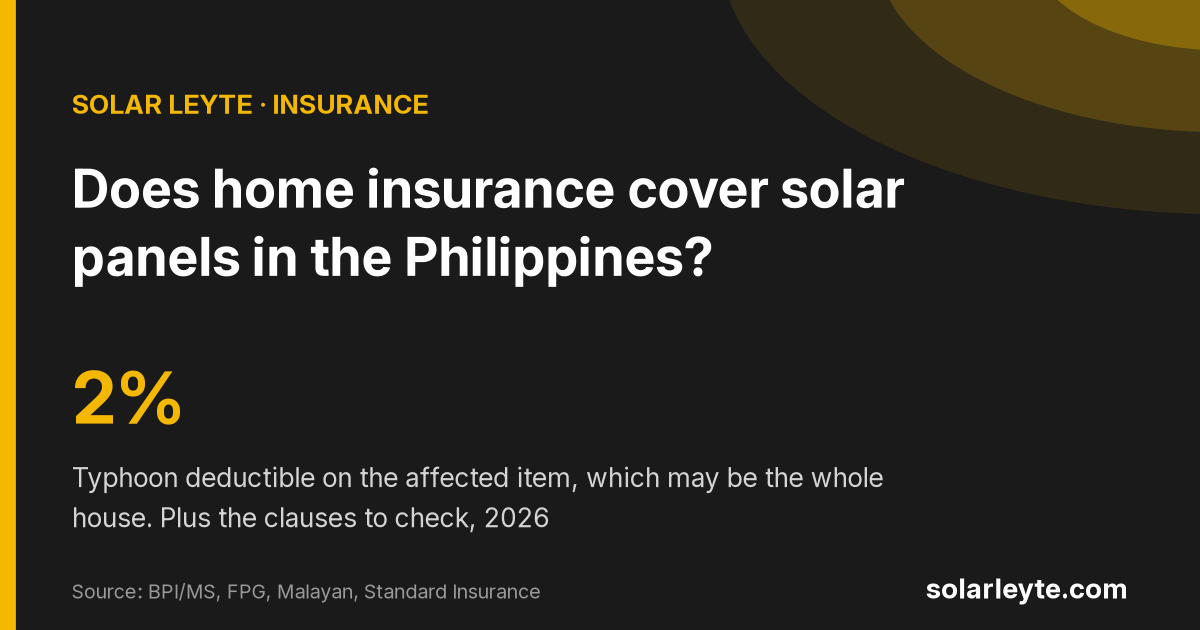
Usually yes, but not automatically, and probably not the way you think. Rooftop panels can be insured as part of your house under a Philippine home (fire) policy. They're only covered for the perils you actually bought, though, and only up to the value you declared. A basic "fire and lightning" policy doesn't cover typhoons or floods at all. Typhoon and flood cover come as endorsements with a deductible of at least 2% of the whole building's value. And the standard fire policy wording excludes electrical damage to an inverter unless a fire follows.
Covered ba gyud ang imong solar? This post walks through what the policy wording says, using the published terms and brochures of four Philippine insurers, so you know what to ask before the next storm. None of the four brochures or pages we checked mentions solar panels by name, so the only reliable answer is the one your insurer gives you in writing.
Facts checked 8 October 2026 (Philippine time). This is a plain-language guide, not insurance or legal advice. Insurers' brochures say the policy prevails over the brochure, so read your own policy schedule and endorsements.
Why check your policy now
PAGASA's outlook for October to December 2026 expects three to six tropical cyclones, with most tracks over central and southern Luzon and secondary tracks over the Visayas and northern Mindanao. In September, PAGASA's climate chief told the Philippine News Agency that the few storms expected this quarter are likely to reach typhoon or super typhoon strength, and most are the landfalling, crossing type.
Insurance won't hold a panel on the roof. That's the installer's job, which we cover in our typhoon installation guide and the before, during and after checklist. Insurance decides who pays if something gives anyway. And an endorsement you add after a storm has been named won't help with that storm.
What a typical home policy covers for solar
The table below is our reading of the published wording. The main source is BPI/MS's Home Protect insuring terms, which print the full standard fire policy conditions and endorsements, cross-checked against the FPG, Malayan and Standard Insurance product pages. Your policy may differ, so treat every row as a question to ask.
What happens | Fire and lightning only | With typhoon and flood endorsements | Where else to look |
|---|---|---|---|
A fault in the inverter or wiring starts a fire that damages the house | Fire damage is covered | Same | The inverter itself: only the actual fire damage (see the electrical exclusion below) |
Typhoon winds tear panels and rails off the roof | Not covered (the fire policy excludes typhoons) | Covered, minus the 2% deductible | Workmanship warranty, if poor mounting caused it |
Rain gets in and soaks an indoor inverter or battery | Not covered | Only if the typhoon first damaged the roof or walls | – |
Flood water reaches a ground-floor inverter or battery | Not covered | Covered by the flood endorsement, minus the 2% deductible | – |
Storm surge | Not covered | Excluded from the typhoon endorsement; ask how the flood endorsement treats high tide and sea overflow | – |
Lightning surge kills the inverter, no fire | Excluded | Still excluded | Surge protection; for businesses, electronic equipment or machinery breakdown cover |
Inverter or battery fails on its own | Not covered | Not covered | Manufacturer's warranty |
Panels slowly lose output or corrode | Not an insured peril | Not an insured peril | Panel performance and product warranty |
Panels stolen from the roof | Usually not covered | Theft during or after a typhoon or flood is excluded | Ask; in the policies we read, burglary cover is for property inside the premises |
Earthquake shakes the array loose | Not covered | Needs an earthquake endorsement (also a 2% deductible) | – |
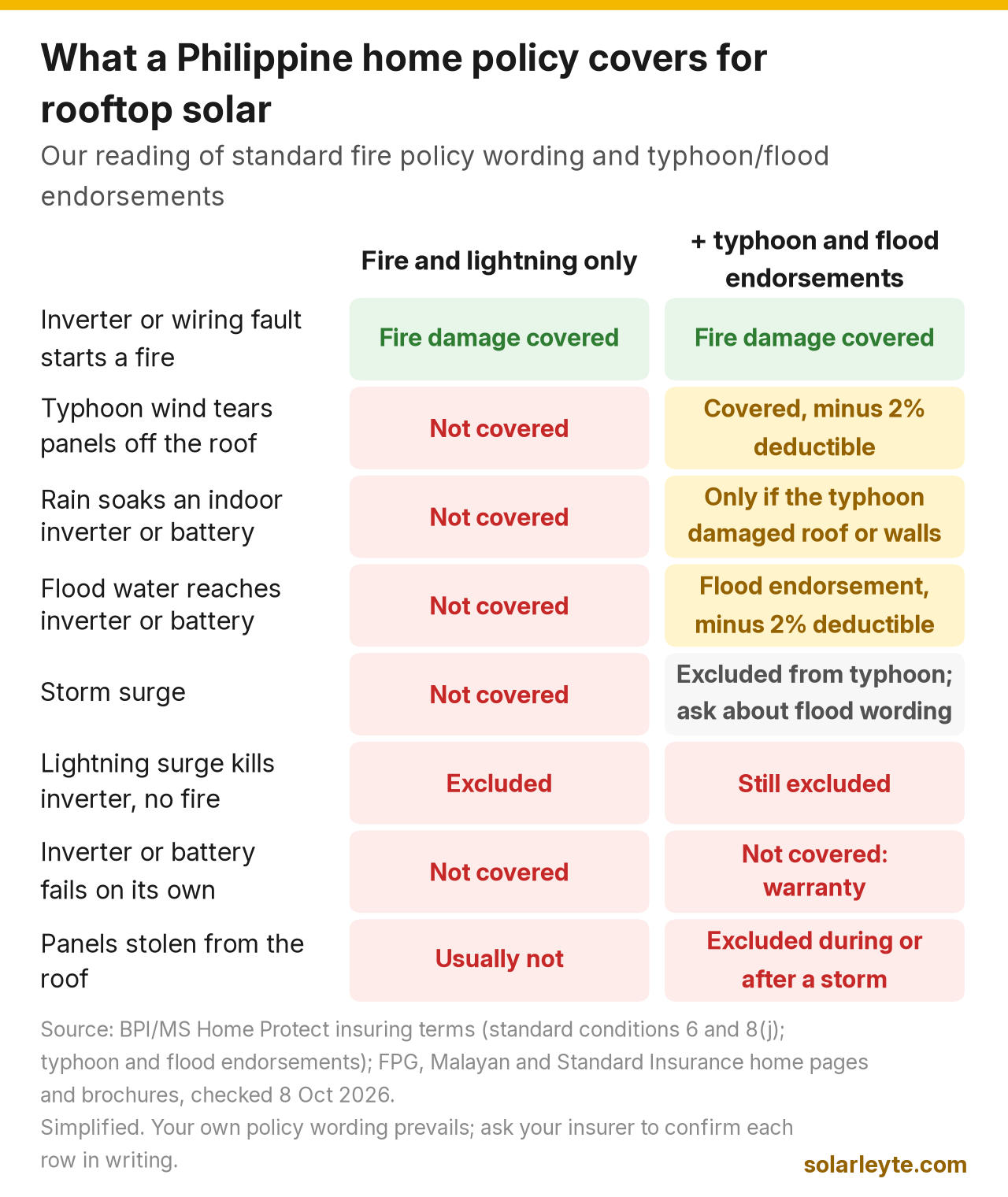
Two things stand out. The typhoon and flood endorsements matter more for rooftop solar in Leyte and Biliran than anything else on the policy. And the risks people worry about most for electronics, lightning surges and plain breakdowns, sit outside a home policy no matter which endorsements you add.
Fire-only policies don't cover typhoons
The standard Philippine fire policy, as printed in BPI/MS's terms, says the insurance "does not cover any loss or damage" caused by "typhoon, hurricane, tornado, cyclone or other atmospheric disturbance", or by earthquake. Typhoon, flood and earthquake cover are added by separate endorsements, each "in consideration of the payment by the Insured ... of an additional premium."
Most home packages sold today bundle these in:
- FPG MyHome Mate lists typhoon or windstorm, including flood caused by it, plus flood or overflow of the sea, earthquake and volcanic eruption among its perils, with a typhoon endorsement and a flood endorsement in its clauses.
- Malayan Home Protect lists typhoon and flood with fire and lightning, earthquake fire and shock, and the extended coverage perils. Malayan says premium rates are subject to quotation.
- Standard Insurance compares three home plans on its website. Only House Protect Plan 2 is ticked for earthquake, typhoon and flood. Home Safe (up to ₱500,000) and House Protect Plan 1 are marked as not covering them.
- BPI/MS Home Protect (the version we read) lists fire and lightning, earthquake, typhoon, flood, extended coverage, riot and strike, robbery or burglary inside the premises, and landslide.
So even a named "home" package can leave typhoons out. The first question is simple: does your policy schedule list the typhoon and flood endorsements? If you bought fire insurance years ago through a bank or a housing loan, check. Fire-only cover is still sold, and it covers the wrong risk for a roof in Eastern Visayas.
Is solar part of the "building" or the "contents"?
This decides which sum insured your system falls under, and which deductible applies.
- Malayan defines Building as "the main structures of your home, like the walls, roof, and floors". It defines Contents as personal belongings inside your home, "excluding electronics, cash, and jewelries".
- The deductible clauses in the BPI/MS terms treat "each building, including machinery, equipment and fixtures normal to its operation" as one item.
Panels and rails bolted to the roof look like part of the building. A wall-mounted inverter and battery could be read either way, and a portable power station is plainly a movable electronic item. Under Malayan's definition, that would leave it outside contents. None of the insurers' pages we checked spells this out for solar, so ask for it in writing:
- Are the panels, rails and roof fixings included in the building sum insured?
- Is the inverter and battery treated as building (a fixture) or as contents?
- If contents exclude electronics, how do I cover a battery or a power station?
Some websites say Philippine insurers sell "solar riders" at set prices. We couldn't find any such product on the insurers' own pages listed in the sources (8 October 2026). If an agent offers one, ask for the endorsement wording before you pay.
Declare the system, or the average clause cuts your claim
Home insurance in the Philippines is subject to an average clause. Standard Insurance quotes it in its FAQ: if the property is worth more than the sum insured at the time of loss, "the insured shall be considered as being his own insurer for the difference, and shall bear a ratable proportion of the loss accordingly." It gives the formula as:
Claim = sum insured ÷ actual value of the property × amount of loss
Adding solar raises the value of your house. If you don't raise the sum insured to match, you become under-insured, and every claim on the building gets cut, not only claims on the panels.
Three more clauses make declaring the system worth a phone call:
- Automatic increase. FPG's MyHome Mate lists an "Automatic Increase Clause – 10% within 60 days; subject to additional premium." Ask whether a new solar system falls under it, and declare it within that window anyway.
- Changes that raise the fire risk. The standard conditions in the BPI/MS terms say cover stops for the affected property if circumstances are "changed in such a way as to increase the risk of loss or damage by fire", unless the insurer agrees by endorsement. Whether a rooftop system or a battery counts is the insurer's call. Telling them in writing removes the doubt.
- Actual cash value or replacement value. Standard Insurance explains that an actual cash value (sound value) basis pays the depreciated value. A replacement or reinstatement value basis pays the brand-new cost at the time of loss, without deducting wear and tear. FPG lists a reinstatement value endorsement. Panels lose book value every year, so ask which basis your policy uses.
The 2% typhoon deductible, and why small roof damage often isn't claimable
Standard Insurance says that "in the Philippines, there is a mandatory Deductible for catastrophe perils like earthquake, typhoon and flood", applied by all non-life insurers: "your share will be 2% of the actual cash value of the affected item". FPG cites the same 2% "per standard PIRA deductible wordings". In BPI/MS's typhoon and flood endorsements, it's "a minimum of 2%" per occurrence, and one occurrence covers up to 168 consecutive hours. The average clause applies after the deductible.
The catch for solar is the word "item". If the panels count as part of the building, the 2% is worked out on the whole building, panels included. It isn't 2% of the panels.
Here's a worked example. It is a Solar Leyte calculation with assumed values, not an insurer's quote. Take a concrete house in Naval with a building value of ₱2,000,000. It adds a 5 kW grid-tie system at ₱250,000, the listed price of one installed 5 kW package in our 5kW price breakdown. The building is now worth ₱2,250,000, so the typhoon deductible is 2% × ₱2,250,000 = ₱45,000.
Typhoon damage (assumed) | Policy | Paid by insurer (our calculation) |
|---|---|---|
3 cracked panels, about ₱25,500 (3 × ₱8,500, the highest 550 W listing in our 5kW post) | Typhoon endorsement, system declared | ₱0: the loss is below the ₱45,000 deductible |
Half the array and rails torn off, roof sheets damaged: ₱150,000 | Typhoon endorsement, sum insured raised to ₱2,250,000 | ₱105,000 (₱150,000 − ₱45,000) |
Same ₱150,000 loss | Typhoon endorsement, solar not declared (sum insured still ₱2,000,000) | ₱93,333 ((₱150,000 − ₱45,000) × 2.00/2.25) |
Same ₱150,000 loss | Fire and lightning only | ₱0 |
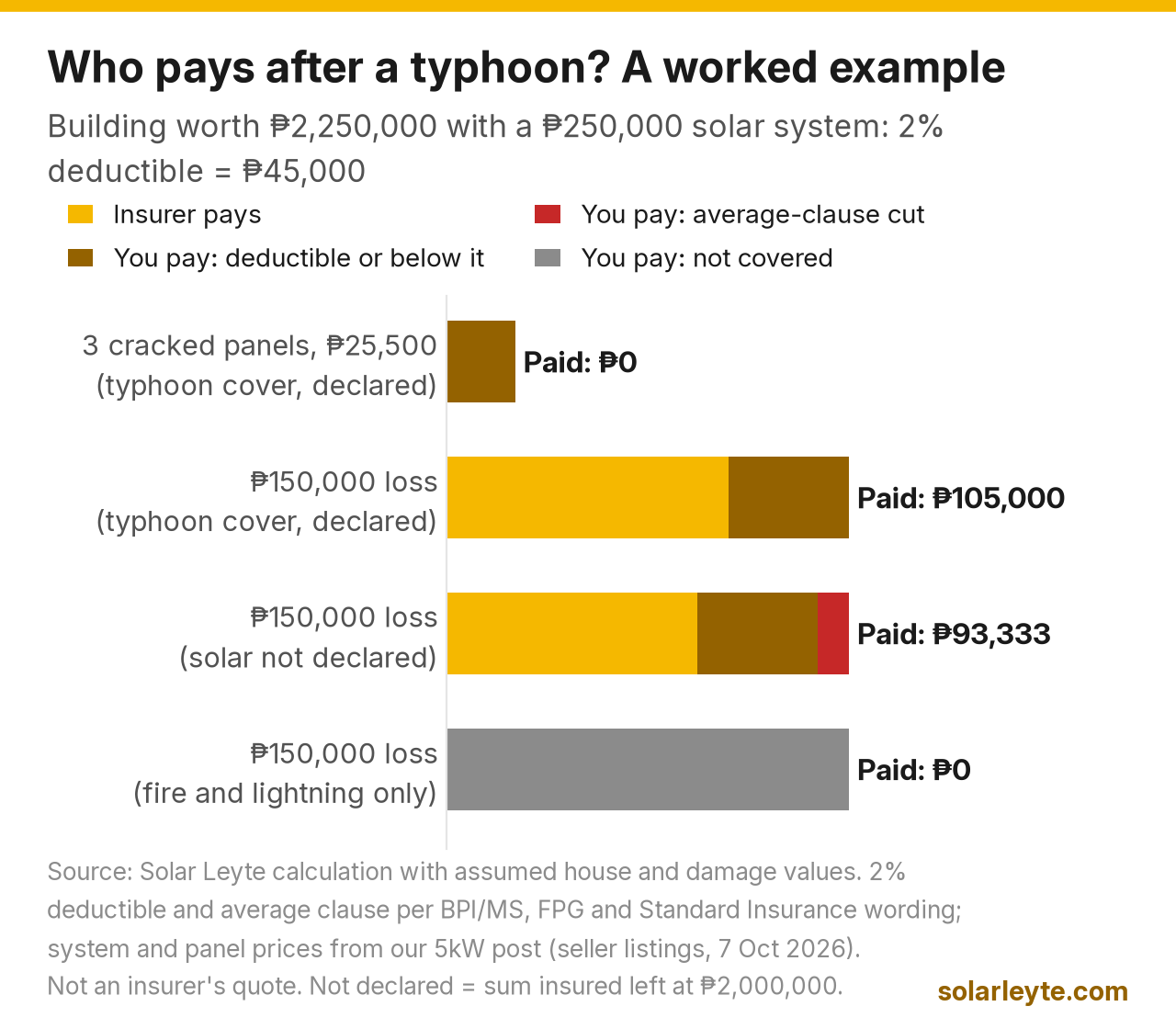
The lesson isn't "don't bother". A typhoon that takes the array and part of the roof is exactly the loss insurance is for. Just don't expect a claim for a few cracked panels. Budget for small repairs yourself, and make sure the mounting is done right so the big loss is less likely.
Lightning, surges and inverter failures: the exclusion most people miss
The standard fire policy conditions in the BPI/MS terms exclude "loss or damage to any electrical machine or apparatus or to any portion of the electrical installation arising from or occasioned by over-running, excessive pressure, short-circuiting, arcing, self-heating or leakage of electricity from whatever cause ... unless fire ensues therefrom and liability shall be limited to actual damage by the ensuing fire." A bracket in the clause adds that lightning is included.
In plain terms:
- A lightning surge or a short circuit that kills your inverter, with no fire, isn't covered under the fire policy.
- If the fault does start a fire, the fire damage is covered, but not the electrical damage that caused it.
- An inverter or battery that simply fails is a warranty matter. Our hybrid inverter and battery posts list the warranty terms for the models we priced.
That's why surge protection is worth the small cost. Our 5kW breakdown lists a DC surge protection device at ₱600, and the seller recommends one at each end of the DC line. It's also why a proper installation matters for fire risk; see our solar fire safety post. Ask your insurer whether this exclusion can be removed or bought back on your policy. If it can't, the warranty is your only protection for electrical damage.
Typhoon and flood fine print that matters for rooftop solar
These come from the typhoon and flood endorsements in BPI/MS's published terms. Other insurers' wording may differ, so ask for yours.
- "Typhoon" means a storm as recorded by the Weather Bureau. Note the PAGASA storm name and dates for any claim.
- You must take reasonable precautions. Loss from "the neglect of the Insured to use all reasonable means to save and preserve the property during or after a Typhoon" is excluded. Following our typhoon checklist and keeping a record that you did helps.
- A roof already in poor condition is a problem. The typhoon endorsement excludes damage if the building "was already in a damaged, defective, fallen or displaced condition" as regards roofs, gutters and flashing. Fix leaks and loose sheets before the season, and keep the installer's photos of the roof fixings.
- Rain damage needs roof damage first. Rain is covered only if it enters through openings the typhoon made in the roof or walls. Rain through an open window isn't covered.
- Flood and storm surge are excluded from the typhoon endorsement. The flood endorsement covers "inundation of land not usually covered by water", including by "extraordinary high tide" or after a typhoon. It excludes goods in the open, and water seeping or backing up through drains. Homes near the shore in Tacloban, Palo or coastal Biliran should ask exactly how sea flooding is treated.
- Theft during or after a typhoon or flood is excluded. Store loose equipment and portable power stations indoors.
- An empty house loses cover. Under the standard conditions, cover ceases if the building stays unoccupied for more than 30 days unless the insurer agrees by endorsement. If the family is abroad or in Manila for months, tell the insurer first.
- No refund on the typhoon and flood premium. If you cancel, the insurer keeps 100% of it.
How to claim after a typhoon
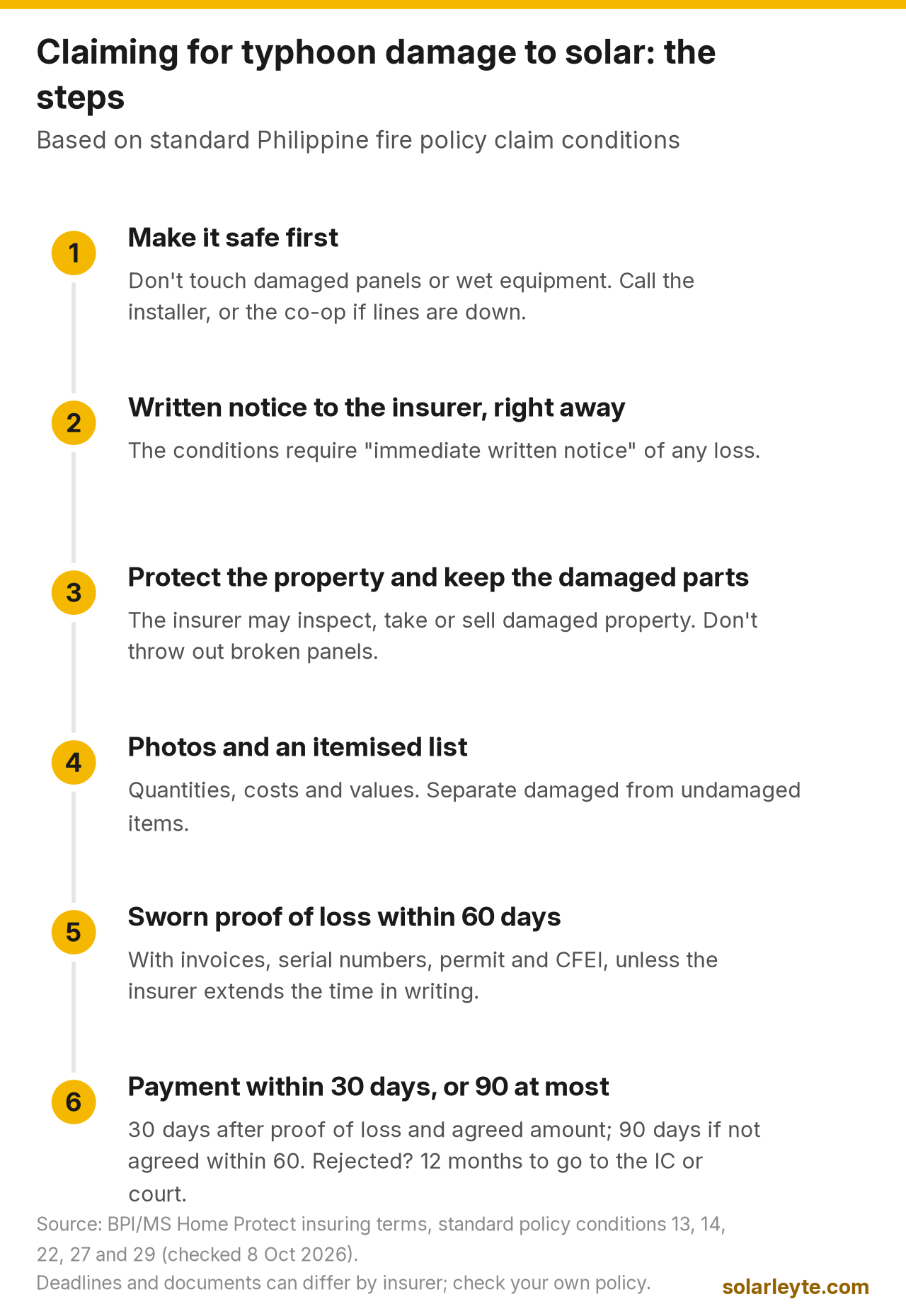
The steps below follow the claim conditions in BPI/MS's published terms. Check your own insurer's deadlines, which may differ.
- Make it safe first. Don't touch damaged panels or wet equipment. Our checklist covers when to call the installer and when to call the co-op.
- Tell the insurer in writing, right away. The conditions require "immediate written notice" of any loss.
- Protect the property from further damage and keep the damaged parts. The insurer may inspect, take or sell damaged property. Don't throw away broken panels before the adjuster has seen them.
- Photograph everything and list it. Give quantities, costs and values, and separate damaged from undamaged items.
- File a sworn proof of loss within 60 days, with invoices and receipts, unless the insurer extends the time in writing.
- Payment. The settlement clause says the insurer pays within 30 days after receiving the proof of loss and agreeing the amount. If the amount isn't agreed within 60 days, it pays within 90 days of the proof of loss. A dispute over the amount goes to arbitration. If a claim is rejected, you have 12 months to bring it to the Insurance Commission or a court.
The papers that make this easy are the same ones a good installer hands over: an invoice listing every panel, inverter and battery by brand, model and serial number, the electrical permit and CFEI, and dated photos of the system. Our guide to choosing an installer lists the full handover folder.
Questions to ask your insurer or agent
- Does my policy schedule include the typhoon, flood and earthquake endorsements, or is it fire and lightning only?
- Are the rooftop panels, rails and fixings included in the building sum insured? Can you confirm that in writing?
- Are the inverter and battery treated as building or contents? If contents exclude electronics, how do I cover them?
- How much should I raise the sum insured by, and does the automatic increase clause cover a new system until I do?
- Is the policy on actual cash value or replacement value?
- How is the 2% deductible worked out for my house: on the building as a whole, or on the panels as a separate item?
- Does the electrical exclusion apply, and can I buy it back?
- How does the flood endorsement treat storm surge and sea overflow at my address?
- Is theft of panels from the roof covered at any time?
- What documents will you need for a claim, and what are the deadlines?
Also check that the insurer is licensed. The Insurance Commission publishes the list of life and non-life companies with a valid certificate of authority.
For businesses, resorts and farms
A commercial system on a store, a resort or a farm has more at stake, and more options. Insurers sell engineering lines alongside fire cover:
- Electronic equipment insurance. SGI Philippines describes it as covering "computers, low-voltage equipment, and other electronic devices against the risk of damage".
- Machinery breakdown insurance. SGI says it covers machinery and equipment "against unforeseen and sudden physical loss due to accidental, mechanical, and electrical breakdowns". Chubb Philippines offers boiler and machinery breakdown cover, with an option for business interruption.
- Erection all risks insurance. SGI says it covers the erection and installation of machinery and equipment "during storage, erection, testing, and commissioning", including third-party liability. For a large installation, ask whether you or the contractor carries it.
Whether a given policy will accept a rooftop solar plant, and on what terms, is something only the insurer can tell you. Bring the single-line diagram and the equipment list when you ask.
Insurance and warranties do different jobs
A panel's product warranty covers manufacturing defects. Its performance warranty guarantees output over the years. The installer's workmanship warranty covers their own work. None of them pays for a panel smashed by flying roofing, and a home policy doesn't pay for an inverter that simply fails. You want both, in writing and in your name. Our installer guide explains what a written warranty must include under the Consumer Act.
FAQ
Does home insurance cover solar panels in the Philippines?
It can. Rooftop panels can be insured as part of the building, but only for the perils on your policy and up to the declared value. None of the insurer pages we checked mentions solar by name, so get written confirmation that the system is included, and raise the sum insured to cover it.
Is typhoon damage to solar panels covered?
Only if your policy has a typhoon endorsement. The standard fire policy excludes typhoons. With the endorsement, you bear a deductible of at least 2% of the actual cash value of the affected item, which may be the whole building.
Is lightning damage to my inverter covered?
Usually not, unless a fire follows. The standard fire policy excludes electrical damage from short circuits, surges and similar causes "from whatever cause", and the clause says that includes lightning. If a fire follows, only the fire damage is covered.
Do I need to tell my insurer I installed solar?
Yes. It raises your property's value, and the average clause cuts claims if you're under-insured. Some policies also require an endorsement when the fire risk changes. Tell them in writing and keep their reply.
How much does it cost to add solar to my home policy?
Insurers quote premiums for each property. Malayan says its rates are "subject to quotation". Ask for the extra premium to raise the sum insured, and for the typhoon and flood endorsements if you don't have them.
Planning solar and want a quote you can hand to your insurer?
Send us a photo of your latest BILECO or LEYECO bill and tell us whether you need brownout backup. We'll send an itemised quote that lists every panel, inverter and battery by brand, model and price. That's the same list your insurer will want when you declare the system. No obligation.
- Call/Text: 0955 723 5093
- Email: official@macc-inc.com or benjie@macc-inc.com
- Website: www.macc-inc.com
- Request a quote online: solarleyte.com/quote
- Office: Brgy. Talustusan, Naval, Biliran 6543
Sources (all checked 8 October 2026)
- BPI/MS Insurance Corporation, Home Protect Fire Insurance: insuring terms and conditions (PDF): perils list; earthquake, typhoon and flood endorsements with the 2% deductible and 168-hour clauses; standard policy conditions 6 (typhoon and earthquake exclusion), 8(j) (electrical exclusion), 9 (change of risk, 30-day unoccupancy), 13 (notice and 60-day proof of loss), 14, 20 (average), 27 (12-month action) and 29 (settlement within 30/90 days). The version we read is a group policy, so limits differ from individual policies.
- FPG Insurance, Home insurance product page (perils; deductibles "2% of the actual cash value of the affected item (per standard PIRA deductible wordings)") and MyHome Mate Homeowners brochure (PDF) (perils, typhoon and flood endorsements, automatic increase clause, reinstatement value endorsement, "our insurance policy shall prevail over this brochure")
- Malayan Insurance, Home Protect brochure (PDF) (perils; definitions of building and contents; premium rates subject to quotation)
- Standard Insurance, Home insurance (House Protect) page (plan comparison: earthquake, typhoon and flood ticked only for House Protect Plan 2; FAQ on actual cash value vs replacement value, the average clause and the mandatory 2% catastrophe deductible)
- SGI Philippines, Engineering insurance (electronic equipment, machinery breakdown, erection all risks); Chubb Philippines, Boiler and machinery breakdown insurance
- Insurance Commission, Life and non-life companies
- PAGASA, Seasonal climate outlook, July–December 2026 (PDF) (October–December: 3 to 6 tropical cyclones, secondary tracks over the Visayas); Philippine News Agency, Few but strong tropical cyclones likely in last quarter of 2026 (22 September 2026)
- Prices in the worked example: our 5kW solar system price post (ABC Solar Electronics 5.0 kW grid-tie package, ₱250,000; Reflections Solar Solutions AE Solar 550 W panel, ₱8,500; DC SPD, ₱600; listings checked 7 October 2026). House value and damage amounts are assumptions.