On 7 October 2026, Philippine solar shops listed 5 to 6 kW hybrid inverters from Deye, SRNE and Sungrow at ₱45,000 to ₱58,000. Deye's 8 kW units ran ₱72,000 to ₱99,000, and 12 to 16 kW units ₱135,000 to ₱170,000. That's about ₱8.40 to ₱12.50 per watt of rated output. The same shop that sells a Deye 5 kW hybrid for ₱53,000 sells a Deye 5 kW grid-tie inverter for ₱27,000, so the hybrid costs about twice as much. What the extra buys you is power during a brownout, once you add a battery.
Brownout na pud? A grid-tie inverter shuts off when BILECO or LEYECO power goes out, even at noon. A hybrid inverter can keep a backup circuit running from the battery and the panels (grid-tie vs hybrid explained). With the Visayas grid on repeated yellow and red alerts this year (what the alerts mean), that's the main reason Leyte and Biliran homes are pricing hybrids. This post lists real prices, explains the datasheet numbers that matter, and shows how to pick a size.
Prices checked 7 October 2026 (Philippine time) on each seller's own website. They change often, and stock varies. Check the seller's page before you buy. Listing a product isn't an endorsement, and Solar Leyte earns nothing from these links.
Hybrid inverter prices in the Philippines (October 2026)
These are listed prices for the inverter only: no battery, panels, wiring or installation. "₱ per W" is the listed price divided by the rated output, our calculation.
Inverter (as listed) | Rated output | Battery voltage | Seller | Listed price | ₱ per W |
|---|---|---|---|---|---|
Sungrow SH5.0RS | 5 kW | High voltage, 80–460 V | LakaSolar | ₱45,000 (was ₱50,000) | ₱9.00 |
SRNE HESP4855S100-H | 5.5 kW | 48 V (40–60 V) | Reflections Solar Solutions | ₱50,000 | ₱9.09 |
Deye 5 kW (SUN-5K-SG03LP1-EU spec sheet) | 5 kW | 48 V (40–60 V) | ABC Solar Electronics, Cebu | ₱51,000 | ₱10.20 |
Deye SUN-5K-SG03LP1-EU | 5 kW | 48 V (40–60 V) | Reflections Solar Solutions | ₱53,000 | ₱10.60 |
Deye 5 kW hybrid (model not stated) | 5 kW | Not stated | Phsolar | ₱57,000 | ₱11.40 |
Deye 6 kW hybrid (model not stated) | 6 kW | Not stated | Phsolar | ₱58,000 | ₱9.67 |
Deye 8 kW (SUN-8K-SG05LP1-EU spec sheet) | 8 kW | 48 V (40–60 V) | ABC Solar Electronics, Cebu | ₱72,000 | ₱9.00 |
Deye 8 kW hybrid (model not stated, 190 A) | 8 kW | Not stated | Reflections Solar Solutions | ₱98,000 | ₱12.25 |
Deye 8 kW hybrid (model not stated) | 8 kW | Not stated | Phsolar | ₱99,000 | ₱12.38 |
Deye 12 kW hybrid (model not stated) | 12 kW | Not stated | Phsolar | ₱150,000 | ₱12.50 |
Deye SUN-16K-SG01LP1-EU | 16 kW | 48 V (40–60 V) | LakaSolar | ₱135,000 (was ₱150,000) | ₱8.44 |
Deye 16 kW hybrid (model not stated) | 16 kW | Not stated | Phsolar | ₱170,000 | ₱10.63 |
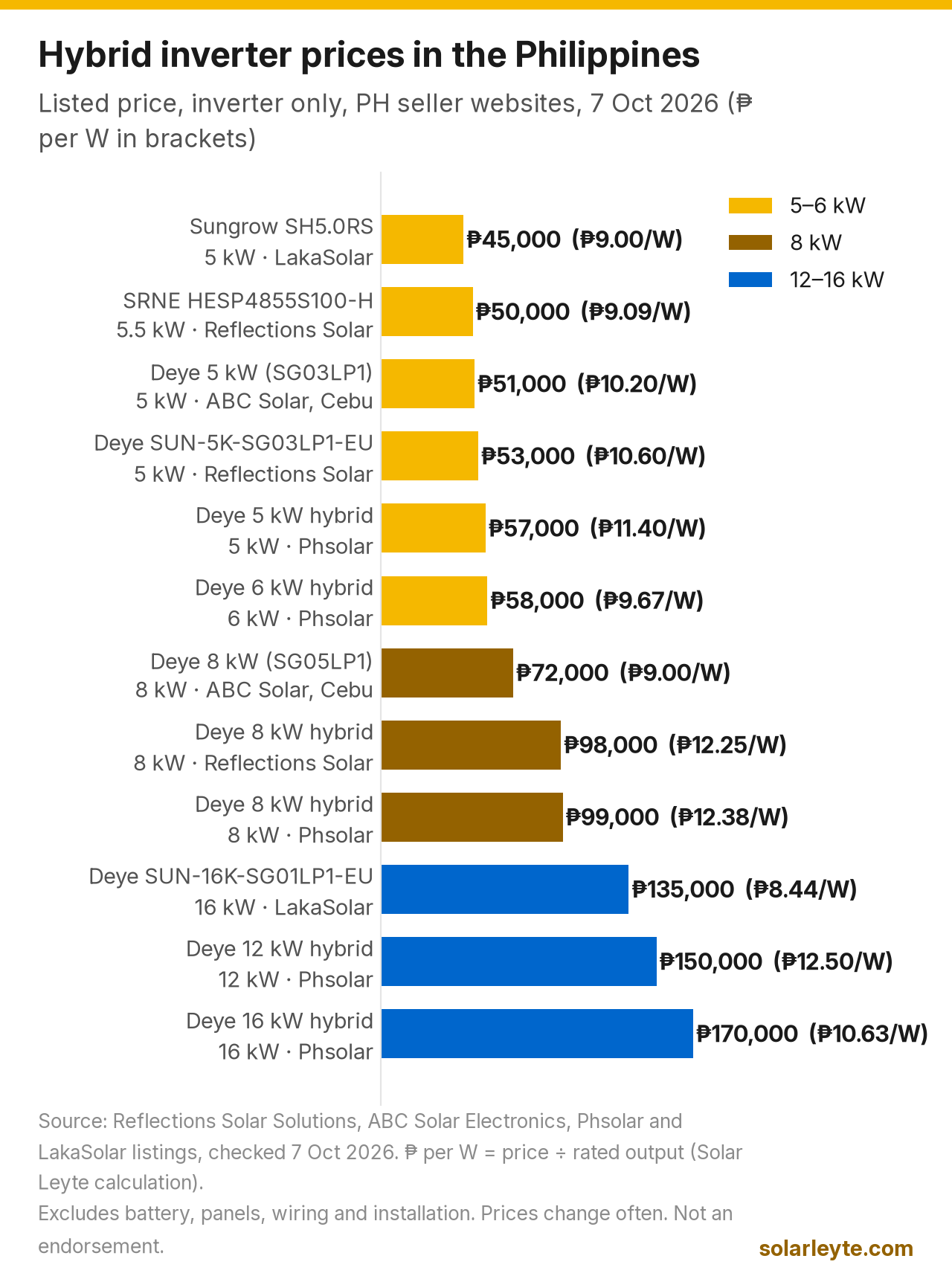
What stands out:
- The same Deye 8 kW size is listed at ₱72,000 in Cebu and ₱98,000 to ₱99,000 elsewhere. That's a ₱27,000 spread. The listings don't all name the exact model, and some may include accessories or a different warranty. Ask each seller for the full model number (for example SUN-8K-SG05LP1-EU), what's in the box and the warranty in writing.
- ABC Solar Electronics is in Talisay City, Cebu, the closest of these sellers to Leyte and Biliran. Reflections Solar Solutions is in Biñan, Laguna, Phsolar in Bacoor, Cavite. Ask about freight to your town and who handles warranty claims in Eastern Visayas.
- Sungrow's SH5.0RS was the cheapest 5 kW unit, but it only takes high-voltage batteries. The 48 V (51.2 V) wall batteries in our solar battery price guide won't work with it. More on that below.
- Check the listing details. LakaSolar lists the same Deye SUN-12K-SG04LP3-EU at ₱135,000 on one page and ₱22,000 on another, and a Deye 6 kW hybrid at ₱6,000. Those look like listing errors, so we left them out. Confirm the price in writing before you pay.
Not in the table:
- Solis. Solis has a Philippine office and sells the S6-EH1P(3-10)K-L-PLUS series of single-phase hybrids for 40–60 V batteries (Solis Philippines). We couldn't find a listed Philippine price on 7 October, so ask installers for a quote.
- Growatt. Sungrid Energy lists Growatt SPH and SPE hybrids, but shows no prices online (Sungrid Energy).
- Lazada and Shopee listings, which change by the hour and often don't name the exact model.
Hybrid vs grid-tie vs off-grid: what the extra money buys
The word "hybrid" gets used for two different machines in Philippine listings. Know which one you're being offered.
- Grid-interactive hybrid (everything in the table above). It works with the grid like a grid-tie inverter, so it can be set for net metering or zero export, and it also charges and runs from a battery. When the grid fails, it switches its backup output to battery and solar.
- Off-grid inverter-charger, often sold as a "hybrid" because it can charge from the grid or a generator. It powers your loads from solar and battery, with the grid as backup input, but it doesn't send power back into the grid. These are cheaper.
- Grid-tie inverter. No battery and no backup. Cheapest, and it shuts down in a brownout.
Type, around 5 kW | Example (as listed) | Seller | Listed price |
|---|---|---|---|
Grid-tie, no battery | Deye 5 kW grid-tie | Reflections Solar Solutions | ₱27,000 |
Grid-tie, no battery | Solis 5000 W single-phase on-grid | Solar Hub PH | ₱40,000 |
Off-grid inverter-charger | SRNE HFP4850S80-H, 5 kVA, 48 V | Reflections Solar Solutions | ₱33,600 |
Off-grid inverter-charger | Axpert VM II 5 kVA (4,000 W), 48 V | ABC Solar Electronics | ₱45,000 |
Grid-interactive hybrid | Sungrow, SRNE and Deye 5–5.5 kW (table above) | Various | ₱45,000 to ₱57,000 |
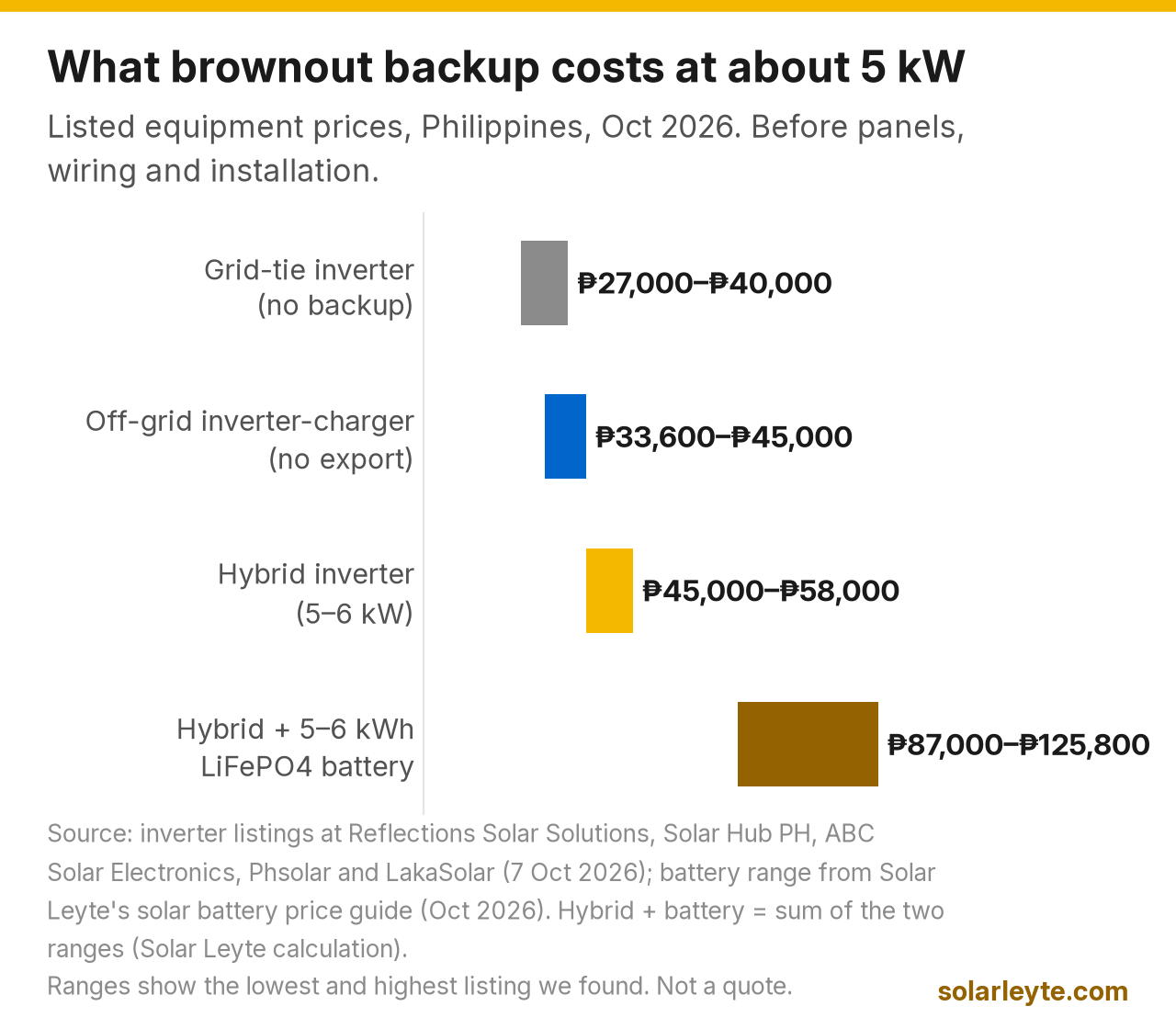
The inverter isn't what makes hybrid solar expensive. The battery is. A 5–6 kWh LiFePO4 battery was listed at ₱42,000 to ₱67,800 when we checked Philippine sellers this month (solar battery prices). Add one to a 5 to 6 kW hybrid at ₱45,000 to ₱58,000 and the two parts come to about ₱87,000 to ₱125,800 (our calculation), before panels, wiring, protection devices and installation. For what panels add, see our solar panel price guide.
Can you start without a battery? Many hybrids can run with no battery connected. LakaSolar's Deye listings say they work "with or without battery," and it notes the 12 kW model runs "with limited hybrid functions without a battery." You get no backup until you add one, though, and you'll have paid the hybrid premium in the meantime. If you plan to add a battery within a year or two, a hybrid now saves replacing a grid-tie inverter later.
The datasheet numbers that matter for a brownout
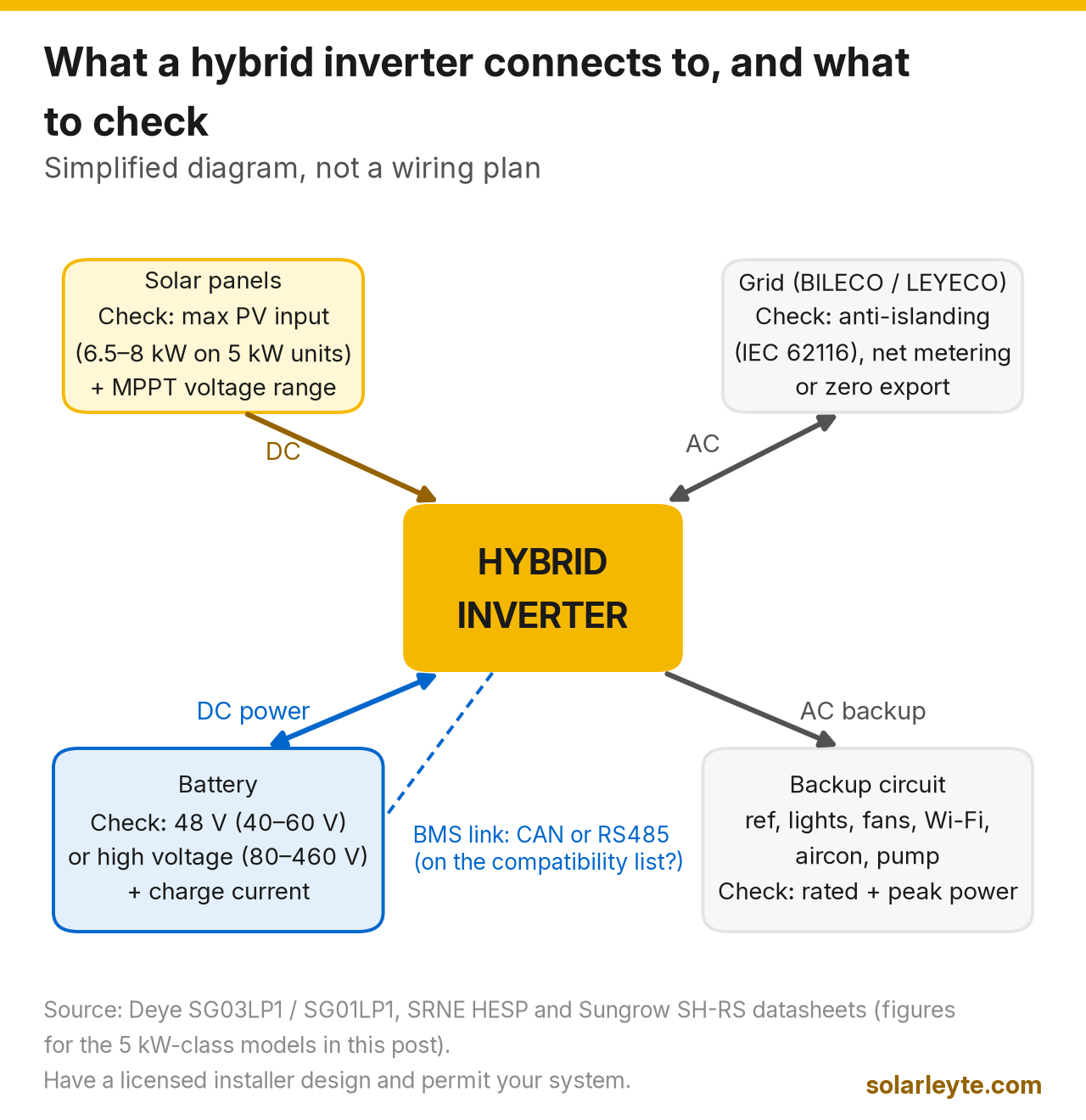
Here is how the main models compare on the specs that decide whether a hybrid keeps your house running. All figures are from the makers' datasheets.
Spec | Deye SUN-5K-SG03LP1-EU | SRNE HESP4855S100-H | Sungrow SH5.0RS | Deye SUN-16K-SG01LP1-EU |
|---|---|---|---|---|
Rated output | 5,000 W | 5,500 W | 5,000 W | 16,000 W |
Short-term peak (off-grid) | 2× rated for 10 s | 11,000 VA max output | 8,400 VA for 10 s | 2× rated for 10 s |
Battery voltage | 40–60 V | 40–60 V | 80–460 V | 40–60 V |
Max battery charge current | 120 A | 100 A (solar), 60 A (grid) | 30 A, 6,600 W max | 290 A |
Max PV input | 6,500 W | 4,000 W + 4,000 W | 7,500 Wp recommended | 25,600 W |
MPPT trackers / voltage range | 2 / 150–425 V | 2 / 120–450 V | 2 / 40–560 V | 3 MPPT / 150–425 V |
Battery (BMS) communication | RS485, RS232, CAN | RS485, CAN | CAN, RS485 | RS485, CAN |
Parallel units | Up to 16 | Up to 6 | Up to 3 (on-grid port) | Up to 16 |
Warranty (datasheet) | 5 or 10 years, depends on install site | 5 years | Ask the seller | 5 or 10 years, depends on install site |
Sources: Deye SUN-3.6/5/6K-SG03LP1-EU and SUN-12/14/16K-SG01LP1-EU datasheets; SRNE HESP 4–6 kW datasheet; Sungrow SH3.0–6.0RS datasheet.
Surge rating: can it start your ref, pump and aircon?
Motors and compressors pull a short burst of extra power when they start (our portable power guide explains why). In a brownout, the inverter has to supply that burst from the battery alone.
- Deye rates its off-grid peak at 2 times rated power for 10 seconds, so about 10,000 W for a 5 kW model.
- SRNE lists a maximum output of 11,000 VA for the 5.5 kW model and a "load motor capacity" of 4 HP for the 5.5 and 6 kW models (3 HP for the 4 and 4.6 kW). A 1 HP motor is 746 W.
- Sungrow lists 8,400 VA for 10 seconds in off-grid mode, and up to 6,000 W for backup loads.
If your list includes a deep-well or jetmatic pump, an aircon and a ref that might all start at once, ask the installer to check the peak rating against those motors, not just the running watts.
Battery voltage: 48 V or high voltage?
This decides which batteries you can buy, now and later.
- 48 V ("low voltage") hybrids, such as the Deye SG03LP1, SG05LP1 and SG01LP1 and the SRNE HESP, take batteries in the 40 to 60 V range. That's the common 51.2 V LiFePO4 wall or rack battery, the kind listed at ₱42,000 to ₱67,800 for 5–6 kWh in our battery price guide.
- High-voltage hybrids, such as the Sungrow SH5.0RS (80 to 460 V), need a high-voltage battery stack. Choosing one means choosing from a smaller list of batteries. Price the battery before you decide on the inverter.
CAN or RS485: will the battery and inverter talk?
A lithium battery's BMS (battery management system) tells the inverter how hard it can charge and discharge. All four models above take CAN and RS485, but that alone doesn't guarantee they'll work together. The protocols have to match.
- Check the inverter maker's battery compatibility list, or the battery maker's list of supported inverters. For example, SRNE publishes a battery compatible inverter list, and some battery listings in our battery guide name Deye, Growatt or Victron as compatible.
- Ask the installer to set up and test the communication link at commissioning. A battery running without a working BMS link is charged on voltage alone, which is less safe and less accurate.
Charge current: how fast it refills the battery
After an evening brownout, you want the battery full again by the next one. Charge current × battery voltage gives the charging power. At 51.2 V, Deye's 120 A on the 5 kW model is about 6.1 kW, and SRNE's 100 A from solar is about 5.1 kW (our calculations). Sungrow caps battery charging at 6,600 W. At those rates, a 5 kWh battery could refill from solar in about an hour of strong sun, if the panels can supply that much and the battery's own BMS accepts it. Check the battery's maximum charge current too. SRNE limits charging from the grid to 60 A, about 3.1 kW at 51.2 V.
PV input: how many panels it can take
The inverter limits your panel array. The Deye 5 kW takes up to 6,500 W of panels on two MPPT trackers, the SRNE 5.5 kW up to 4,000 W on each of its two trackers, and Sungrow recommends up to 7,500 Wp on the SH5.0RS. Two trackers let you split panels between two roof faces. To work out how many panels your home needs, see how many solar panels do I need.
Parallel units and three-phase
Need more later? Deye's hybrids allow up to 16 units in parallel, SRNE's HESP up to 6 (a parallel set can also make three-phase power), and Sungrow's SH-RS up to 3 on the grid port. Most homes in Leyte and Biliran are single-phase. Shops, resorts and clinics with three-phase service need a three-phase model or a parallel set-up.
Which size hybrid inverter does your home need?
Size the inverter to the loads you want on backup at the same moment, then check the surge. Size the battery to how many hours you need. These are planning examples, our estimates, using appliance figures cited in our battery guide and aircon guide. Check your own nameplates.
What must keep running | Running load (estimate) | Suggested size | Why |
|---|---|---|---|
Essentials: ref, 4 LED bulbs, 2 stand fans, Wi-Fi, phones | Under 0.5 kW | 3.6 to 5 kW | Any unit runs this. The ref's start-up surge is the main peak. Spend on the battery instead. |
Essentials + one 1 HP inverter aircon (870 W rated) | About 1.1 to 1.3 kW | 5 kW | Leaves room for the ref and aircon compressors starting together. |
Essentials + two 1 HP aircons + a 1 HP pump (746 W) | About 2.6 to 2.8 kW | 5 to 6 kW | Running load is fine. Check the peak rating against the pump and two compressors. |
Whole house: 3 or more aircons, water heater, cooking | 4 kW and up | 8 kW or more, or two units in parallel | At this size the battery cost climbs fast. Most homes back up a few circuits, not the whole house. |
How we got the numbers: two Sharp 16-inch stand fans at 58 W each, four 9 W LED bulbs and a 10 W router come to under 200 W (Meralco tested values, our router assumption). An 8 cu ft inverter ref averages under 30 W over a day by its DOE label, though its compressor draws more while running. A DOE-labelled 1 HP inverter aircon is rated at 870 W. A 1 HP motor is 746 W.
Don't oversize "just in case". A bigger inverter costs more and can't make a small battery last longer. A 5 kW hybrid running two aircons at about 1.7 kW would empty a 5 kWh battery (about 4.6 kWh usable) in under 3 hours (our calculation). If you want aircon through a long night brownout, the battery is the bigger decision. Our aircon post has the battery math.
Net metering, zero export and the paperwork
- Net metering works with a hybrid. A grid-interactive hybrid exports like a grid-tie inverter, so you can apply for net metering with BILECO or LEYECO II and get credit for daytime exports. The steps are in our BILECO net metering guide and LEYECO II net metering guide. Deye's datasheets list grid standards including IEC 61727 and the IEC 62116 anti-islanding test. Anti-islanding is what makes the inverter stop exporting when the grid is down, to protect lineworkers.
- Or set it to zero export. Most hybrids can limit export with a meter or CT clamp. Since August 2026, DOE Department Circular DC2026-08-0017 lets homes run zero-export systems of any size without an ERC certificate of compliance, though you still need a building permit and must notify the co-op. The trade-off is that exported power earns nothing. Details are in our plug-and-play and zero-export guide.
- Product certification is coming. On 25 May 2026, the DTI published a draft order that would make PS or ICC certification mandatory for solar inverters, including hybrid and off-grid units, along with panels and batteries. Only products with the PS Safety Mark or ICC certification would be allowed on the market, after a one-year adjustment period once the rules are enforced (pv magazine; DTI draft, via WTO TBT notice). It was still a draft when we checked. Keep the inverter's certificates and serial number with your receipt.
Before you buy: a checklist
- Get the full model number, not just "Deye 8 kW hybrid," and match it to the maker's datasheet.
- List your backup loads and ask the seller to confirm the continuous and peak ratings cover them.
- Pick the battery and the inverter together. Check the battery voltage (48 V or high voltage) and that the battery is on the inverter's compatibility list for CAN or RS485.
- Check the PV input and MPPT voltage range against the panels you plan to use.
- Get the warranty in writing. Deye's datasheets say its warranty is 5 or 10 years depending on where the inverter is installed. Ask what applies in the Philippines and who handles claims in Eastern Visayas.
- Plan the install for heat and typhoons. The datasheets above rate these inverters IP65, and Deye and SRNE say they derate in heat above 45°C. Mount them in shade, away from flood level, with proper surge protection (typhoon guide; solar fire safety).
- Use a licensed installer. A hybrid connects to your house wiring and the grid, so it needs a proper electrical permit and design.
FAQ
How much is a hybrid inverter in the Philippines? On 7 October 2026, Philippine sellers listed 5 to 6 kW hybrid inverters at ₱45,000 to ₱58,000, 8 kW Deye units at ₱72,000 to ₱99,000, and 12 to 16 kW units at ₱135,000 to ₱170,000. That's inverter only, before battery, panels and installation.
Is a hybrid inverter much more expensive than a grid-tie one? At one shop, a Deye 5 kW hybrid was ₱53,000 against ₱27,000 for a Deye 5 kW grid-tie inverter, about ₱26,000 more. The bigger cost is the battery: ₱42,000 to ₱67,800 for 5–6 kWh in our October 2026 check.
What size hybrid inverter do I need for my house? For essentials (ref, lights, fans, Wi-Fi), a 3.6 to 5 kW unit is plenty. With one or two 1 HP inverter aircons, most homes pick 5 to 6 kW. Whole-house backup with several aircons needs 8 kW or more. Check the surge rating if you'll run a pump.
Can a hybrid inverter work without a battery? Many can. LakaSolar's Deye listings say they work with or without a battery. But you get no brownout backup until you add one.
Which is better, Deye, SRNE or Sungrow? It depends on the battery you'll use, local service and warranty more than the brand. Deye and SRNE take common 48 V batteries; Sungrow's SH-RS needs a high-voltage battery. We'll compare the brands in more detail in a separate post.
Solar Leyte is run by MACC Systems & Energy Solutions Inc., a solar installer in Naval, Biliran.
Get a free hybrid solar quote from MACC
Tell us what must keep running in a brownout and for how many hours, and send a photo of your last BILECO or LEYECO bill. We'll size the inverter and battery for that list and show you the math, with no obligation.
- Call/Text: 0955 723 5093
- Email: official@macc-inc.com or benjie@macc-inc.com
- Website: www.macc-inc.com
- Office: Brgy. Talustusan, Naval, Biliran 6543
Sources (all checked 7 October 2026)
- Seller listings: Reflections Solar Solutions, Deye 5 kW hybrid (SUN-5K-SG03LP1-EU), Deye 8 kW hybrid, Deye 5 kW grid-tie, SRNE HESP4855S100-H and SRNE HFP4850S80-H; ABC Solar Electronics, 5.0 kW Deye hybrid, 8.0 kW Deye hybrid and Axpert VM II 5 kVA; Phsolar, Deye hybrid inverters, 5 to 16 kW; LakaSolar, Sungrow 5 kW hybrid, Deye SUN-16K-SG01LP1-EU and Deye SUN-12K-SG04LP3-EU; Solar Hub PH, Solis 5000 W on-grid inverter
- Datasheets: Deye, SUN-3.6/5/6K-SG03LP1-EU and SUN-12/14/16K-SG01LP1-EU (Jul 2026), plus the SG05LP1 spec table on ABC Solar Electronics' 8 kW listing; SRNE, HESP 4–6 kW datasheet and battery compatible inverter list; Sungrow, SH3.0/3.6/4.0/5.0/6.0RS datasheet; Solis Philippines, S6-EH1P(3-10)K-L-PLUS; Sungrid Energy, Growatt inverters
- Regulation: DOE, DC2026-08-0017 (zero-export and micro-solar); DTI, draft department administrative order on mandatory certification of solar energy systems (25 May 2026), via WTO TBT notice; pv magazine, Philippines proposes stricter PV, battery product certification rules (2 Jun 2026)
- Appliance figures and battery prices: Solar Leyte, solar battery prices (DOE energy labels, Meralco tested appliances) and solar for aircon