Since August 2026, Filipino homes can install solar for their own use with much less paperwork, as long as it doesn't sell power back to the grid. DOE Department Circular No. DC2026-08-0017 creates two categories. A small plug-and-play "micro-solar system" (up to 1 kW of panels and an 800 W micro-inverter) needs only a written notice to your co-op: no building permit and no ERC Certificate of Compliance (COC). A zero-export system of any size still needs a building permit, but households, clinics and hospitals no longer need a COC. Co-ops like BILECO and the LEYECOs can't charge pre-installation clearance, permit or inspection fees for either.
The catch: any power these systems push to the grid earns nothing. If you want bill credits for exported solar, you still need net metering.
Pwede na ba mag-solar nga walay daghang papeles? For small systems, yes. Below is what the circular actually says (we quote it directly), who qualifies, what you give up, and what BILECO and LEYECO had posted when we checked.
All facts checked 6 October 2026 (Philippine time). Quotes are from the circular itself (DOE, DC2026-08-0017 PDF). This is a plain-language summary, not legal advice.
What DC2026-08-0017 is
The circular's short title is the "Streamlined SGF ZESS and MSS Policy." It covers solar systems "intended solely for own-use consumption" that "do not export electricity to the distribution system, regardless of connection type" (Section 2). It was published in BusinessWorld and Daily Tribune (DOE circular page) on 5 August 2026 (Enviliance ASIA), and it takes effect "immediately after its publication" (Section 13). The DOE announced it to the public on 20 August 2026 (DOE media release).
Two terms you'll see everywhere:
- MSS (Micro-Solar System): "consumer-grade, plug-and-play solar generation system/s intended for own use" (Section 3.2). This is what most people mean by plug-and-play or balcony solar.
- SGF ZESS (Self-Generating Facility Zero-Export Solar System): solar "of any capacity that are intended solely for own-use and are not for the export of electricity to the distribution system" (Section 3.1). It comes in two types:
- Connected: tied to the co-op's lines but "equipped with control or isolation mechanisms that prevent the export of electricity."
- Isolated: operates "independently" and is "not connected to the distribution system" (true off-grid).
The circular says it "complements" the existing net-metering framework rather than replacing it. Households, clinics, hospitals and other medical facilities are expressly covered (Section 2).
Micro-solar, zero-export or net metering: the rules side by side
Micro-solar (MSS) | Connected zero-export | Isolated zero-export (off-grid) | Net metering | |
|---|---|---|---|---|
Size limit | Panels up to 1,000 W DC, micro-inverter up to 800 W AC | Any size | Any size | Up to 100 kW |
Written notice to your co-op | Required (DOE form, Annex A) | Required (DOE form, Annex A) | Not required | Full application |
Building permit | Not required | Required (an existing permit may be accepted) | Required (an existing permit may be accepted) | Electrical permit and CFEI from the LGU |
ERC Certificate of Compliance | Not required | Required, except households, clinics, hospitals and medical facilities | Required, except households, clinics, hospitals and medical facilities | Required (₱1,500 fee) |
Credit for power sent to the grid | None | None | None (no grid connection) | Yes, at the co-op's blended generation rate |
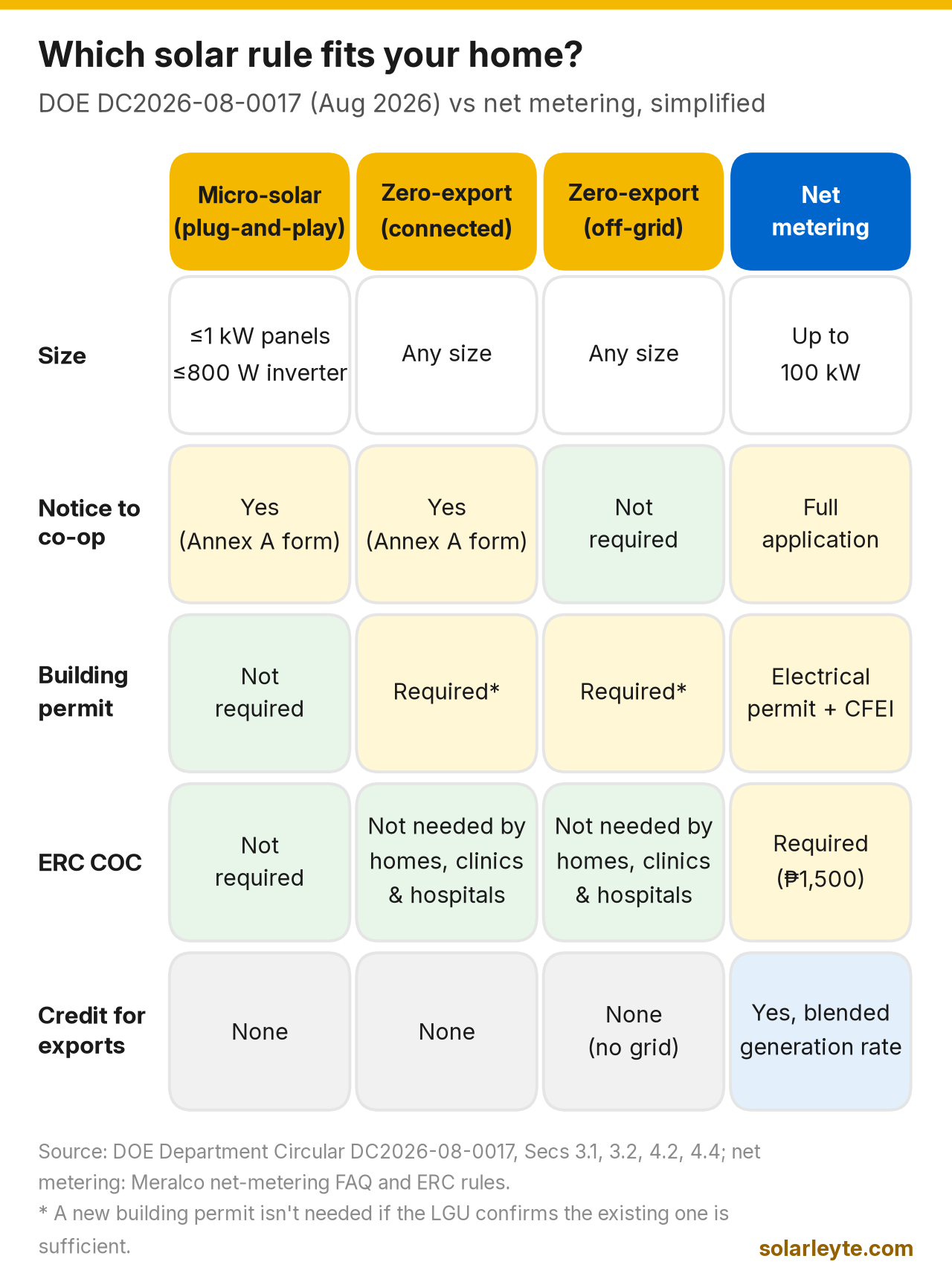
Sources: DC2026-08-0017 Sections 3.1, 3.2, 4.2 and 4.4 (first four columns); for net metering, Meralco's net-metering FAQ and our BILECO net metering guide.
Micro-solar systems (plug-and-play): who qualifies
To count as an MSS, the circular (Section 3.2) says the system must have all three of these:
- Panels: "A total direct current (DC) nameplate capacity not exceeding one thousand Watts (1,000 Watts) or one kilowatt (1 kW)." For example, two 500 W panels fit (1,000 W), but two 580 W panels (1,160 W) would be over the limit.
- Micro-inverter: "A factory-set, grid-tied inverter with a maximum alternating current (AC) output of eight hundred Watts (800 Watts)... equipped with an Automatic Anti-Islanding Disconnection safety mechanism."
- Connection: "designed to connect directly via a standard household wall outlet or circuit with PEC-compliant installation." PEC is the Philippine Electrical Code, so the outlet or circuit still has to be wired to code.
What you need to do: send your co-op the one-page notification form in Annex A of the circular. What you don't need: "For MSS, end-users shall not be required to secure a Building Permit or a COC under this Circular" (Section 4.2). The circular adds that this is "without prejudice to compliance with other applicable laws," so wiring and safety rules still apply.
Will a plug-and-play kit work during a brownout?
No, not on its own. The circular requires an anti-islanding micro-inverter. Meralco explains that a system without a battery "will automatically stop supplying power during an outage through its anti-islanding function," which protects lineworkers (Meralco FAQ). So a micro-solar kit cuts your daytime bill but won't keep your fan or ref running in a BILECO or LEYECO brownout. For that you need a battery, either a hybrid system or a portable power station. See grid-tie vs hybrid solar and our solar battery price guide.
The 12-month meter rule
If you still have an old analog meter, you don't have to wait for a new one. The circular (Section 6.7) gives registered micro-solar systems "a temporary reprieve for twelve (12) months from the date of system notification":
- During those 12 months, "the net-consumption recorded by the existing meter shall be honored as the basis for billing."
- The co-op "shall replace the existing analog meters with meters that comply with the applicable ERC regulations and are suitable for MSS within this twelve (12)-month window."
- "The cost of meter replacement shall be in accordance with applicable ERC regulations." The circular doesn't say the new meter is free, so ask your co-op what you'll pay.
This rule is written for micro-solar only. The DOE's release describes it the same way: existing analog meters "may continue to be used during a 12-month transition period" (DOE).
Size it so you don't export
Any power a micro-solar system sends to the grid "shall be treated as Non-Compensated Export and shall not be eligible for any billing credit, offset, or monetary compensation, regardless of meter type, unless the end-user is enrolled in the Net-Metering Program" (Section 4.4). There's a second reason to avoid exporting. Meralco warns that on a one-way meter, excess solar "may be recorded as imported energy... which will inadvertently increase your bill" (Meralco FAQ).
So the right size is the power your home actually uses in the daytime. Think of a ref, electric fans, Wi-Fi, a TV or a daytime aircon. If your home only draws about 300 W at noon, an 800 W kit will push power to the grid for free.
What a micro-solar kit could save on a BILECO bill (our calculation)
These are Solar Leyte calculations, not a quote. They use BILECO's posted July 2026 residential rate of ₱18.3407/kWh (see our BILECO rate tracker) and the planning yield in our panel sizing guide: 3.5 kWh per kWp per day, a deliberately lower figure than Global Solar Atlas's estimate of about 3.9 for Naval, Biliran. The 800 W inverter cap trims a little off the sunniest hours, so treat 105 kWh as an upper estimate.
System | Solar made per month | Used at home | Monthly saving at ₱18.3407/kWh |
|---|---|---|---|
1 kWp micro-solar, all used at home | up to ~105 kWh | 105 kWh | ~₱1,926 |
1 kWp micro-solar, 70% used at home | up to ~105 kWh | 73.5 kWh | ~₱1,348 (the rest earns nothing) |
3 kWp zero-export system, 60% used at home | ~315 kWh possible | 189 kWh | ~₱3,466 |
Same 3 kWp system on net metering | ~315 kWh | 189 kWh + 126 kWh exported × ~₱9.50 | ~₱4,663 |
How we got these: 1 kWp × 3.5 kWh × 30 days = 105 kWh, and 105 × ₱18.3407 = ₱1,925.77. The 3 kWp rows use the same 189/126 kWh split and the ~₱9.50/kWh September 2026 BILECO blended generation rate (PRESYO-PH) as our BILECO net metering guide: 189 × ₱18.3407 = ₱3,466.39, plus 126 × ₱9.50 = ₱1,197.00, for a total of ₱4,663.39.
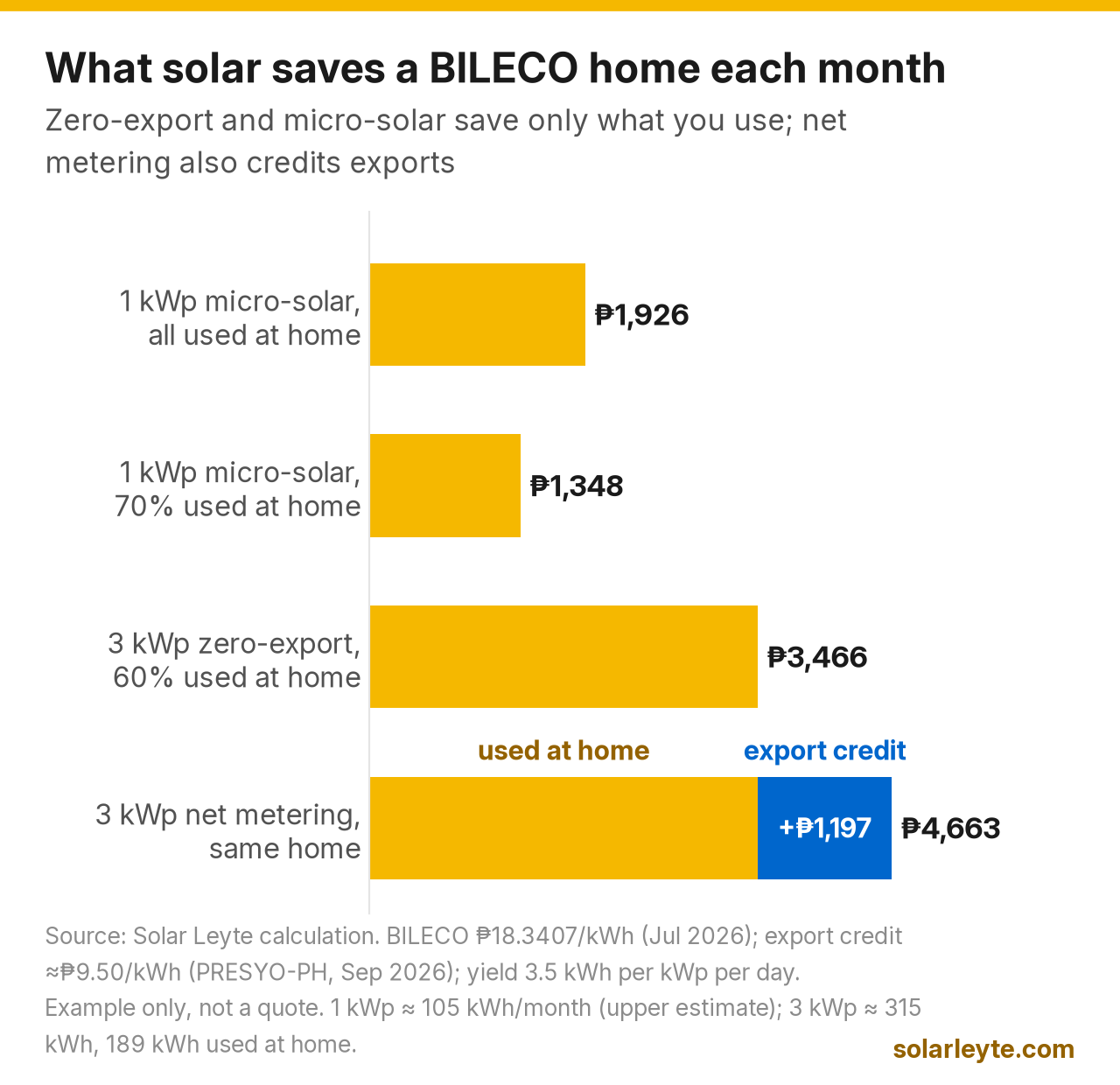
On a zero-export system, the inverter holds production back instead of exporting, so the 126 kWh in that row is never made. The difference between the last two rows, about ₱1,197 a month in this example, is what net metering adds, and what you give up by going zero-export. For full payback math, including the no-export case, see Is solar worth it?
Zero-export systems (SGF ZESS): bigger systems, fewer papers
A zero-export system is a normal rooftop system of any size, set up so it never sends power out. Here is what the circular requires (Section 4.2):
- Notice to the co-op: required for connected systems, using the same Annex A form. Isolated (off-grid) systems "shall not be required to submit such notification."
- Building permit: required for both types, from your city or municipality. But "a new permit shall not be required if the host LGU verifies that the existing Building Permit is sufficient," in which case you submit a copy of that permit.
- ERC COC: required "unless the SGF ZESS is for the use of households, clinics, hospitals, and other medical facilities."
Small businesses take note. The COC exemption names households, clinics, hospitals and other medical facilities only. A sari-sari store, resort, water refilling station or rice mill isn't on that list. Rappler's reading is the same: "Other users, such as businesses, generally still need one" (Rappler, 21 Aug 2026). If your store is part of your home, ask your co-op which category you fall under. The ERC has been told to set up "a single-transaction and simplified process for the issuance of COCs for SGF ZESS" (Section 7.2).
Keeping it zero-export is your job. A connected system must "continuously" maintain "functional and effective control or isolation mechanisms that strictly prevent the export of electricity" (Section 5.3). If it fails to, that "shall constitute a violation of this Circular." The co-op can require corrective measures and extra protection, and any exported power earns no credit. In practice, inverter makers handle this with an export-limit setting plus a current sensor (CT) or meter at your main panel (Solis export power management guide). Ask your installer to show you the setting and test it.
Also worth knowing: "The end-users shall bear all operational and financial risks associated with the underperformance, downtime, or failure of their SGF ZESS or MSS" (Section 5.4).
What BILECO and LEYECO can and can't do now
Section 6 of the circular tells every distribution utility, co-ops included, to:
- Drop the up-front barriers. Co-ops must ensure "no administrative barriers, including pre-installation clearances, technical permits, or inspection fees, are imposed as conditions for the installation" of zero-export or micro-solar systems (6.1).
- Keep your service capacity. Your transformer and service-drop capacity must "remain intact and are not reduced or downgraded solely due to the installation," so the grid can still carry your load if your solar fails (6.2).
- Switch to a notice-after-install process and keep a registry of these systems (6.3). They must report the number and capacity of installations to the DOE every quarter (6.5).
- Help you move to net metering later if you decide you want export credits after all (6.4).
- Update their Citizens' Charters "within thirty (30) days from the effectivity of this Circular" (6.6). Counting from the 5 August publication, that's about 4 September 2026 (our count).
Co-ops may still run a Distribution Impact Study, but only "at its own cost," and it "shall not delay, prevent, or otherwise affect the end-user's installation" (4.3).
What our local co-ops had posted (checked 6 October 2026)
- BILECO (bileco.com.ph): we found no notification form, zero-export page or announcement about the circular on the home, news, downloads or new-connection pages.
- LEYECO II (leyeco-2.com): the website has a net metering process page, but we found nothing on zero-export or micro-solar.
- LEYECO IV (leyecoiv.com) and LEYECO V (leyeco-v.com.ph): nothing on the new rules on their home or advisory pages.
We checked the websites only. A co-op may have posted something on Facebook or have forms at its office, so call before you install. The circular doesn't make you wait for a co-op version of the form: Annex A is attached to the circular itself (the last page of the DOE PDF).
What the Annex A notice asks for: your name, service or customer account number, service address, contact number and email; whether the system is a zero-export system or micro-solar; installed PV capacity (DC); installed inverter capacity (AC); the date of installation; and a signed declaration that the information is true and that the installation "complies, or shall comply" with DOE and ERC requirements. Keep a received copy.
Questions to ask BILECO or your LEYECO:
- Where do I submit the DC2026-08-0017 Annex A notice (office, email or online), and will you stamp a received copy?
- Is my meter analog? If it's replaced within the 12 months, how much will I pay?
- For a zero-export system, do you need anything besides the notice? (Under Section 6.1, there should be no clearance, technical permit or inspection fee.)
- Has your Citizens' Charter been updated for the new process?
- If I want net metering later, what changes?
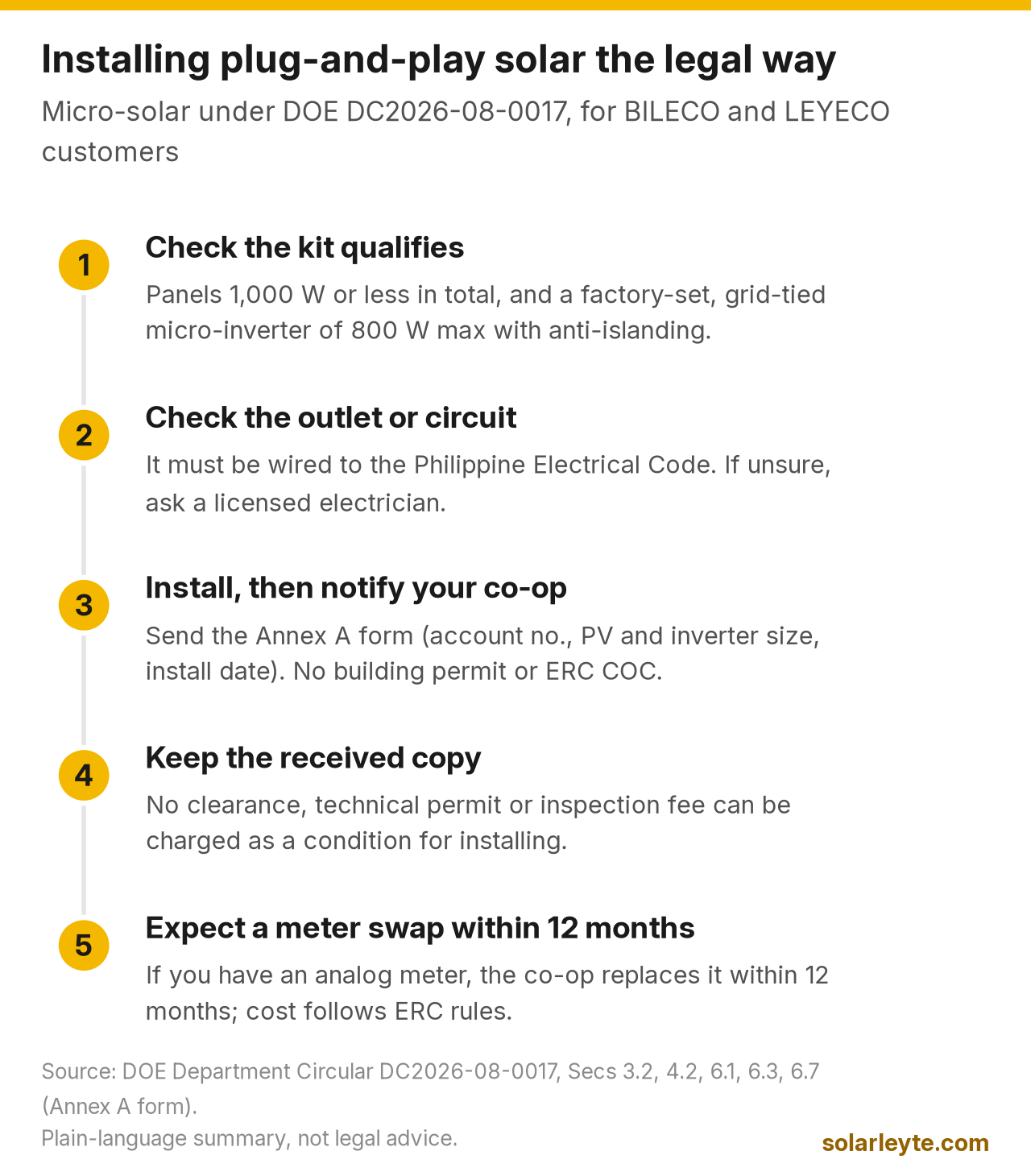
How to do it properly: step by step
Micro-solar (plug-and-play):
- Check that the kit qualifies: panels totalling 1,000 W or less, and an 800 W-max, factory-set, grid-tied micro-inverter with anti-islanding.
- Make sure the outlet or circuit it plugs into is wired to the Philippine Electrical Code. If you're unsure, have a licensed electrician check it.
- Install, then send the Annex A notice to your co-op. The circular calls this a "post-installation notification process" (Section 6.3).
- Keep your received copy. If you have an analog meter, expect a meter replacement within 12 months.
Zero-export (connected):
- Get the building permit from your LGU, or ask the LGU to confirm that your existing permit is enough.
- If you're not a household, clinic, hospital or medical facility, apply for the ERC COC.
- Install with a working export-limit or isolation setup, and test it.
- Send the Annex A notice to your co-op.
Zero-export (isolated or off-grid): get the building permit (or confirmation of your existing one), plus a COC if you aren't a household or medical facility. No co-op notice is needed.
For any system, the circular's whereas clauses remind us that under the PEC, electrical plans for a construction permit "shall be signed and sealed by a professional electrical engineer." Most solar fires start in DC wiring, connectors and isolators, often because of poor installation, so read our solar fire safety guide before you buy a cheap kit online.
What's still pending
- ERC rules. The ERC was given 90 days from effectivity (about 3 November 2026, our count) to set "the technical, commercial, and interconnection rules applicable to SGF ZESS and MSS" and to harmonise them with the net-metering rules (Section 7). We found no ERC issuance on this in our searches as of 6 October 2026. Details such as meter types and costs may change when it arrives.
- LGU guidelines. The DOE and DILG were to set uniform guidelines for LGUs within 60 days (Section 8.3), which is about 4 October 2026 by our count. We found none published in our searches as of 6 October.
- Product standards. The DOE will work with DTI's Bureau of Philippine Standards, "where necessary," to put these components on the mandatory certification list (Section 8.2).
- Condos and HOAs. The DOE will coordinate with DHSUD so these systems can go on "balconies, windows, designated building envelopes, rooftops, or available areas" unless there's proof of structural risk or a threat to public safety (Section 8.1). That matters more in cities than in most of Leyte and Biliran.
We'll update this page when the ERC rules come out or when BILECO or a LEYECO publishes its process.
Zero-export or net metering: which fits your home?
Zero-export or micro-solar makes sense if:
- someone is home in the daytime and your ref, fans or aircon soak up most of the solar;
- you want to start small (one or two panels) without the net-metering paperwork;
- your transformer's hosting capacity is full. LEYECO II, for example, lists hosting limits per transformer in its net metering process. See our LEYECO II net metering guide.
Net metering is better if:
- the house is empty in the daytime, so much of your solar would be exported;
- you're installing a larger system (3 kWp and up) and want credit for every kWh. In our example, that's worth about ₱1,197 a month;
- you're willing to handle the electrical permit, CFEI, ₱1,500 COC fee and meter swap. The steps are in our BILECO and LEYECO II guides.
Need power in brownouts? Neither rule helps by itself. You need a battery: see grid-tie vs hybrid.
FAQ
Is plug-and-play solar legal in the Philippines? Yes, under DOE DC2026-08-0017, if it qualifies as a micro-solar system: panels up to 1 kW, an 800 W-max grid-tied micro-inverter with anti-islanding, and a PEC-compliant outlet or circuit. You must notify your distribution utility using the circular's Annex A form.
Do I need a building permit for a 1 kW plug-and-play kit? No. The circular says MSS end-users "shall not be required to secure a Building Permit or a COC," without prejudice to other laws such as the Philippine Electrical Code.
Do I need an ERC COC for a zero-export rooftop system? Not if it's for a household, clinic, hospital or other medical facility. Other users, including most businesses, still need one. You still need a building permit (or LGU confirmation that your existing one is enough).
Can BILECO or LEYECO charge me an inspection fee? Not as a condition for installing a zero-export or micro-solar system. Section 6.1 bars "pre-installation clearances, technical permits, or inspection fees." Meter replacement costs follow ERC rules.
Will I get credit for power I send to the grid? No. Exports from these systems are "Non-Compensated Export." For credits, enrol in net metering.
Can I switch from zero-export to net metering later? Yes. Co-ops must "provide necessary technical guidance" to customers who move to net metering, subject to ERC rules (Section 6.4).
Solar Leyte is run by MACC Systems & Energy Solutions Inc., a solar installer in Naval, Biliran.
Not sure if zero-export, micro-solar or net metering fits your home? Ask MACC
Send us your latest BILECO or LEYECO bill and tell us when the house is busiest. We'll show you how much solar you'd actually use in the daytime, whether net metering is worth the paperwork, and the savings math. No obligation.
- Call/Text: 0955 723 5093
- Email: official@macc-inc.com or benjie@macc-inc.com
- Website: www.macc-inc.com
- Office: Brgy. Talustusan, Naval, Biliran 6543
Sources (all checked 6 October 2026)
- DOE, Department Circular No. DC2026-08-0017, Policy Guidelines for Self-Generating Facility Zero-Export Solar Systems and Micro-Solar Systems for Own-Use (PDF), including the Annex A notification form, and its circular page (publication in BusinessWorld and Daily Tribune)
- DOE, DOE Simplifies Rules for Own-Use Solar, Expands Access for Filipino Consumers (media release, 20 Aug 2026)
- Enviliance ASIA, Philippines Deregulates Small-Scale Solar Power Systems for Self-Consumption (publication date, 5 Aug 2026)
- Rappler, Want to install solar panels? How DOE's simplified rules apply to you (21 Aug 2026)
- GMA News, DOE simplifies rules for installing own-use solar systems (20 Aug 2026)
- pv magazine, Philippines eases rules for own-use solar systems (11 Aug 2026)
- BusinessMirror, DOE simplifies rules for own-use solar panel installation (5 Aug 2026)
- Meralco, Net-Metering FAQ (anti-islanding, one-way meters, net-metering requirements) and Non-Exporting DER Programs
- Solis, Export Power Management and Load Monitoring by CT
- Global Solar Atlas, Naval, Biliran (solar yield)
- Co-op websites: BILECO, LEYECO II net metering process, LEYECO IV, LEYECO V
- Solar Leyte: BILECO rate tracker (₱18.3407/kWh, July 2026), BILECO net metering guide (PRESYO-PH blended generation rate, net-metering fees)