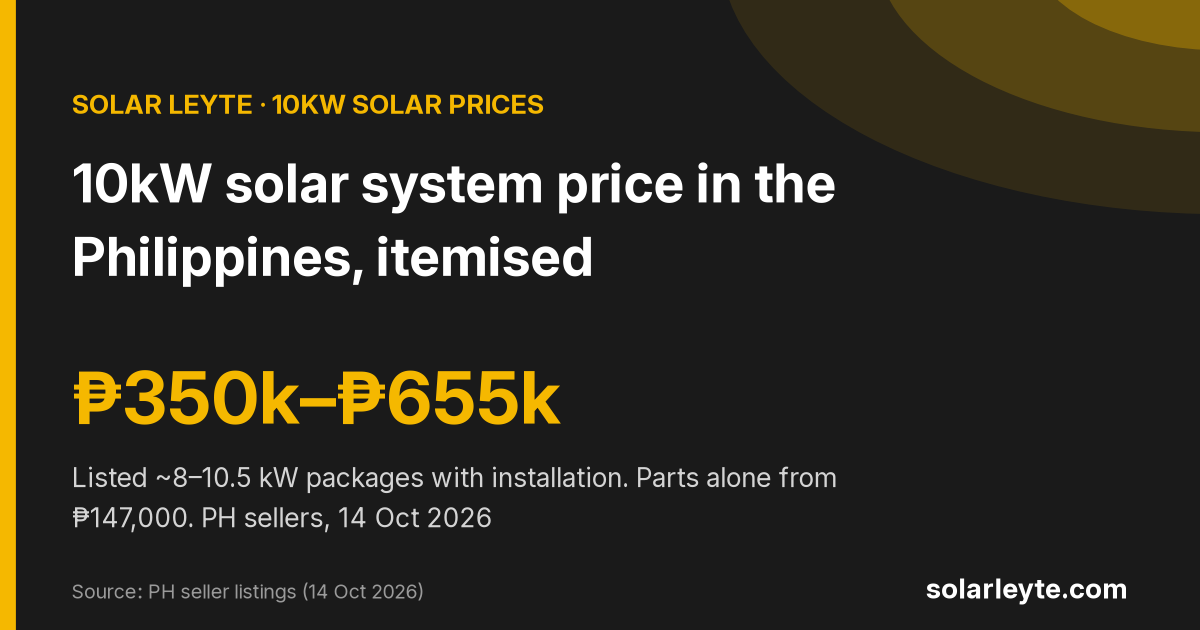
On 14 October 2026, the parts for a ~10 kW grid-tie solar system added up to about ₱147,000 to ₱282,000 at Philippine sellers' listed prices. A ~10 kW hybrid with about 10–12 kWh of lithium battery came to about ₱274,000 to ₱472,000 in parts. Complete packages near that size that sellers list with installation ran from about ₱350,000 (8 kW grid-tie) to ₱505,000–₱655,000 (10.5 kW hybrid, VAT exclusive on the Cebu listings).
Pila man gyud ang 10kW? Most "10kW solar price" pages give one round number with no breakdown. This one lists every part we priced, the seller, and the date we checked, so you can read any quote line by line. It's a parts and package price post for the size-specific query — not a replacement for our 5kW solar system price post or the evergreen solar panel price guide. If you're still working out what size you need, start with how many solar panels do I need.
Prices checked 14 October 2026 (Philippine time) on each seller's own website or package flyer. They change often. Listing a product isn't an endorsement, and Solar Leyte earns nothing from these links. None of the totals below is a MACC price or a quote.
The quick answer: 10kW solar price in the Philippines (October 2026)
What you're pricing | Listed price range | Per watt (our calculation) | What's included |
|---|---|---|---|
~10 kW grid-tie, parts only (9.9 kWp) | ₱147,000 to ₱282,000 | ₱14.90 to ₱28.40 | 18 × 550 W panels, ~8–10 kW grid-tie inverter, mounting, cable and protection |
~10 kW hybrid + ~10–12 kWh battery, parts only | ₱274,000 to ₱472,000 | ₱27.70 to ₱47.70 | Same, with an 8–12 kW hybrid inverter and two 5–6 kWh LiFePO4 batteries |
8.0 kW grid-tie package (listed) | ₱350,000 | ₱43.75 | 16 × 500 W panels, SolaX Smart X1 8.0, mounting, protection, "free installation" (ABC Solar Electronics) |
9.35–11 kWp grid-tie packages (listed) | ₱365,000 to ₱413,000 | ₱37.50 to ₱39.00 | Phsolar "Complete Package – Grid Tie" variants; installation package per the seller |
10.5 kW hybrid packages (listed, VAT exclusive) | ₱505,000 to ₱655,000 | ₱48.00 to ₱62.20 | 18 × 585 W panels (10.53 kWp), 10 kW hybrid, 10.24–30.72 kWh battery, "free installation" (ABC Solar Electronics) |
10–11 kW hybrid packages (other sellers) | ₱565,000 to ₱650,000+ | — | GetSolar 10 kW (11.16 kWp + 16.08 kWh) ₱565,000 all-in; Takiyo Business 10 kW listed ₱570,000, "starts at ₱650,000" after assessment |
Parts totals are rounded sums of the itemised tables below. "Per watt" divides by 9,900 W of panels for the parts build-ups (18 × 550 W) and by each package's stated panel watts where we have them. Parts-only totals leave out labour, design, permits, delivery and some small items, so they are not what you'd pay for a finished system. More on that gap below.
What a 10 kW system is made of
A "10 kW" system usually means about 10 kW of panels (kWp) with an inverter rated near 8–12 kW. With today's 550 W panels, that's 18 panels, or 9,900 W (9.9 kWp). ABC Solar Electronics' 10.5 kW hybrid packages use eighteen 585 W panels instead (10.53 kWp). GetSolar's 10 kW hybrid uses eighteen 620 W panels (11.16 kWp). Here's what each part does (our solar panel price guide explains how each one shows up on a quote):
- Panels. Still the biggest single cost in a grid-tie system at this size.
- Inverter. Grid-tie (no brownout backup) or hybrid (backup once you add a battery). See grid-tie vs hybrid and our hybrid inverter price guide.
- Battery (hybrid only). Often two 5–6 kWh modules (~10–12 kWh) for a large home evening load; packages go higher.
- Mounting. Rails, clamps and roof feet. In typhoon country, don't skimp here (typhoon guide).
- Cable and protection. PV cable, connectors, surge protection, DC and AC isolators, breakers.
- Labour, permits and paperwork. Not in the parts tables. Every finished system needs them.
Eighteen 550 W panels of the AE MD-144 size (2,278 × 1,133 mm per Reflections Solar Solutions) take about 46.5 m² of roof, panel area only (18 × 2.278 m × 1.133 m, our calculation). Your installer needs extra room for edge clearance and walkways. That is roughly double the roof of a 5 kW system.
Panels: 550 W modules from Philippine sellers
Panel (as listed) | Seller | Listed price | ₱ per W | 18 panels (9.9 kWp) |
|---|---|---|---|---|
LVTOPSUN 550 W mono | ABC Solar Electronics, Cebu | ₱4,200 | ₱7.64 | ₱75,600 |
AE SOLAR 550 W | ABC Solar Electronics, Cebu | ₱6,700 | ₱12.18 | ₱120,600 |
Sunova 550 W mono PERC | Phsolar | ₱6,700 | ₱12.18 | ₱120,600 |
AE 550 W mono PERC | Phsolar | ₱7,000 | ₱12.73 | ₱126,000 |
AE Solar MD-144 550 W (15-year product, 30-year performance warranty per listing) | Reflections Solar Solutions | ₱8,500 | ₱15.45 | ₱153,000 |
₱ per W and the 18-panel totals are our calculations. Prices are per panel, before delivery. More watt-class context is in our 550W to 620W panel prices post.
- The cheapest and dearest panel differ by ₱4,300 each, or ₱77,400 across eighteen. Ask each seller for the exact model number, the datasheet and the warranty in writing.
- ABC's own 10.5 kW packages use 585 W panels, not the 550 W LVTOPSUN line above. We kept the parts build-up on 550 W so you can compare with our 5 kW post and with open retail listings.
Inverter: grid-tie or hybrid, around 8–12 kW
Inverter (as listed) | Type | Seller | Listed price |
|---|---|---|---|
Solax 8 kW grid-tie | Grid-tie | Phsolar | ₱35,000 |
Sunways 10.0 kWp grid-tie | Grid-tie | Phsolar | ₱45,000 |
Megarevo 8 kW HOOG | Grid-tie | Phsolar | ₱92,000 |
Deye 8.0 kW hybrid | Hybrid | ABC Solar Electronics, Cebu | ₱72,000 |
Hopetrek SUN-SL-HP10K-A1, 10 kW, 48 V-class (VAT incl.) | Hybrid | Beyond Hygiene Asia | ₱98,500 |
Deye 8 kW hybrid | Hybrid | Phsolar | ₱99,000 |
Deye 12 kW hybrid | Hybrid | Phsolar | ₱150,000 |
A true ~10 kW grid-tie string inverter on Phsolar's list is the Sunways 10.0 kWp at ₱45,000. The Solax 8 kW (₱35,000) and Megarevo 8 kW (₱92,000) are included because many "10 kW" quotes pair ~10 kWp of panels with an 8 kW inverter (array oversizing). Confirm the inverter's max PV input and export limit against your co-op rules.
On the hybrid side, ABC's 8 kW Deye is ₱72,000; Hopetrek's 10 kW is ₱98,500; Phsolar's Deye 8 kW is ₱99,000 and its 12 kW is ₱150,000. What the hybrid premium buys you is backup during a BILECO or LEYECO brownout, but only once a battery is connected. Specs and service notes are in our Deye vs Solis vs SRNE comparison and the hybrid inverter price guide.
Battery: usually two modules at this size
Battery (as listed) | Capacity | Seller | Listed price | 2 units | Combined kWh |
|---|---|---|---|---|---|
ONE SOLAR HIGEE120, 51.2 V 120Ah LiFePO4 | 6.14 kWh | LakaSolar | ₱42,000 (was ₱45,000) | ₱84,000 | 12.29 kWh |
Hopetrek ESS-LB5-W01, 51.2 V 100Ah | 5.12 kWh (4.6 kWh usable) | Beyond Hygiene Asia | ₱63,200 (VAT incl.) | ₱126,400 | 10.24 kWh |
Both are 48 V-class batteries that match the low-voltage hybrids above. LakaSolar says the HIGEE120 is compatible with Deye hybrid inverters (including larger Deye sizes). ABC's 10.5 kW package flyers use 51.2 V 200Ah (10.24 kWh) or 300Ah (15.36 kWh) modules, one or two units — that is how their package prices step from ₱505,000 to ₱655,000. Essentials through a 4-hour brownout still fit in one 5 kWh module for many homes; a large home with evening aircon needs more (solar battery price guide, solar for aircon).
Mounting: rails, clamps and roof feet, itemised
This is an example parts list for 18 panels in two rows on a metal roof, using Reflections Solar Solutions' aluminium mounting prices so the line items are comparable. Quantities are our estimate (roughly double the 9-panel list in our 5 kW post). Your installer will set the real number of roof attachments from your roof structure and the wind loads.
Item (Reflections Solar Solutions, RCC mounting) | Unit price | Quantity (our estimate) | Subtotal |
|---|---|---|---|
PV aluminium rail, 2.2 m | ₱550 | 20 | ₱11,000 |
L foot (roof attachment, with screws) | ₱89.60 | 40 | ₱3,584 |
Mid clamp | ₱50 | 32 | ₱1,600 |
End clamp, 30 mm | ₱100 | 8 | ₱800 |
Splice kit (joins rails) | ₱89.60 | 16 | ₱1,433.60 |
Mounting total | ₱18,417.60 |
Ask your installer how the rails are fixed to the purlins, not just the roof sheet. Our typhoon guide explains why that matters in Eastern Visayas.
Cable and protection, itemised
Item | Seller | Unit price | Quantity (our estimate) | Subtotal |
|---|---|---|---|---|
DC solar PV cable, twin 4 mm², 50 m roll | Reflections Solar Solutions | ₱4,000 | 2 | ₱8,000 |
MC4 connector pair | LakaSolar | ₱200 | 8 | ₱1,600 |
DC surge protection device (SPD) | Reflections Solar Solutions | ₱600 | 2 | ₱1,200 |
IP66 DC isolator switch | LakaSolar | ₱2,100 | 2 | ₱4,200 |
Suntree IP66 AC isolator switch | LakaSolar | ₱1,625 | 1 | ₱1,625 |
Himel 2-pole AC breaker, 40 A | Reflections Solar Solutions | ₱300 | 1 | ₱300 |
Distribution box, 18-way | Reflections Solar Solutions | ₱1,200 | 1 | ₱1,200 |
Grid-tie total | ₱18,125 | |||
Hybrid adds: RSS DC MCCB 250 A (battery breaker) | Reflections Solar Solutions | ₱1,500 | 1 | ₱1,500 |
Hybrid adds: battery cable, 25 mm², per metre | LakaSolar | ₱1,200 | 4 | ₱4,800 |
Hybrid total | ₱24,425 |
We counted two DC cable rolls and two DC isolators because an 18-panel array is usually split across more than one string. The 40 A AC breaker in the Reflections listing may be light for a continuous ~10 kW AC output — ask your installer for the correct amp rating. This list still leaves out the grounding rod and wire, conduit, AC cable to your panel board, and monitoring. Prices for those depend on your house and your service entrance.
Grid-tie vs hybrid: the full parts build-up
Add the tables up and you get this. "Low" uses the cheapest listing for each part, "high" the dearest among the inverters we treated as ~8–12 kW class.
Part | Grid-tie, low | Grid-tie, high | Hybrid, low | Hybrid, high |
|---|---|---|---|---|
18 × 550 W panels | ₱75,600 | ₱153,000 | ₱75,600 | ₱153,000 |
Inverter (~8–12 kW) | ₱35,000 | ₱92,000 | ₱72,000 | ₱150,000 |
Battery (~10–12 kWh LiFePO4, two modules) | – | – | ₱84,000 | ₱126,400 |
Mounting | ₱18,417.60 | ₱18,417.60 | ₱18,417.60 | ₱18,417.60 |
Cable and protection | ₱18,125 | ₱18,125 | ₱24,425 | ₱24,425 |
Parts total | ₱147,142.60 | ₱281,542.60 | ₱274,442.60 | ₱472,242.60 |
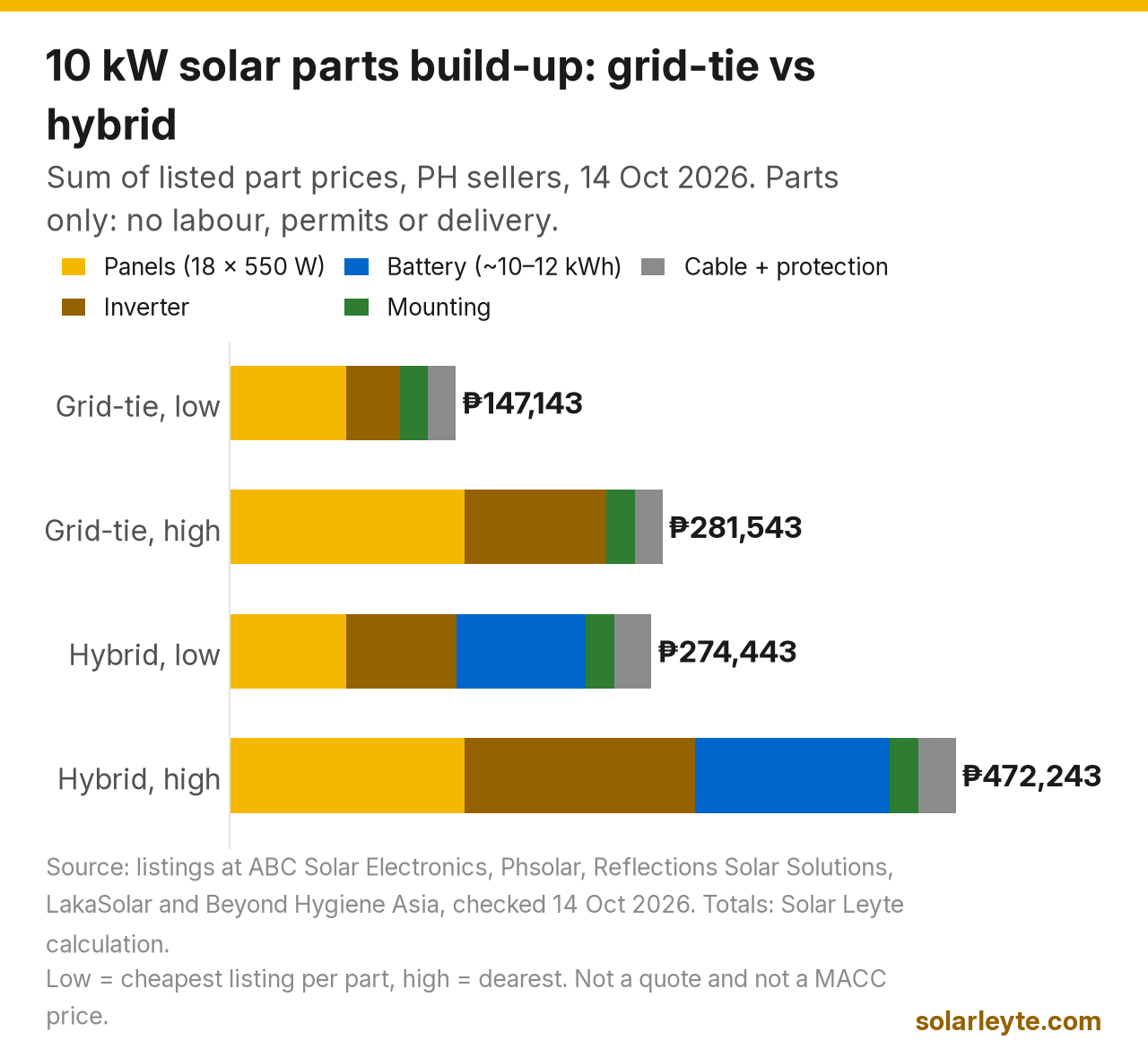
All totals are Solar Leyte calculations from the listed prices above.
What stands out:
- In grid-tie, the panels are about half to more than half the parts cost. At the high end they're ₱153,000 of ₱281,543.
- In hybrid, the battery pair and hybrid inverter together are ₱156,000 to ₱276,400, often more than the panels. Going hybrid roughly doubles (or more) the parts bill for the same 9.9 kWp of panels.
- Mounting and protection are a small share, about ₱36,000 to ₱43,000. That's not where to cut. A cheap clamp or a missing surge protector is what fails in a typhoon or a lightning storm (solar fire safety).
Listed ~10 kW packages: what sellers charge with installation
Package (as listed) | Seller | Listed price | ₱ per W | What the listing / flyer says is included |
|---|---|---|---|---|
8.0 kW grid-tie package | ABC Solar Electronics, Talisay, Cebu | ₱350,000 | ₱43.75 | 16 × 500 W panels, SolaX Smart X1 8.0 Dual MPPT, mounting, protection, PV cable, AC accessories, "free installation" |
9.35 kWp grid-tied | Phsolar, Bacoor, Cavite | ₱365,000 | ₱39.04 | Filed under "Installation Package"; component list not shown online |
10.45 kWp grid-tied | Phsolar | ₱397,000 | ₱37.99 | Same product family |
11 kWp grid-tied | Phsolar | ₱413,000 | ₱37.55 | Same product family |
10.5 kW hybrid, 1 × 51.2 V 200Ah (10.24 kWh) | ABC Solar Electronics | ₱505,000 (VAT exclusive) | ₱47.96 | 18 × 585 W panels, 10 kW hybrid with export, mounting, protection, cable, AC accessories, "free installation" |
10.5 kW hybrid, 1 × 300Ah (15.36 kWh) | ABC Solar Electronics | ₱540,000 (VAT exclusive) | ₱51.28 | Same, larger single battery |
10.5 kW hybrid, 2 × 200Ah (20.48 kWh) | ABC Solar Electronics | ₱575,000 (VAT exclusive) | ₱54.61 | Same, two 200Ah batteries |
10.5 kW hybrid, 2 × 300Ah (30.72 kWh) | ABC Solar Electronics | ₱655,000 (VAT exclusive) | ₱62.20 | Same, two 300Ah batteries |
10 kW hybrid, 11.16 kWp + 16.08 kWh | GetSolar Philippines | ₱565,000 all-in | ₱50.63 | 18 × 620 W panels, 10 kW Solis hybrid, 1 × 314Ah 51.2 V battery, accessories, delivery and installation per the store page |
Takiyo Business 10 kW expandable hybrid | Takiyo Japan | ₱570,000 listed; "starts at ₱650,000" after assessment | — | ~10 kWp PV, expandable hybrid, LiFePO4; final BOM after site assessment |
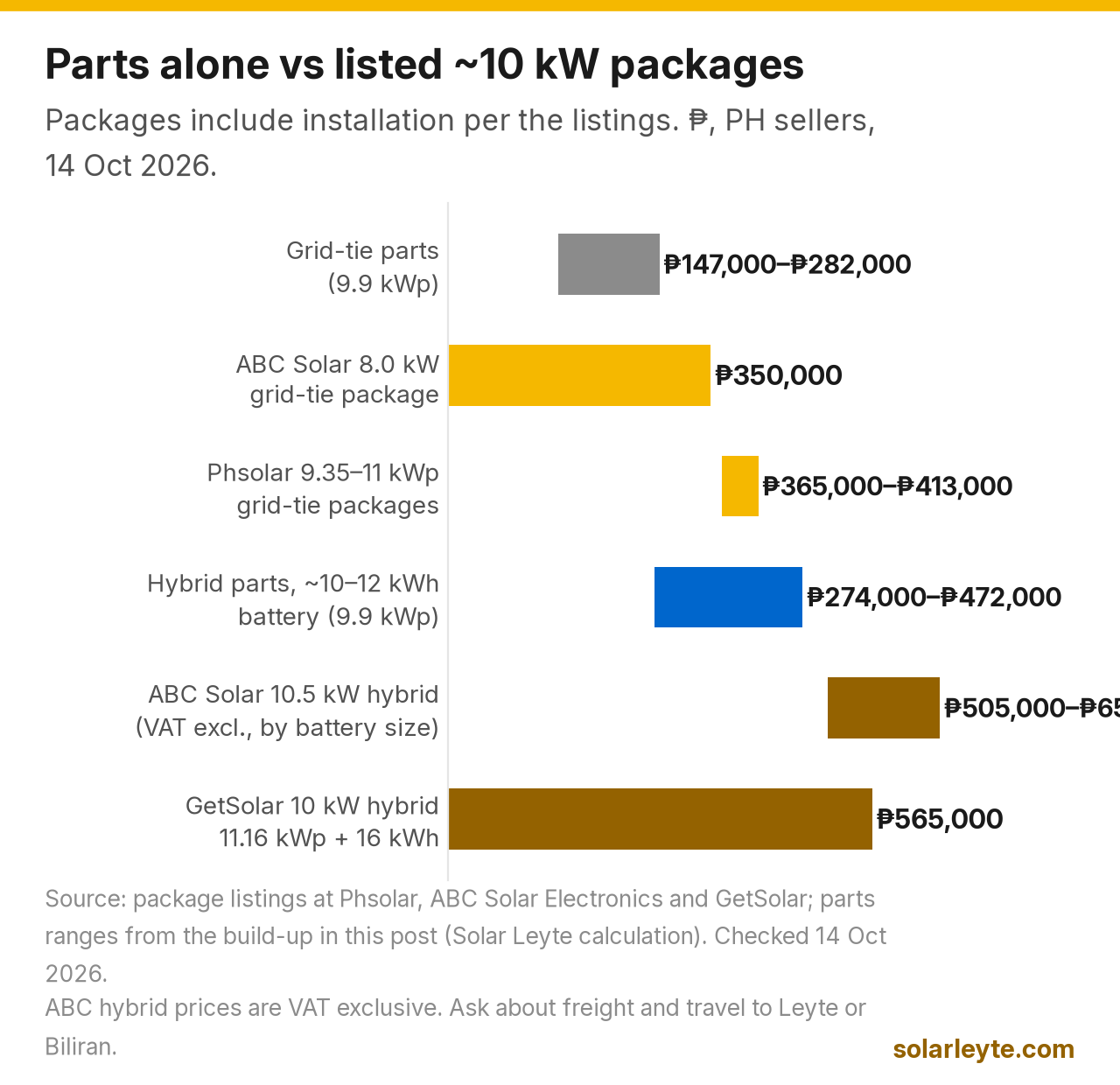
₱ per W is our calculation from each listing's stated panel watts where available. Battery kWh for ABC uses 51.2 V × Ah ÷ 1,000 (our calculation).
On ABC's 10.5 kW hybrid line, the only difference the flyers highlight between the four prices is the battery bank (one or two modules, 200Ah or 300Ah). That is the same pattern we saw on their 5.5 kW hybrids in the 5kW price post.
Why a package costs more than the parts. A Phsolar 10.45 kWp grid-tie package at ₱397,000 is about ₱115,000 to ₱250,000 more than our grid-tie parts build-up (our calculation). The listings don't break that difference down. It covers design, labour, the electrical permit and inspection, net-metering paperwork, delivery, small electrical items, warranty handling, and the seller's margin. Don't treat our parts total as the "real price". Use it to check that a quote's equipment line looks sensible.
Two things to ask a Cebu or Luzon seller. Does "free installation" or "all-in" cover Leyte or Biliran, and who pays the freight and the team's travel? And who handles a warranty claim in Eastern Visayas if the inverter fails in year three? Our installer checklist covers the paperwork to ask for.
Paperwork that adds to the price
- Net metering. To get credit for daytime exports you apply with your co-op. The steps, documents and fees are in our BILECO net metering guide and LEYECO II net metering guide.
- Zero export. Zero-export means the system sends no power to the grid at all. Since August 2026, DOE Department Circular DC2026-08-0017 lets a zero-export system skip the ERC certificate of compliance (COC), but only if it serves a household, a clinic, a hospital or another medical facility. Shops, farms and offices still need a COC. You also need a building permit unless your LGU accepts the existing one, and if the system is connected to the grid you must notify the co-op using the Annex A form. The only setups allowed to export are separate plug-and-play micro systems of 1 kW or less, and they get no credit for what they send out (plug-and-play and zero-export rules).
- Electrical permit and CFEI. LGU steps and the 3/7-day rule are in our electrical permit / CFEI post.
- Ask whether the quote includes these. It's one of the questions on our quote checklist.
What a 10 kW system saves at BILECO and LEYECO rates
Using the same planning number as our panel sizing guide, each kWp makes about 105 kWh a month in Leyte and Biliran. So 9.9 kWp makes about 1,040 kWh a month (our estimate). ABC's 8.0 kW grid-tie flyer claims about 1,250 kWh a month and ₱6,000–₱8,000 bill savings; its 10.5 kW hybrid flyers claim ₱12,000–₱16,000 a month. Ours is lower because we derate for shade, heat, dust and cloudy months.
If you used every kWh at home, here's what 1,040 kWh would be worth at September 2026 rates (1,039.5 kWh × rate, our calculation):
Co-op | Residential rate, Sep 2026 | Value of ~1,040 kWh a month |
|---|---|---|
BILECO | ₱18.93/kWh, the PRESYO-PH tracker figure from ICSC, compiled from co-op disclosures (rate tracker) | about ₱19,678 |
LEYECO IV | ₱16.9708/kWh (rate tracker) | about ₱17,641 |
LEYECO V | ₱16.3837/kWh | about ₱17,031 |
LEYECO II | ₱14.0488/kWh (rate tracker) | about ₱14,604 |
These are approximate per-kWh rates, and the four aren't on the same VAT basis, so treat the table as a rough comparison. Fixed monthly charges come on top, such as the ₱5 residential charge at LEYECO IV and LEYECO V.
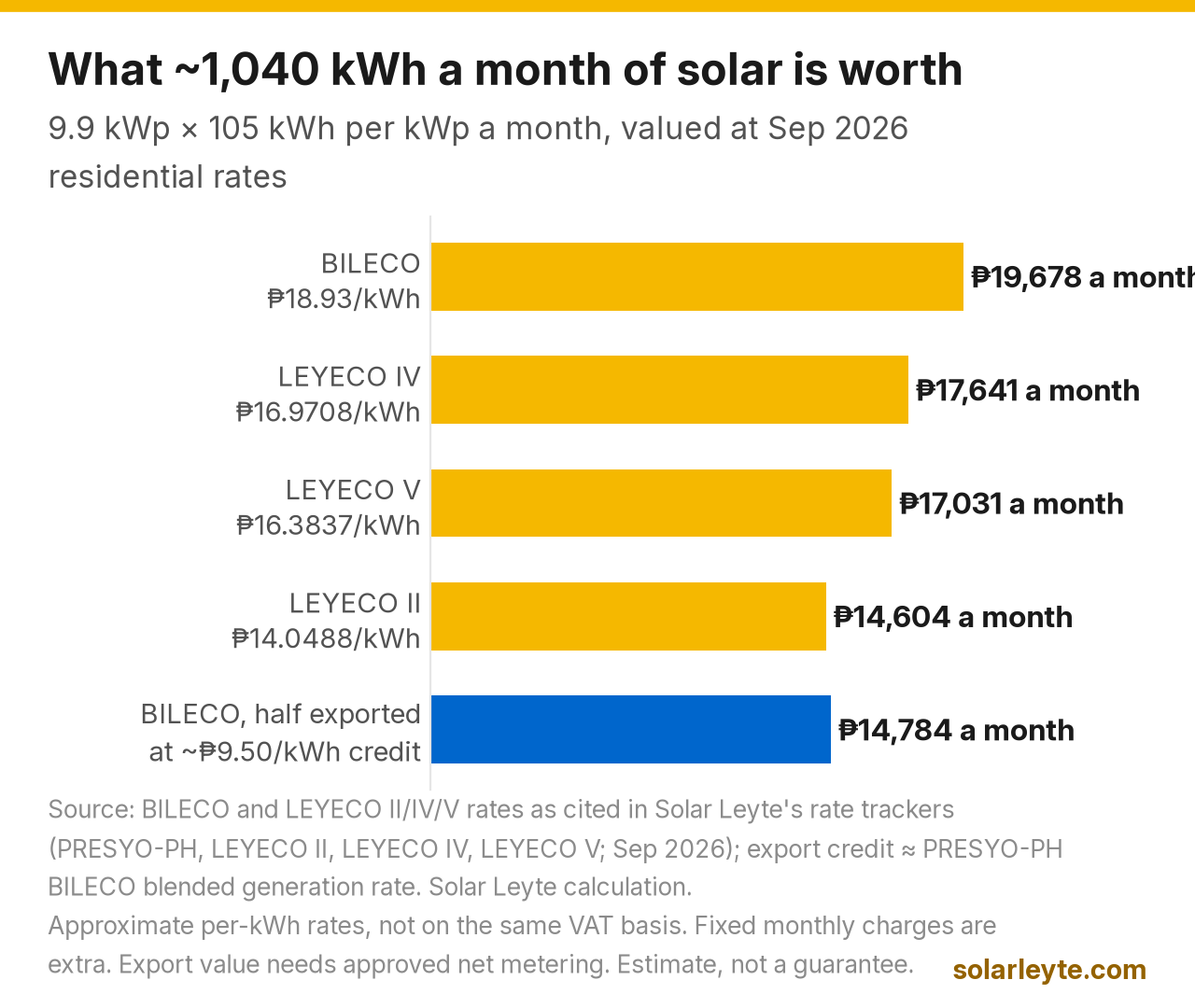
Most homes and shops don't use it all at home. A grid-tie system exports what you don't use, and under net metering exports earn a lower credit. At BILECO, with half used at home and half exported at about ₱9.50/kWh (approximately BILECO's blended generation charge, per PRESYO-PH for September 2026), the 9.9 kWp system is worth about ₱14,784 a month, or ₱177,408 a year (520 × ₱18.93 + 520 × ₱9.50, our calculation). Against the Phsolar 9.35–11 kWp grid-tie packages above (₱365,000 to ₱413,000), that's a simple payback of about 2.1 to 2.3 years, if rates hold. Three things to keep in mind. The export part only counts once BILECO approves your net metering application and swaps your meter. Export credits can only bring your bill down to zero, and any extra is carried over to the next month rather than paid out. And fixed charges stay on the bill whatever the panels produce. Rates may not hold either: BILECO moves every month. Our is solar worth it post runs the payback at lower rates, for evening-heavy homes, and for hybrids.
Who is 10 kW for? A large multi-aircon home, a sari-sari or refilling station with daytime load, a small resort, or a poultry/piggery with fans — not a typical 200–300 kWh/month bungalow. Check your bill: if you're already near 800–1,200 kWh a month, or you run daytime business loads, 10 kW is in the right conversation. Smaller homes usually land closer to 5 kW or 3 kW. Business load examples: water refilling stations, sari-sari stores, poultry and piggery.
How to compare two 10kW quotes
- Same size? Compare total panel watts (kWp), not "10 kW" on the cover page. Eighteen 550 W (9.9 kWp), eighteen 585 W (10.53 kWp) and eighteen 620 W (11.16 kWp) are not the same system.
- Brand and exact model for the panels, inverter and battery, with datasheets.
- Battery in usable kWh, not just the label Ah, and its warranty in years and cycles.
- Mounting: rail brand, how many roof attachments, and how they're fixed for typhoon winds.
- Protection: DC and AC surge protection, isolators, breakers and grounding listed as line items — and breaker amp rating matched to the inverter.
- What's included: installation, freight to your town, the electrical permit, net-metering application, monitoring.
- Warranties: product warranties from the makers, plus the installer's workmanship warranty, and who to call in Eastern Visayas.
- Production estimate: ask how many kWh a month they expect at your address, and what sun figure they used.
FAQ
How much is a 10kW solar system in the Philippines? On 14 October 2026, the parts for a ~10 kW (9.9 kWp) grid-tie system came to about ₱147,000 to ₱282,000 at Philippine sellers' listed prices. Complete grid-tie packages near that size were listed at ₱350,000 (8 kW) to about ₱365,000–₱413,000 (9.35–11 kWp). Hybrid packages with battery ran about ₱505,000–₱655,000 on one Cebu seller's 10.5 kW line (VAT exclusive).
How much is a 10kW hybrid solar system with battery? In parts, about ₱274,000 to ₱472,000 with ~10–12 kWh of LiFePO4 (two modules). Listed packages: ABC Solar Electronics 10.5 kW hybrids ₱505,000–₱655,000 (VAT exclusive, free installation per the flyer); GetSolar 10 kW with 16 kWh ₱565,000 all-in; Takiyo Business 10 kW listed ₱570,000 / from ₱650,000 after assessment.
How many panels are in a 10kW system? Eighteen 550 W panels make 9.9 kWp. ABC's 10.5 kW hybrids use eighteen 585 W panels (10.53 kWp). GetSolar's 10 kW hybrid uses eighteen 620 W panels (11.16 kWp). See how many solar panels do I need to size from your bill.
How many kWh does a 10kW solar system produce? About 1,040 kWh a month in Leyte and Biliran using our conservative 105 kWh per kWp. Shade, roof direction and weather change that.
Is 10kW too big for a house? For a typical 300–500 kWh/month home, yes — look at 5 kW first. For a large home with several aircons, or a shop/farm with daytime load near 800–1,200 kWh/month, 10 kW is a common size.
Why is a package so much more than the parts? Packages include labour, design, permits, delivery, small electrical items, warranty support and margin. Those don't show up in parts prices.
Solar Leyte is run by MACC Systems & Energy Solutions Inc., a solar installer in Naval, Biliran.
Get a free 10kW solar quote from MACC
Want an itemised price for your own roof or shop? Send us a photo of your latest BILECO or LEYECO bill and tell us whether you need brownout backup. We'll size the system, list every part by brand and model, and show you the savings math, with no obligation.
- Call/Text: 0955 723 5093
- Email: official@macc-inc.com or benjie@macc-inc.com
- Website: www.macc-inc.com
- Request a quote online: solarleyte.com/quote
- Office: Brgy. Talustusan, Naval, Biliran 6543
Sources (all checked 14 October 2026)
- Panels: ABC Solar Electronics, LVTOPSUN 550 W (₱4,200 via store product API excerpt) and AE SOLAR 550 W (₱6,700); Phsolar, Sunova 550 W and AE 550 W; Reflections Solar Solutions, AE Solar 530–550 W (MD-144)
- Grid-tie inverters: Phsolar, Solax 8 kW, Sunways 10.0 kWp and Megarevo 8 kW HOOG
- Hybrid inverters: ABC Solar Electronics, Deye 8.0 kW hybrid (₱72,000); Beyond Hygiene Asia, Hopetrek SUN-SL-HP10K-A1 (₱98,500 VAT incl.); Phsolar, Deye hybrid variants (8 kW ₱99,000; 12 kW ₱150,000)
- Batteries: LakaSolar, ONE SOLAR HIGEE120 51.2 V 120Ah; Beyond Hygiene Asia, Hopetrek ESS-LB5-W01
- Mounting (Reflections Solar Solutions, checked 14 Oct 2026): PV aluminium rails, L foot, mid clamp, end clamp, splice kit
- Cable and protection: Reflections Solar Solutions, DC solar PV cable, Taxnelle DC SPD, Himel 2-pole breaker, distribution box and DC MCCB 250 A; LakaSolar, MC4 connector pair, IP66 DC isolator, Suntree AC isolator and 25 mm² battery cable
- Packages: ABC Solar Electronics package flyers on 10.5 kW hybrid (1×200Ah), 1×300Ah, 2×200Ah, 2×300Ah, 8.0 kW grid-tie and 8.1 kW hybrid (raw copies in `raw/10kw-solar-2026-10-14/`); Phsolar, Complete Package – Grid Tie; GetSolar Philippines, store / 10 kW hybrid; Takiyo Japan, Takiyo Business 10 kW
- Rates and production: Solar Leyte, BILECO rate tracker (PRESYO-PH, Sep 2026), LEYECO IV and V tracker and LEYECO II tracker; ICSC, PRESYO-PH; production planning figure from our panel sizing guide (Global Solar Atlas, Naval, Biliran)
- Regulation: DOE, DC2026-08-0017 (zero-export and micro-solar)