Short answer: A microinverter is a small inverter that sits under one, two or four solar panels on your roof and turns their DC into 230 V AC right there. On 27 October 2026, unbranded grid-tie micro-inverters on Lazada cost about ₱3,600 to ₱5,300 for 600 to 1,000 W units. Branded ones (Enphase, APsystems, Hoymiles, Deye) had no public Philippine peso price that we could find, so you buy them through distributors or installers. For a simple, unshaded roof facing one direction, one string inverter is usually cheaper. Micros earn their keep when part of your roof gets shade from coconut trees or a neighbour's house, when panels face different directions, or when you want to start small and add panels later.
One thing doesn't change: a microinverter system with no battery still goes dark during a BILECO or LEYECO brownout, same as a string grid-tie inverter.
Prices checked 27 October 2026 (Philippine time) on the seller pages linked below. They change often. Listing a product isn't an endorsement, and Solar Leyte earns nothing from these links. No MACC prices appear in this post.
What a microinverter does (and how it differs from a string inverter)
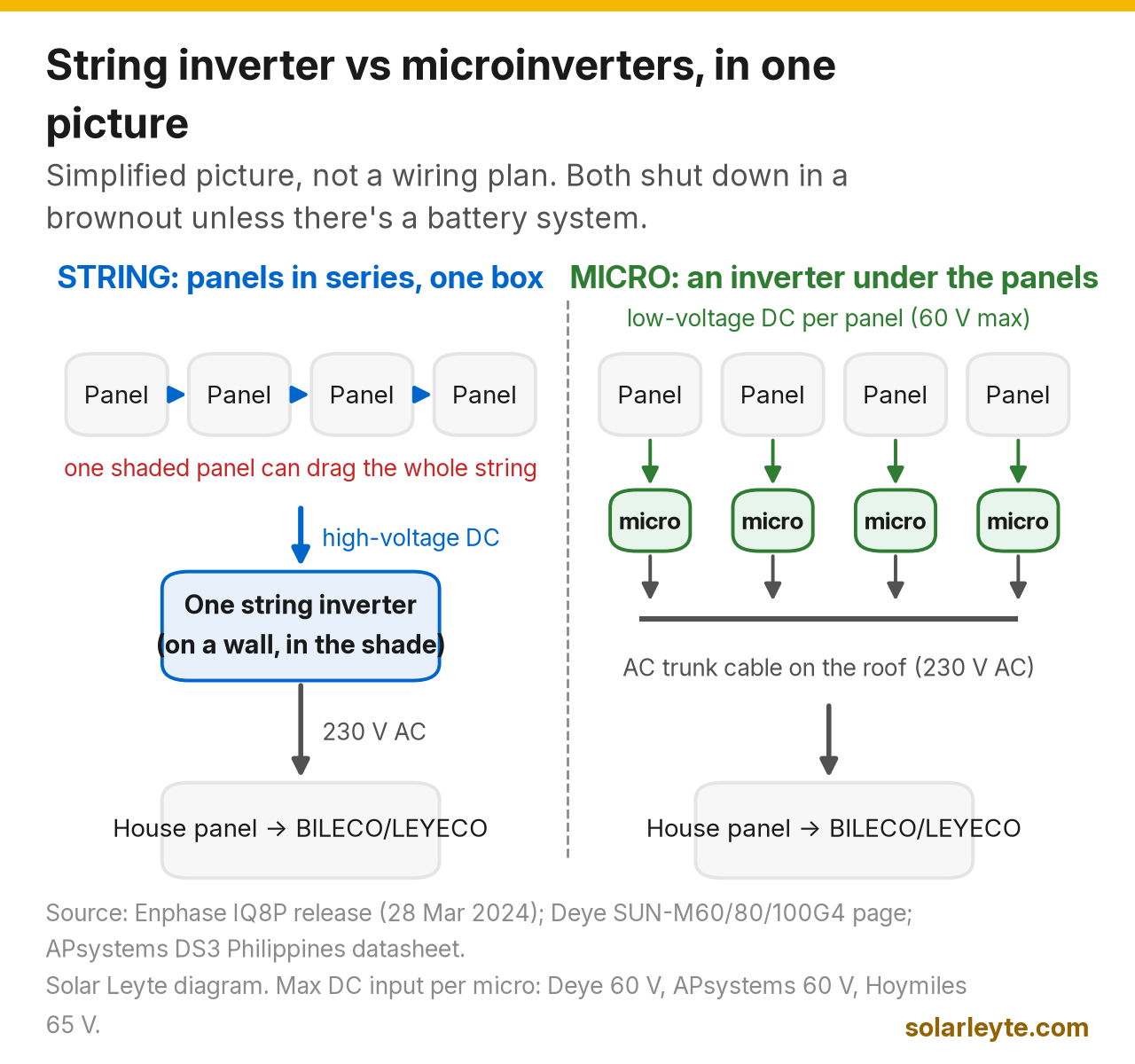
With a string inverter, your panels are wired in series into one long DC string that runs down to a single box on the wall. Enphase describes the difference simply: microinverters "use low-voltage alternating current (AC) power instead of high-voltage direct current (DC) power like central ('string') inverter-based solar systems" (Enphase, 28 Mar 2024).
With microinverters, each panel (or each group of two to four panels) has its own inverter and its own MPPT tracker. So:
- A shaded or dirty panel only drags itself down, not the whole string.
- You can see each panel's output in the app. Deye, for example, lists "module level monitoring" on its SUN-M series (Deye SUN-M60/80/100G4).
- The DC on your roof stays low. Deye's micro accepts a maximum of 60 V DC per input, and APsystems' DS3 is also 60 V (APsystems DS3 Philippines datasheet).
- Every unit lives on the roof, under the panels, in the heat and the typhoon wind. If one fails, someone has to go up and unbolt panels to swap it.
Both types are grid-tie. Both must shut off when the co-op line goes dead (anti-islanding). Deye lists "Anti-islanding Protection: YES" for its micros. If you need lights during brownouts, read grid-tie vs hybrid solar first.
Microinverter brands sold in the Philippines: what the datasheets say
Brand / model | Panels per unit | AC output | Max DC input voltage | Warranty (as published) | Philippine channel |
|---|---|---|---|---|---|
Enphase IQ8P | 1 | 480 W peak | See Enphase datasheet | 15-year limited, if activated in the Philippines | SolidGreen, Brills, UES, Spectrum (Enphase PH distributor page) |
APsystems DS3 (Philippines version) | 2 | 880 VA (DS3-L: 730 VA) | 60 V | 12 years standard; unit must be monitored on APsystems' EMA portal | No public PH price found |
Hoymiles HMS-2000-4T | 4 | 2,000 VA | 65 V | 12 years (Hoymiles' Europe terms; no Philippine terms published) | Brills / Vector Energy, per GoSolarPH (no public price found) |
Deye SUN-M80G4 / M100G4 | 2 | 800 W / 1,000 W | 60 V | 15 years | No PH listing found; EU store price below |
EcoFlow PowerStream | 2 inputs + battery port | 600 W or 800 W, by version | 55 V | Check seller | ecoflowpower.ph |
Sources: Enphase IQ8P launch, 28 Mar 2024; Enphase Philippines distributor page; APsystems DS3 Philippines datasheet, Rev 1.3; Hoymiles HMS-1600/1800/2000-4T datasheet and Hoymiles warranty terms (Europe); Deye SUN-M60/80/100G4 page; EcoFlow PowerStream user manual V1.1.
What stands out:
- Enphase is the only brand we found with a Philippines-specific warranty statement (15 years for IQ8P units activated here) and named Philippine distributors. Ask whoever quotes you to prove they buy through one of those four.
- APsystems publishes a Philippines datasheet (60 Hz, 240 V nominal), but its warranty needs the units to be monitored through its EMA portal. Without Wi-Fi at the house, you could lose the warranty.
- Hoymiles and Deye publish Europe-region documents. That's fine for checking specs, but get the Philippine warranty terms in writing from the seller.
Microinverter prices in the Philippines (27 October 2026)
On Lazada (unbranded or lesser-known brands)
Listing (as named by seller) | Rated output | Seller | Listed price | ₱ per W |
|---|---|---|---|---|
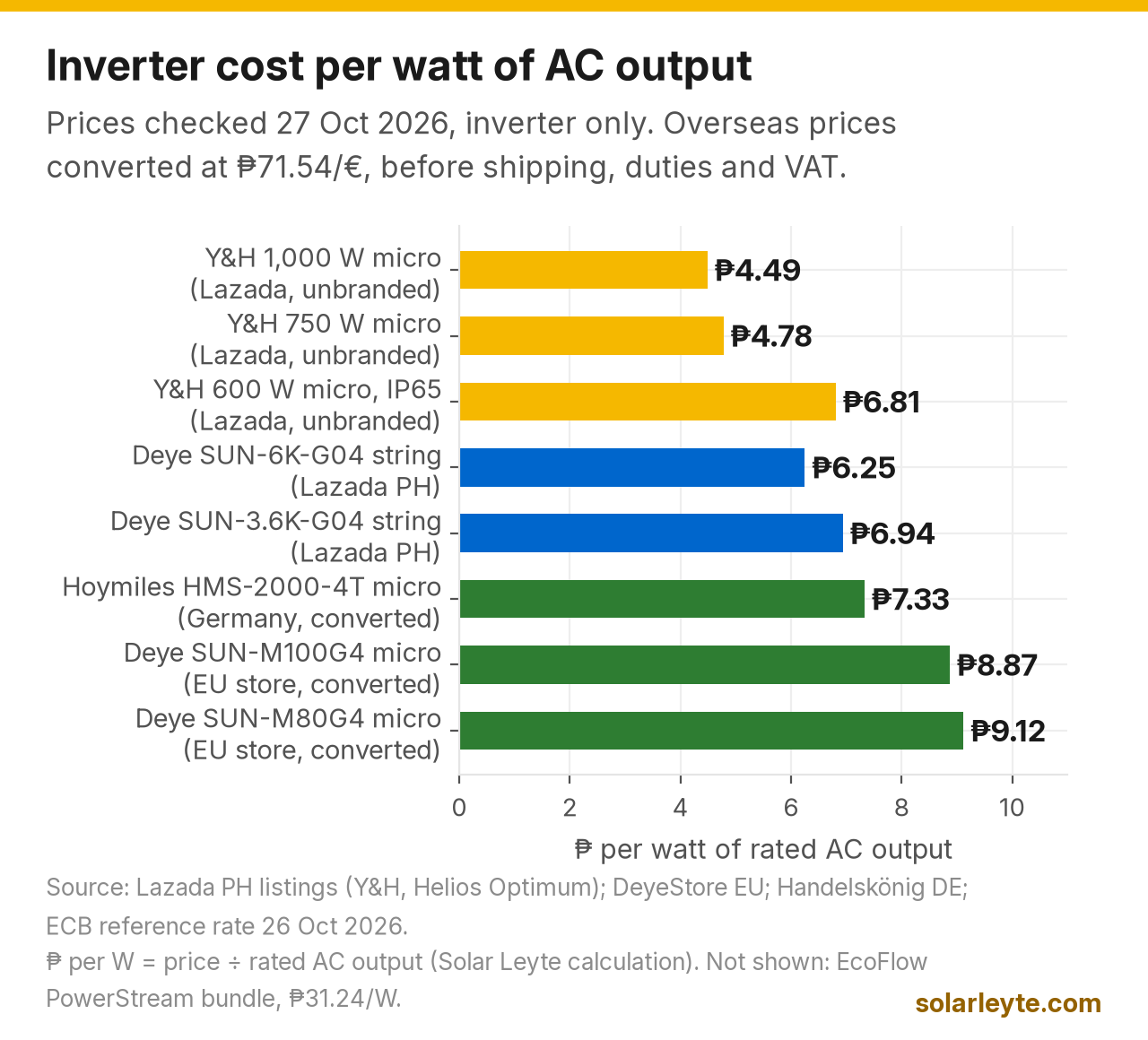
750 W | Live Streaming | ₱3,586 | ₱4.78 | |
600 W | Y&H Solar Store | ₱4,086 | ₱6.81 | |
1,000 W | Y&H Solar Store | ₱4,486 | ₱4.49 | |
500–700 W | ROEXBY Solar Store | from ₱5,265 | n/a (variant not shown) |
"₱ per W" is listed price ÷ rated output (Solar Leyte calculation). Prices are the current (sale) figure shown on Lazada search on 27 October 2026.
Before you buy one of these: the Y&H 600 W unit is listed as IP65, while Deye, Hoymiles and EcoFlow list IP67 for their micros. The ROEXBY title mentions "AC 120V 240V", so check you're getting the 230 V version. Philippine homes run on 230 V ±10% at 60 Hz under the Philippine Distribution Code (Meralco, Understanding Power Quality). Our Lazada and Shopee buying guide covers returns, fake specs and seller checks.
EcoFlow PowerStream (Philippine reseller)
ecoflowpower.ph listed the PowerStream + Super Flat Cable + Smart Plug bundle at ₱24,990 (was ₱29,990) on 27 October 2026. That's about ₱31.24 per watt for the 800 W version (Solar Leyte calculation), but the price includes the cable and smart plug. The same page sells it bundled with a DELTA 2 power station for ₱69,980. PowerStream can charge from and discharge to an EcoFlow power station through its battery port, and it comes in 600 W and 800 W output versions (user manual V1.1).
Check this first: the PowerStream manual we read lists an output frequency of 50 Hz, and the bundle's smart plug is labelled "EU Only". The Philippine grid is 60 Hz. Ask the seller in writing whether the unit they ship is rated for 60 Hz before you pay.
Branded micros: no public peso price
We found no Philippine peso price for Enphase, APsystems, Hoymiles or Deye micros, and the first page of Lazada results for "hoymiles" on 27 October 2026 showed only cables, connectors and other brands' inverters. For a rough idea, here are overseas store prices converted at the ECB reference rate of ₱71.54 per euro (26 October 2026). These are not Philippine prices. Add shipping, duties, VAT, the gateway or Wi-Fi stick, cables and installer margin.
Model | Store (country) | Price | About in pesos | ₱ per W AC |
|---|---|---|---|---|
DeyeStore (EU), excl. VAT | €102 | ₱7,297 | ₱9.12 | |
DeyeStore (EU), excl. VAT | €124 | ₱8,871 | ₱8.87 | |
Handelskönig (Germany), 0% VAT | €204.95 | ₱14,662 | ₱7.33 |
Peso and ₱/W figures are Solar Leyte calculations (ECB euro reference rates).
For comparison, Helios Optimum listed a Deye SUN-3.6K-G04 3.6 kW on-grid string inverter at ₱25,000 (about ₱6.94 per W) and a Deye SUN-6K-G04 6 kW at ₱37,500 (₱6.25 per W) on Lazada the same day. More string prices are in our grid-tie inverter price guide.
Worked example: six panels, micro vs string (example only)
Assumptions: six 550 W panels (3.3 kWp) on one roof. Inverter hardware only, at the prices above. No panels, rails, breakers, cable, gateway, shipping, duties or labour. Your quote will be different.
String option | Microinverter option | |
|---|---|---|
Hardware | 1 × Deye SUN-3.6K-G04 (3.6 kW) | 3 × Deye SUN-M100G4 (2 panels each, 1,000 W AC each) |
Price basis | ₱25,000 (Lazada PH, 27 Oct) | 3 × €124 = €372 ≈ ₱26,613 (EU store, excl. VAT, before shipping and duties) |
Where it sits | On a wall, in the shade | On the roof, under the panels |
Per-panel monitoring | No | Yes |
If one panel is shaded | Can pull down the whole string | Only that panel's MPPT input is affected (each M100G4 has two) |
If the inverter fails | One box to swap at ground level | One unit to swap, on the roof |
What it shows: even before import costs, the micro option's hardware costs about the same as the string inverter in this example. Once you add shipping, duties, VAT and a local margin, micros will usually cost more. You pay the extra to get shade tolerance and per-panel monitoring. On a clear, single-direction roof you're paying for something you won't use much.
When microinverters make sense in Leyte and Biliran
Good fit:
- Partly shaded roofs. A coconut tree, a water tank or a neighbour's second floor shades some panels for part of the day.
- Roofs facing two or three ways, like an east-west roof or a hip roof, where one string would mix panels that peak at different times. Our tilt and direction guide explains why direction matters.
- Starting small. You can add a pair of panels and one more micro later instead of buying a big inverter now.
- Plug-and-play micro-solar. DOE's 2026 rules have a notice-only path for small kits of up to 1 kW of panels with an 800 W micro-inverter. A two-panel, 800 W micro like the Deye SUN-M80G4 is that size. The rules, the co-op notice and what you give up are in our plug-and-play and zero-export post.
Poor fit:
- You mainly want brownout backup. Micros alone stop when the grid drops. For backup you need a hybrid inverter and a battery. See hybrid inverter prices, or the EcoFlow route, which works with its own power stations.
- Big, unshaded, single-direction roofs. One string inverter is simpler and usually cheaper.
- Houses with no stable Wi-Fi, if the brand's warranty depends on monitoring (APsystems says it does).
Heat, typhoons and salt air: what to ask
- Heat: Deye says its micros derate above 45 °C ambient. APsystems says its units "may enter power de-grade mode under poor ventilation". Ask the installer to leave a gap under the panels so air can flow.
- Wind: the micro is bolted to the same rails as the panels. Our lightning and surge protection guide covers grounding, which matters more when there are many electronics on the roof.
- Branch limits: each AC branch takes only so many units. That's 5 Deye M100G4s, 3 Hoymiles HMS-2000s on a 10 AWG branch at 230 V, or 7 to 9 APsystems DS3s depending on wire size. Ask for the branch layout in the quote.
- Replacement: ask who climbs up and swaps a failed unit, how long it takes, and who pays for shipping.
Frequently asked questions
Is a microinverter better than a string inverter?
Not always. It's better on shaded or multi-direction roofs and when you want per-panel monitoring. On a simple roof, one string inverter usually costs less per watt and is easier to service.
Gagana ba ang microinverter kapag brownout?
Hindi, kung walang battery. Like any grid-tie inverter, it shuts down when BILECO or LEYECO power is off (anti-islanding), even under full sun.
How much is a microinverter in the Philippines?
On 27 October 2026, unbranded 600–1,000 W units on Lazada were ₱3,586–₱4,486, and one listing started at ₱5,265. The EcoFlow PowerStream bundle was ₱24,990 at ecoflowpower.ph. We found no public peso price for Enphase, APsystems, Hoymiles or Deye micros.
Can I connect a microinverter myself to my house wiring?
A small micro-solar kit can use DOE's notice-only path, but it still has to meet the rules: up to 1 kW of panels, an 800 W factory-set grid-tied inverter with anti-islanding, and a proper outlet or circuit. See our plug-and-play guide before you plug anything in. Bigger systems fall under the zero-export or net-metering rules explained in that post, including permits.
Can I add a battery later?
With most micros you'd add an AC-coupled battery system or switch to a hybrid design. EcoFlow PowerStream is the exception: it has a battery port for EcoFlow power stations. Ask your installer before you buy, so you don't pay for the inverter twice.
Solar Leyte is run by MACC Systems & Energy Solutions Inc., a solar installer in Naval, Biliran.
Get a free solar quote from MACC
Not sure whether micros or one string inverter suit your roof? Send us a photo of your roof and your last BILECO or LEYECO bill. We'll show you the options with every model number and datasheet, and there's no obligation.
- Call/Text: 0955 723 5093
- Email: official@macc-inc.com or benjie@macc-inc.com
- Website: www.macc-inc.com
- Request a quote online: solarleyte.com/quote
- Office: Brgy. Talustusan, Naval, Biliran 6543
Sources (all checked 27 October 2026)
- Enphase, IQ8P launch in Thailand and the Philippines (28 Mar 2024): 480 W peak, modules up to 640 W DC, 15-year limited warranty for units activated in the Philippines, low-voltage AC vs high-voltage DC.
- Enphase, Philippines distributor page: links to Spectrum, SolidGreen (solid.ph), Brills and UES.
- APsystems, DS3 series datasheet for the Philippines, Rev 1.3 (4 Mar 2025): 730/880 VA, 60 V max input, 240 V/60 Hz, 12-year standard warranty with EMA monitoring, units per branch.
- Hoymiles, HMS-1600/1800/2000-4T datasheet (Europe, V202402) and Limited Warranty Terms (Europe): 2,000 VA, 65 V, IP67, 12-year warranty for HMS models.
- Deye, SUN-M60/80/100G4-EU-Q0 product page: 600/800/1,000 W, 60 V max input, 60 Hz setting, IP67, derating above 45 °C, anti-islanding, 15-year warranty, units per branch.
- EcoFlow, PowerStream microinverter user manual V1.1: 55 V PV input, battery port, 600 W and 800 W versions (EFWN511B/EFWN511), 50 Hz output, IP67.
- GoSolarPH (third-party), Where to buy Hoymiles in the Philippines: Brills Marketing / Vector Energy Solutions as the Hoymiles channel; no published PH price or warranty terms.
- Prices: ecoflowpower.ph PowerStream bundle; Lazada listings for Y&H 750W, Y&H 600W, Y&H 1000W, ROEXBY 500–700W, Deye SUN-3.6K-G04 and Deye SUN-6K-G04; DeyeStore EU SUN-M80G4 and SUN-M100G4; Handelskönig HMS-2000-4T.
- Exchange rate: ECB euro foreign exchange reference rates, 26 October 2026 (1 EUR = 71.540 PHP).
- Grid standard: Meralco, Understanding Power Quality, citing the Philippine Distribution Code (60 Hz, 230 V ±10%).