Short answer: for most solar homes in Leyte and Biliran, the real lightning risk isn't a direct hit on the panels. It's the surge from a strike nearby, or one that comes in on the power line, and it goes straight for the inverter. The fix is cheap compared with what it protects: surge protective devices (SPDs) on the DC side and the AC side, plus a proper ground. In Philippine shops a solar DC SPD costs about ₱600 to ₱1,000 and an AC SPD about ₱500 to ₱600. A full lightning rod system is a separate decision. No Philippine rule we found requires one on a house, and solar panels don't make a strike more likely.
Thunderstorms here aren't occasional. PAGASA's Tacloban station averages 108 thunderstorm days a year, and about three quarters of them fall between May and October.
Last checked: 18 October 2026. This is a plain-English guide based on the standards, codes and datasheets listed under Sources. It's not an electrical design. Rooftop and panel-board work needs a licensed electrician, and protection for a specific house is your installer's or engineer's call.
How often lightning comes to Leyte and Biliran
PAGASA publishes 30-year averages (1991–2020) for its weather stations. Naval has no synoptic station, so Tacloban, about 70 km away, is the closest guide for Biliran.
PAGASA station | Thunderstorm days a year | Days with lightning seen | Busiest months |
|---|---|---|---|
Tacloban City, Leyte | 108 | 79 | May–Oct (12–15 thunderstorm days a month) |
Catarman, Northern Samar | 78 | 45 | May–Jun |
Borongan, Eastern Samar | 61 | 37 | Jun, Sep |
Catbalogan, Western Samar | 58 | 18 | Jun |
Maasin, Southern Leyte | 52 | 141 | Jun–Oct (lightning) |
Guiuan, Eastern Samar | 52 | 123 | Jun–Oct (lightning) |
Source: PAGASA climatological normals 1991–2020, columns 16a (thunderstorm) and 16b (lightning). A thunderstorm day means thunder was heard at the station. Lightning can be seen from much farther away than thunder can be heard, and station practice varies, so compare the thunderstorm column.
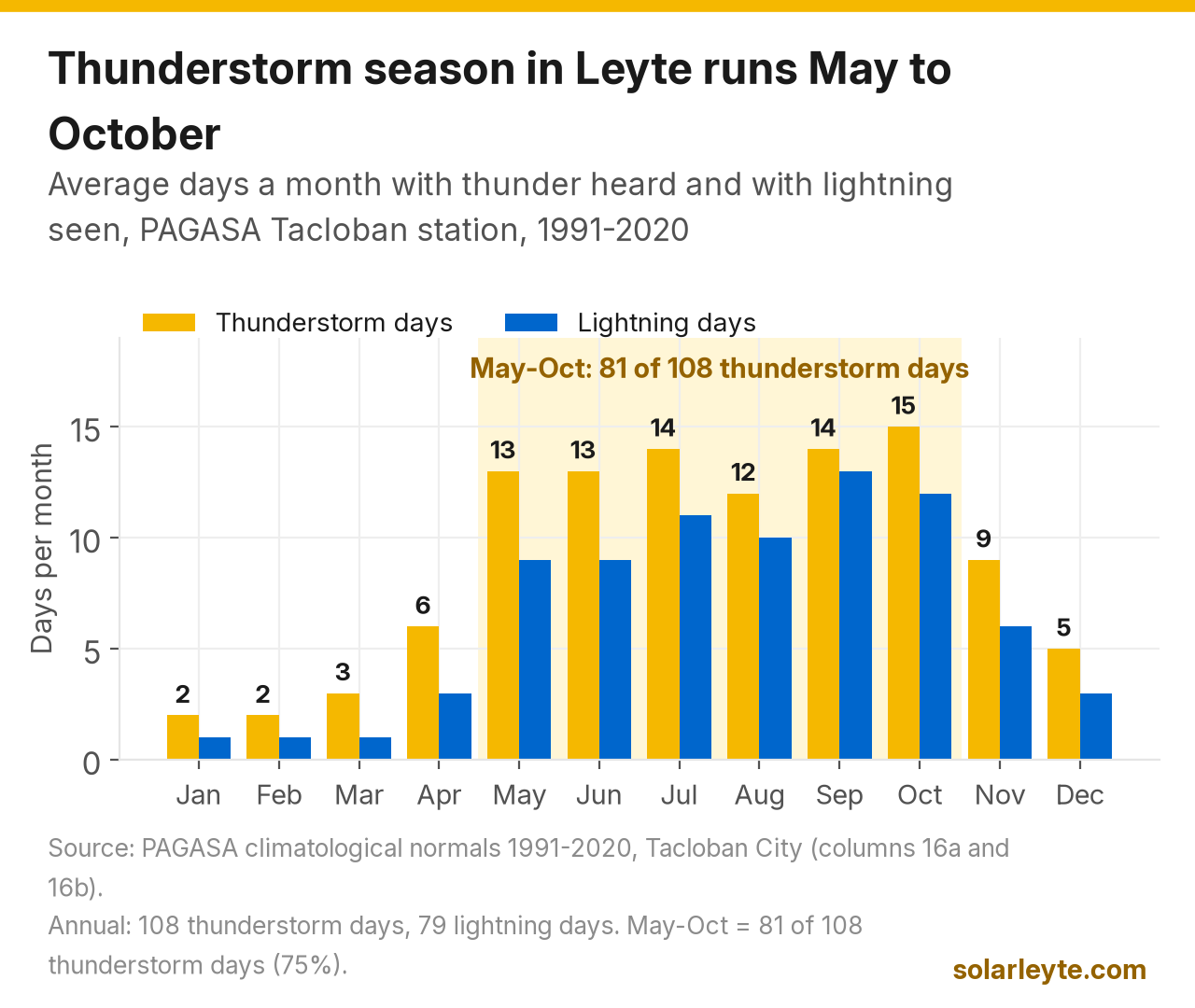
January and February average only 2 thunderstorm days each at Tacloban; October averages 15. Thunderstorm season overlaps typhoon season, so April is a good time to get surge protection checked.
No one publishes a measured ground-flash map for Leyte. Engineers' rules of thumb based on Tacloban's 108 thunderstorm days give roughly 11 to 14 ground flashes per square kilometre per year. That's an estimate, not a measurement. For comparison, Vaisala's network counted 56.59 lightning events per km² across the whole Philippines in 2021, tenth highest in the world, but that count includes cloud-to-cloud flashes.
Do solar panels attract lightning?
No. DEHN, one of the big lightning-protection manufacturers, says that according to current technical knowledge, installing PV modules does not increase the risk of a lightning strike. What panels do add is a long run of cable from the roof down to the inverter. A nearby strike can induce a big voltage spike in that cable loop, and a strike on the distribution line can push a surge into your house through the service entrance. Both arrive at the inverter, the most expensive electronic part of the system.
Example: how often would lightning hit a typical house directly?
This is a rough screening example with our assumptions, not a risk assessment.
- House: 10 m × 8 m, 5 m to the top of the roof, among houses of similar height.
- Method: the collection-area formula in NFPA 780 Annex L (area = L×W + 6H(L+W) + 9πH²), which gives about 1,327 m².
- Ground flashes: 11 to 14 per km² per year (the Tacloban estimate above).
Result: about one direct strike every 110 to 140 years. For the same house standing alone, say on a farm lot or hillside with nothing within three times its height, it's about once every 55 to 70 years.
So the strike that kills an inverter is usually not on your roof at all. At 11 to 14 ground flashes per km² a year, your barangay gets hit many times every season. That's what SPDs are for.
What a surge protector (SPD) does, and the types
An SPD sits in parallel with the circuit and does nothing until the voltage spikes. Then it sends the surge to ground in nanoseconds. Most use metal-oxide varistors that wear out after big hits, which is why good ones have a status window: green is good, red means replace (ABC Solar's Cooper Suntree listing describes exactly this).
- Type 2 is the normal choice for a house without a lightning rod system. It's rated with an 8/20 µs surge wave.
- Type 1 is rated for part of a direct lightning current (10/350 µs wave). DEHN says you need it on the DC side when the house has an external lightning rod system and the panels can't be kept the required separation distance from it.
- Inverters already have some built in. Deye's SUN-3.6–8K-SG05LP1 datasheet lists "TYPE II (DC), TYPE II (AC)". Sungrow's SH-RS and SRNE's HESP datasheets list the same class. But Deye's own manual still asks for a PV junction box with surge protection, "otherwise, it will cause damage on inverter when lightning occurs on PV modules."
So built-in protection is a last line, not the whole plan. An external SPD is cheaper to replace than an inverter board, and you can see its status.
Where the SPDs go on a home solar system
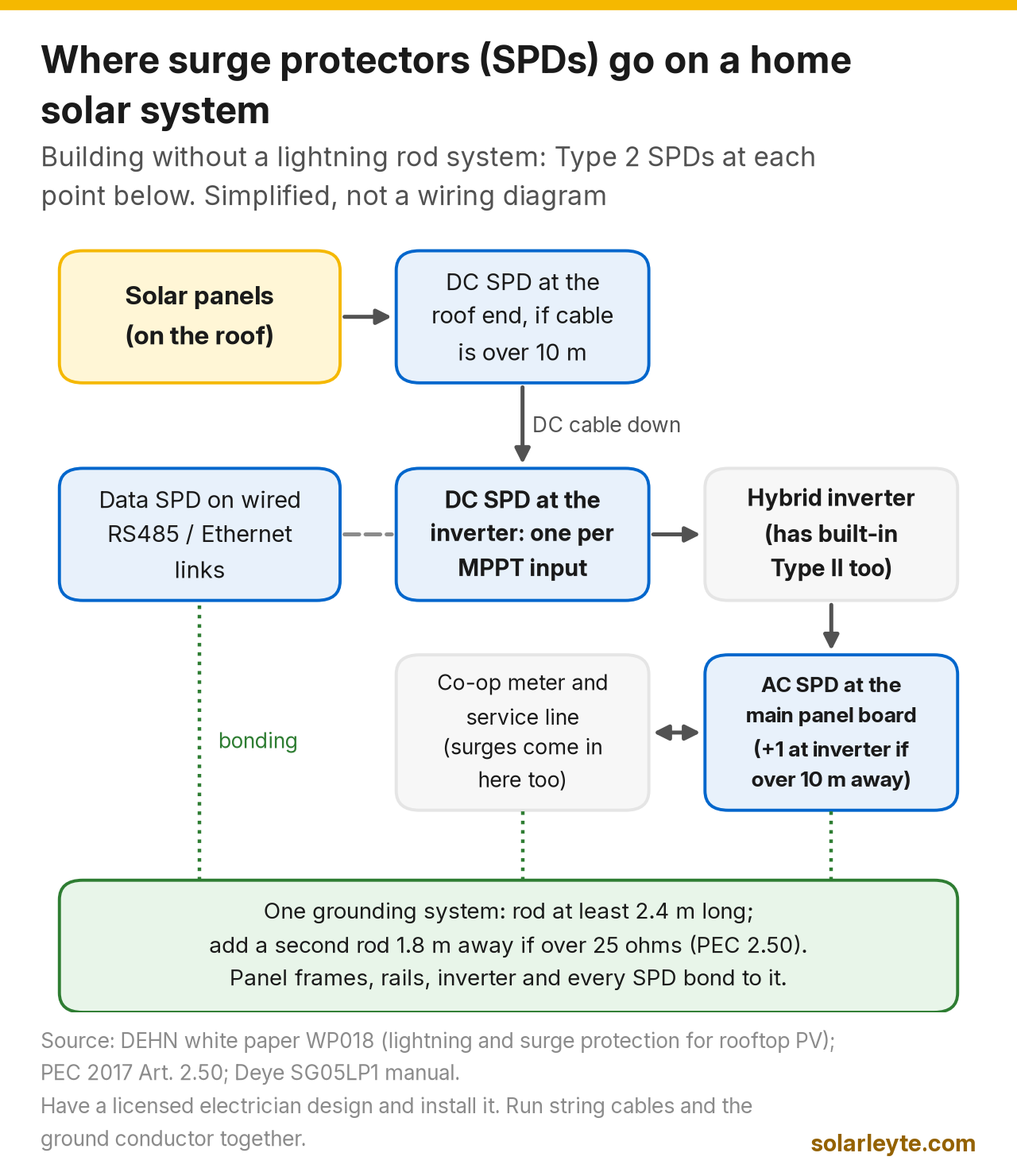
DEHN's recommendation for a building without a lightning rod system is Type 2 SPDs at:
- The DC input of the inverter. Every MPPT input that has panels on it gets its own protection.
- The panel end of the DC cable too, if the cable between the array and the inverter is longer than 10 m.
- The AC side at the main panel board, plus one at the inverter's AC output if the inverter is more than 10 m from that board.
- Wired data links to the inverter, such as RS485 or Ethernet.
Cable routing matters too. DEHN says to avoid large loops: run the string cables and the grounding conductor together along the whole route.
How to read an SPD label
Spec on the label | What to check | Why |
|---|---|---|
Uc (max continuous voltage), DC | At least your string's highest open-circuit voltage; matching the inverter's max PV input voltage gives margin | Too low and the SPD conducts in normal operation and fails |
Uc, AC | 275 V is the common rating for a 230 V supply | Matches the listings in the price table |
In / Imax (8/20 µs) | 20 kA nominal / 40 kA max is common for Type 2 | Higher means it survives more or bigger surges |
Up (protection level) | Lower than what the inverter can withstand; Littelfuse suggests about 20% lower | That's the voltage the inverter still sees during a surge |
Short-circuit rating | Higher than the string's short-circuit current | Needed for a safe failure |
Status window / thermal disconnect | Have one | You'll know when it's used up |
Worked example (our numbers): eight Jinko JKM580N-72HL4-BDV panels in one string are 8 × 52.50 V = 420 V open-circuit at 25°C, and about 425 V on a cool 20°C morning (the datasheet's −0.25%/°C). A Deye 5 kW SG05LP1 accepts up to 500 V of PV input. So the DC SPD should have Uc of at least about 425 V. A 500 V or 600 V DC SPD works, and the 600 V parts in the table give the most margin.
What surge protection and grounding cost in the Philippines
Item (seller, listing checked) | Rating | Price |
|---|---|---|
DC SPD 2P (Phsolar, 18 Oct 2026) | 600 V, 16 kA | ₱200 |
Taxnelle DC SPD (Reflections Solar Solutions, 18 Oct 2026) | PV, MOV with thermal disconnect | ₱600 |
Cooper Suntree DC SPD SUP2-PV (ABC Solar Electronics, 18 Oct 2026) | 500 V DC, 2P, status flags | ₱900 |
DC SPD 2P (Solar Hub PH, 18 Oct 2026) | 600 V, In 20 kA, Imax 40 kA, Up 2.4 kV | ₱1,020 (was ₱1,200) |
AC SPD 2P (Solar Hub PH, 18 Oct 2026) | 275 V, In 20 kA, Imax 40 kA | ₱500 (was ₱980; out of stock) |
AC SPD SUP1-C 2P (ABC Solar Electronics, 18 Oct 2026) | 230 V, Class C | ₱600 |
Copper-plated ground rod 5/8" × 1 m (Electx, 18 Oct 2026) | Too short for the PEC (see below) | ₱450 |
Shieldcon copper-bonded ground rod 5/8" × 3 m (Electx, 18 Oct 2026) | 15.88 mm, 3 m | ₱1,265 |
Copper-plated ground rod 16 mm × 3 m (Electx, 18 Oct 2026) | 3 m | ₱1,350 |
Prices are online listings and change often. They don't include the enclosure, DIN rail, fuses or breakers, wire, clamps or labour.
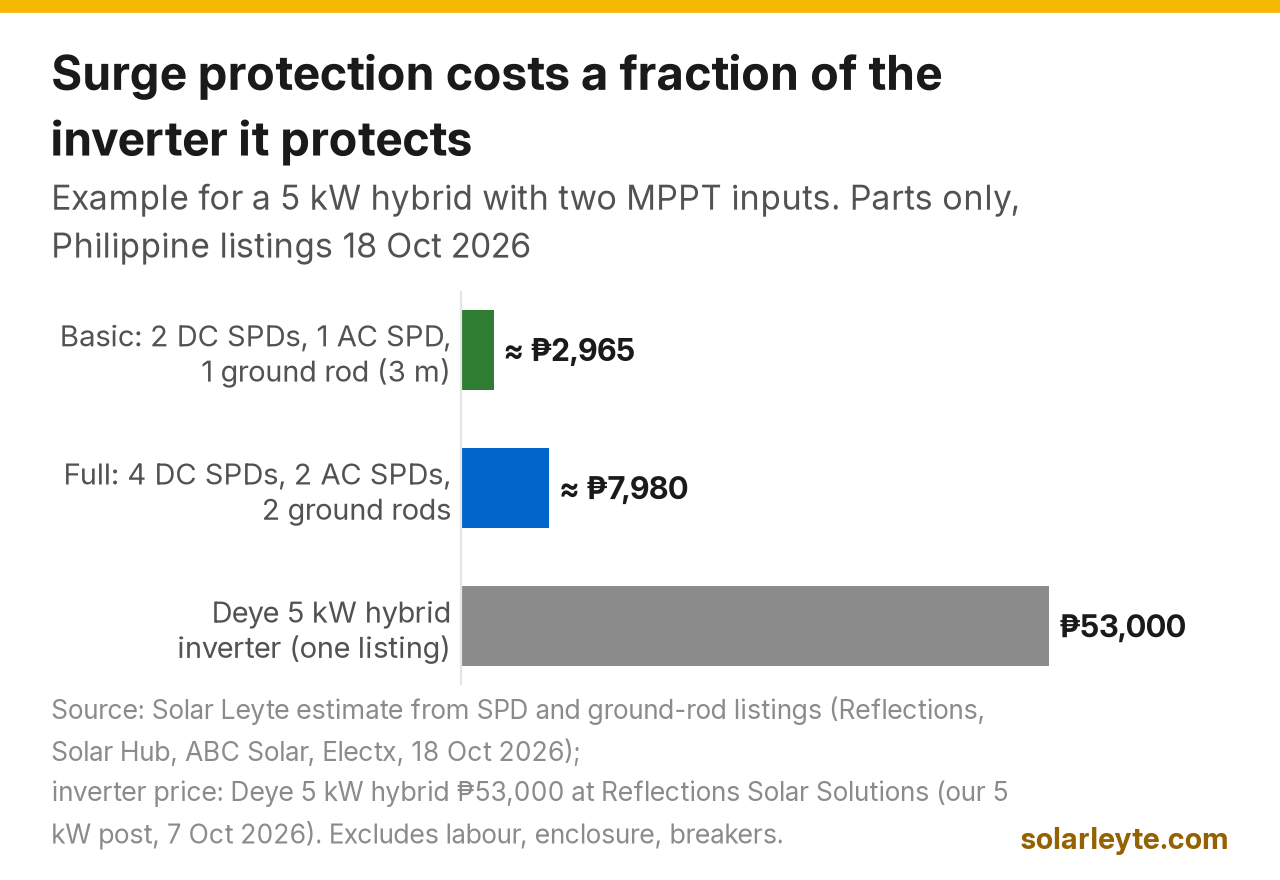
Worked example (our estimate, parts only): for a 5 kW hybrid with two MPPT inputs, a basic setup is two DC SPDs at the inverter, one AC SPD and one 3 m ground rod: about ₱3,000. Add two more DC SPDs at the roof end for a long cable run, a second AC SPD and a second rod for poor soil, and it's about ₱8,000. Our 5 kW price post found a Deye 5 kW hybrid inverter listed at ₱53,000, so the protection parts come to roughly 6% to 15% of the inverter alone.
Grounding: what the Philippine Electrical Code says
An SPD only works if the surge has a good path to earth. The PEC 2017 Part 1 (still the current edition) sets the basics in Article 2.50:
- Rod length: a ground rod must be at least 2,400 mm long and have at least 2,400 mm in contact with the soil. That 1 m rod sold online doesn't meet it on its own.
- Rod size: iron or steel rods at least 16 mm thick; listed copper or stainless rods at least 13 mm.
- 25 ohms: a single rod that doesn't reach 25 ohms or less to ground must get one more electrode, at least 1,800 mm away.
- One ground system: if a lightning rod system is installed, its ground terminals must be bonded to the house's grounding electrode system, not left as a separate "lightning ground".
- Solar frames: the PEC's solar article (6.90) has the module frames bonded together and to the equipment grounding conductor.
Deye also calls the inverter earth connection "mandatory". It also warns not to connect PV+ or PV− to the ground bar, because grounded PV wiring causes leakage faults.
Ask your installer to measure the ground resistance and write it on your handover papers. Sandy coastal soil and rocky hillsides give very different readings.
Do you need a lightning rod for your solar?
For most houses, SPDs and good grounding come first, and a lightning rod system (air terminals, down conductors and grounding) is optional. AEDO Construction searched the Fire Code and Building Code rules and found no requirement for one on ordinary houses.
It's worth a proper look, with a risk assessment by an electrical engineer, if:
- The house or farm building stands alone on a hill, open field or shoreline, with nothing taller nearby.
- It's a resort, school building, poultry house or warehouse with many people, animals or stock inside.
- There's a tall water tank, antenna or tower on the roof.
If you do install one, the panels must sit inside its protected zone and keep a separation distance from its conductors. The PEC's note gives a typical 1,800 mm through air. If that can't be kept, DEHN says the DC side needs Type 1 SPDs. For cost, AEDO's 2026 planning estimate for a basic conventional system on a 10 × 8 m house is about ₱70,000 to ₱130,000. That's a planning range, not a quote.
Warranties and insurance after a lightning hit
Deye's warranty terms exclude damage from "floods, lightning, overvoltage, storms" as force majeure. Solis and SRNE list lightning (and Solis, power surges) as exclusions too. Our Deye vs Solis vs SRNE comparison has the exact wording.
Home insurance isn't automatic either. The standard fire-policy conditions we read exclude damage to electrical equipment from short-circuiting, arcing or leakage of electricity "from whatever cause (lighting included)", unless a fire follows. Our solar panel insurance guide explains what to ask your insurer.
So the SPDs may be the only protection you actually have.
After a thunderstorm: a quick checklist
- Look at the SPD status windows in the DC and AC boxes from the front, without opening anything. Red, or an indicator that has flipped, means call your installer to replace the module.
- Check the inverter display or app for faults. Insulation and grid faults after a storm are common. Our Deye error code guide explains the usual ones.
- If the inverter is dead or smells burnt, switch off the AC and DC isolators in the order your installer gave you, take dated photos and call the installer before anyone opens it.
- Don't touch the system or climb the roof while a storm is overhead. The same goes for our typhoon checklist: inspect from the ground first.
Questions to ask your installer
- Which SPDs (Type, Uc, Imax) are on my DC and AC sides, and is there one at the roof end?
- What ground resistance did you measure, and is it on my papers?
- Who replaces an SPD after a storm, and what does it cost?
Our installer checklist and electrical permit and CFEI guide cover licensing and paperwork.
FAQ
Do solar panels attract lightning? No. DEHN says standard PV modules don't increase the risk of a strike. Their cables can pick up surges from nearby strikes, though.
My inverter already has surge protection. Do I still need an SPD? Usually yes. The Deye, Sungrow and SRNE models we checked have Type II protection built in, but Deye's own manual still asks for a PV junction box with surge protection.
How much does solar surge protection cost in the Philippines? In our 18 October 2026 check, DC SPDs were ₱200 to ₱1,020 and AC SPDs ₱500 to ₱600. A 3 m ground rod was ₱1,265 to ₱1,350. For a typical 5 kW home system, the parts come to roughly ₱3,000 to ₱8,000 before labour.
Do I need a lightning arrester (lightning rod) for my solar panels? Not usually for an ordinary house among other houses. Get an engineer's risk assessment for buildings standing alone on high or open ground, or holding many people or animals.
Will my warranty or insurance pay if lightning kills my inverter? Don't count on it. Deye, Solis and SRNE exclude lightning damage, and standard fire policies exclude electrical damage unless a fire follows.
Solar Leyte is run by MACC Systems & Energy Solutions Inc., a solar installer in Naval, Biliran.
Get a free solar quote from MACC
Want your system's surge protection and grounding checked, or planning a new one? Send us a recent electric bill and a photo of your roof. We'll get back to you with a free, no-obligation written quote.
- Call/Text: 0955 723 5093
- Email: official@macc-inc.com or benjie@macc-inc.com
- Website: www.macc-inc.com
- Office: Brgy. Talustusan, Naval, Biliran 6543
- Or use the site quote form: /quote
Related guides
- Solar in typhoon country: installing and protecting a system
- Solar panels and typhoons: before, during and after checklist
- Are solar panels a fire risk?
- Does home insurance cover solar panels?
- 5kW solar system price, itemised
Sources (all checked 18 October 2026)
- PAGASA, climatological normals 1991–2020: Tacloban City (108 thunderstorm days, 79 lightning days a year; monthly 2–15), Catarman (78 / 45), Borongan (61 / 37), Catbalogan (58 / 18), Maasin (52 / 141), Guiuan (52 / 123)
- Keraunic, What is the keraunic level?: screening relations Ng ≈ 0.1 × Td and Ng ≈ 0.04 × Td^1.25 (our calculation for Td = 108: 10.8 and 13.9)
- Vaisala, 2021 Annual Lightning Report: Philippines 56.59 total lightning events per km² (cloud-to-ground plus cloud pulses), 10th by density
- Lumex, NFPA 780 Annex L risk assessment calculator: collection area LW + 6H(L+W) + 9πH² and strike frequency N × A × C × 10⁻⁶ (our example: 1,327 m², once every ~110–140 years among similar houses, ~55–70 years isolated)
- DEHN, Lightning and surge protection for rooftop photovoltaic systems (white paper WP018): PV doesn't increase strike risk; surges by inductive coupling or via the service entrance; Type 2 SPDs at every DC input, the AC output, the main board and data lines; extra DC SPD at the module end beyond 10 m and extra AC SPD beyond 10 m; type 1 rated 10/350 µs; avoid conductor loops; and Rooftop PV lightning and surge protection: Type 1 on the DC side if the separation distance isn't maintained
- Littelfuse, Surge protection devices for solar applications: induced surges; DC MCOV at least the max PV voltage; Up about 20% below equipment withstand; short-circuit rating above string Isc
- Deye, SUN-3.6–8K-SG05LP1-EU user manual (19 Mar 2026): PV junction box with surge protection requested; earth connection mandatory; PV+/PV− not to ground bar; max PV input 500 V; surge protection level TYPE II (DC), TYPE II (AC); warranty excludes "floods, lightning, overvoltage, storms"
- Sungrow, SH3.0–6.0RS datasheet: DC Type II / AC Type II; SRNE, HESP 4–6 kW datasheet: surge protection AC type II / DC type II
- Solis, global warranty: excludes damage caused by lightning, flood, power surge; SRNE, warranty description: force majeure including lightning
- Jinko, JKM575–600N-72HL4-BDV datasheet (via our 550–620 W panel price post): 580 W Voc 52.50 V, Voc temperature coefficient −0.25%/°C
- Philippine Electrical Code 2017 Part 1, Article 2.50 Grounding and Bonding (text via Filipino Engineer): 2.50.3.3(a)(5) rods at least 2,400 mm long, 16 mm steel / 13 mm listed; 2.50.3.4(g) at least 2,400 mm in contact with soil; 2.50.3.7 25 ohms and 1,800 mm spacing; 2.50.5.17 lightning protection bonding and 1,800 mm typical separation; VPRM Engineering, PEC 2017 Chapter 6 checklist: Art. 6.90 module frames bonded to the EGC
- AEDO Construction, Lightning protection in the Philippines: which buildings need it? (23 Sep 2026): no house requirement found in the Fire Code RIRR or the Revised IRR of PD 1096; PEC 2017 Part 1 still current (citing Filipino Engineer, May 2026); planning estimate ₱70,000–₱130,000 for a 10 × 8 m house
- SPD and ground rod listings: Phsolar DC SPD; Reflections Solar Solutions, Taxnelle DC SPD; ABC Solar Electronics DC SPD and AC SPD; Solar Hub PH DC SPD and AC SPD (ratings quoted as 8/20 µs); Electx 1 m rod, Shieldcon 3 m rod and 3 m copper-plated rod
- Inverter price for the cost comparison: our 5kW solar system price post (Deye 5 kW hybrid ₱53,000 at Reflections Solar Solutions, 7 Oct 2026)
- Insurance wording: BPI/MS Home Protect terms and conditions, via our solar panel insurance guide