Yes, a cracked solar panel usually still works, but whether you should keep it depends on what cracked. Hairline cracks in the cells under intact glass often cost only a few percent of that panel's output. IEA PVPS puts it below 2.5% when no part of a cell is cut off. Broken front glass is a different problem. Water and air get in, the insulation can fail (your inverter may show an insulation or earth fault), and hot spots can follow. LONGi's maintenance manual is blunt: if the glass is broken, the module must be replaced.
Hot spots are cells running much hotter than their neighbours. You can't see them until they leave a brown or burnt mark. A thermal camera finds them. Under IEC TS 62446-3, a single cell running 10 to 40 °C hotter is a fault to fix "in a reasonable period", and more than 40 °C hotter means stop and fix it promptly.
Below: how to tell which problem you have after a typhoon, what each costs at BILECO rates, and what a warranty pays for. If the panel is beyond saving, see our broken solar panel disposal guide.
Last checked 29 October 2026. Technical claims come from IEA PVPS, IEC, NREL, Kiwa PVEL and manufacturer manuals and warranties listed in the Sources. Peso figures are Solar Leyte calculations with stated assumptions, not quotes.
Quick answer: what you see and what to do
What you see | What it usually means | What to do |
|---|---|---|
Spiderweb or shattered front glass | Glass is breached; cells under it are probably broken too | Stay off the roof. Ask your installer to isolate and replace the panel. |
One crack line or chip in the glass, panel still producing | Glass is breached; insulation can fail when wet | Same as above. Don't wait for the next rain. |
Thin dark lines or "snail tracks" on the cells, glass intact | Cell cracks, often old ones made visible | Note it, photograph it, and watch your monitoring app. |
Brown, yellow or burnt spot on one cell | A hot spot that has already done damage | Have it checked with a thermal camera; plan a replacement. |
Melted or browned junction box or connector | Overheating connection or bypass diode | Treat as a fire risk. Call your installer now. |
Inverter shows an insulation or earth fault after rain | Water reaching live parts somewhere in the array | Don't touch the array. Book an inspection. |
Nothing visible, but output dropped after the storm | Hidden cracks, a failed diode, a loose connector or shading | Compare with last month's numbers, then call your installer. |
Sources: IEA PVPS Photovoltaic Failure Fact Sheets 2025; LONGi O&M manual V3.0; IEC TS 62446-3. Actions are our plain-language summary.
Cracked glass vs cracked cells: two different problems
A solar panel is a sandwich: tempered or heat-strengthened glass on top, a layer of solar cells, then a backsheet or a second sheet of glass. Many of the 550 to 620 W panels sold here are dual-glass with 2.0 mm sheets on both sides. The LONGi Hi-MO 7 and Jinko Tiger Neo 72HL4-BDV datasheets both list 2.0 mm glass.
Cracked cells under intact glass. The silicon cells are thin and brittle. They can crack in the factory, in transport, when someone walks on the panel, or when strong wind flexes it. IEA PVPS says most cell cracks can't be seen by eye, only large ones or ones that later form "snail tracks". A crack only matters if it cuts part of the cell off from the circuit. If it doesn't remove more than 10% of a cell's area, IEA PVPS says the impact is "limited to no impact". Even with every cell in a 60-cell panel cracked but still connected, the loss is typically below 2.5%.
Broken front glass. The fact sheets put it plainly: when the glass is broken, "the insulation of the modules is no longer guaranteed, in particular in wet conditions", and ground faults and inverter shutdowns can follow. Broken glass also causes hot spots, and over time water and oxygen corrode the cells. Their advice is that all damaged modules have to be replaced. A shattered panel can also drag down the whole string it's wired into.
Datasheets test panels against a 25 mm hailstone at 23 m/s (LONGi Hi-MO 7). A coconut, roof sheet or branch in a typhoon is far heavier, so debris breakage isn't a sign of a bad panel, but it still means a replacement.
What is a hot spot, and why does it matter?
When one cell is shaded, cracked or faulty, it can stop producing and start resisting the current from the other cells. It turns that energy into heat. IEA PVPS says this can melt solder, damage the encapsulant and backsheet, and even break the glass.
Panels limit this with bypass diodes in the junction box. A typical large panel has three (the LONGi Hi-MO 7 datasheet lists "three diodes"), each guarding about a third of the cells. When one section has a bad cell, its diode switches on and that third of the panel is skipped. The panel keeps working at about two-thirds power and doesn't overheat.
That's why a single hot cell usually costs very little. IEA PVPS notes that "most modules with a single hot cell have an insignificant power loss". The loss becomes real "when a bypass diode is permanently activated". A failed diode is a problem in itself: it can stop protecting the cells, or overheat in the junction box.
How hot is too hot?
Temperature difference vs a normal cell | What it means | Action |
|---|---|---|
A few °C (dirt in a rainy area) | Normal | Rain usually washes it off |
10 to 20 °C (at about 800 W/m² sun) | Watch it; may point to a diode or junction box problem | Check again and find the cause (IEA PVPS) |
10 to 40 °C, one cell (IEC class 2) | Thermal abnormality | Find the cause and fix it within a reasonable time |
Over 20 °C (IEA PVPS) or over 40 °C (IEC class 3) | Critical / safety-relevant | Fix promptly; IEC says interrupt operation |
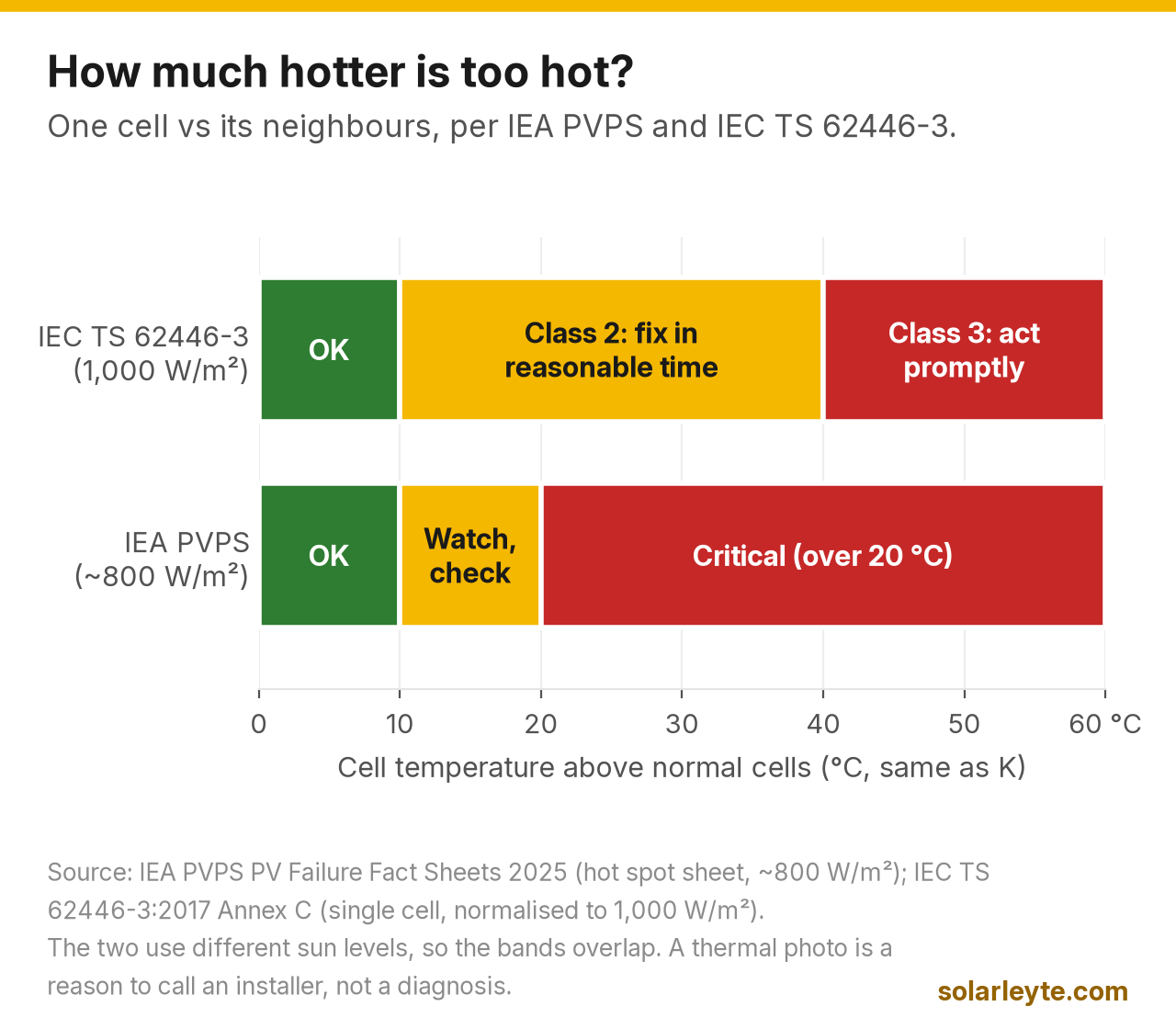
Sources: IEA PVPS PVFS 2025 (hot spot fact sheet, at about 800 W/m²); IEC TS 62446-3:2017 Annex C (normalised to 1,000 W/m²). The two use different reference conditions, so the numbers overlap.
A phone thermal camera can show a hot cell, but a proper IEC TS 62446-3 inspection needs strong, steady sun, a camera accurate to ±2 °C and someone who knows how reflections and wind fool the reading. Treat your own photo as a reason to call someone, not a diagnosis.
How to check your panels after a typhoon (without climbing up)
- Look from the ground or a window. Use your phone's zoom. Look for shattered glass, a bent frame, a panel that has shifted, or debris sitting on the array.
- Check the inverter screen or app. An insulation, leakage or earth fault after rain is a warning sign. On Deye hybrids, F24 is "DC insulation impedance failure"; see our Deye error codes guide.
- Compare output with a similar sunny day. Monitoring apps let you see each day's kWh. A drop of about a third on one string, on a clear day, is a hint that a bypass diode has switched on.
- Take photos. Wide shots of the roof and close-ups of the damage, plus the serial label if your installer can reach it. You need these for warranty or insurance.
- Don't touch, hose or walk on a broken panel. LONGi's manual says a module with damaged glass should be separated from the circuit by someone wearing protective gear, and not touched while wet. Panels make voltage whenever there's light. There is no off switch on the panel itself.
- Ask for proper tests if output dropped but nothing is visible. An installer can run voltage and current checks per string (our multimeter test guide explains what normal looks like), an I-V curve or a thermal scan.
Our typhoon checklist has the full before, during and after list.
What a damaged panel costs you each month
Here's what different kinds of damage cost on one 550 W panel. This is a Solar Leyte worked example with assumptions, not a measurement of your system.
Assumptions: one 550 W panel; Solar Leyte's planning figure of about 105 kWh per kWp a month; every kWh replaces power you would have bought from BILECO at the July 2026 residential rate of ₱18.3407/kWh. Exported kWh under net metering are credited at less than that, so your figure could be lower.
Damage (one 550 W panel) | Output lost (assumed) | kWh lost a month | Peso value a month | Per year |
|---|---|---|---|---|
Cracked cells, nothing cut off | under 2.5% (IEA PVPS) | about 1.4 | about ₱26 | about ₱318 |
Badly cracked cells | about 5% (Kiwa PVEL study) | about 2.9 | about ₱53 | about ₱636 |
One bypass diode stuck on | one-third of the panel | about 19.3 | about ₱353 | about ₱4,237 |
Panel out of service | the whole panel | about 57.8 | about ₱1,059 | about ₱12,710 |
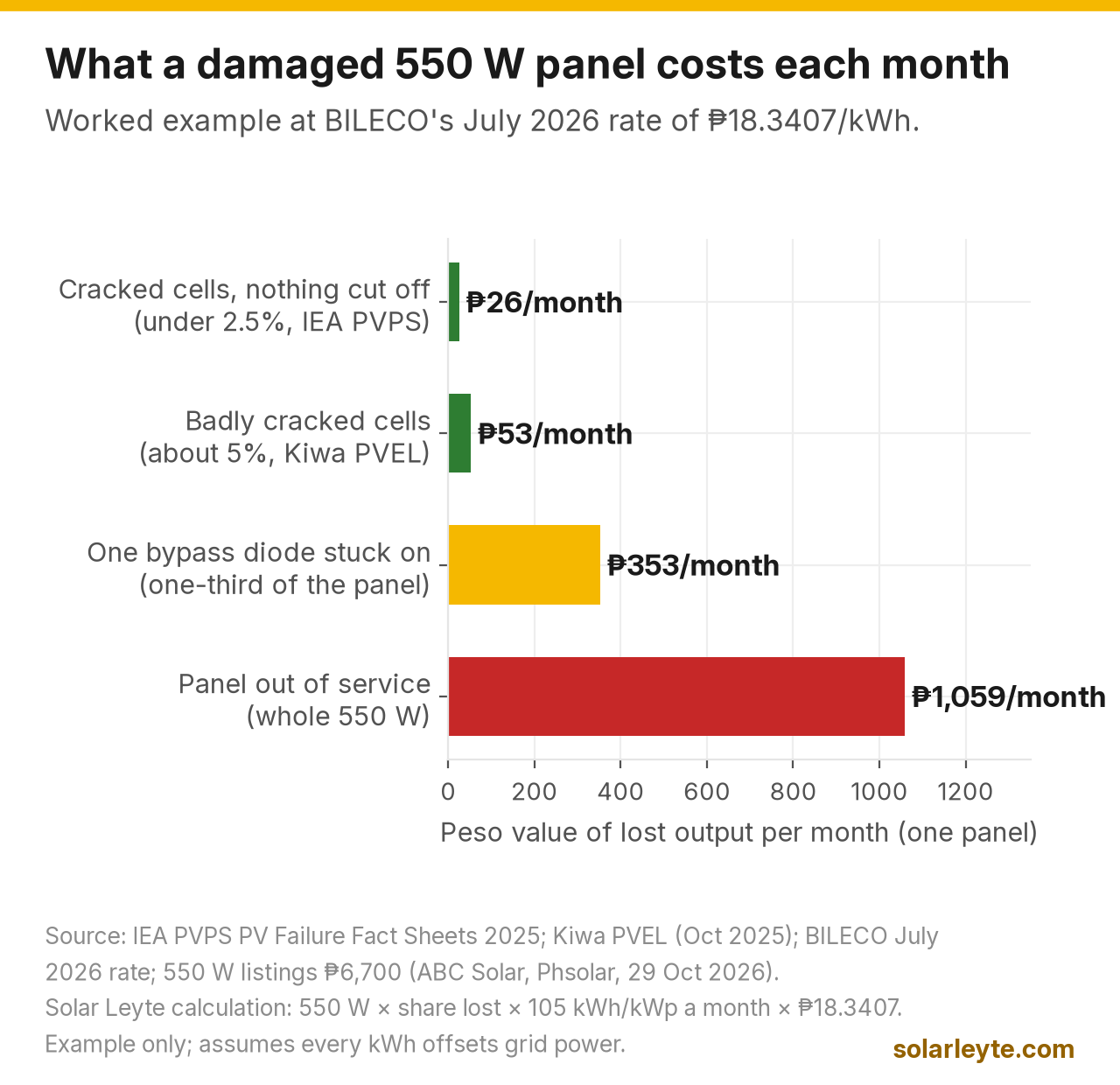
Solar Leyte calculations: 550 W × share lost × 105 kWh/kWp ÷ 1,000 × ₱18.3407.
For comparison, 550 W panels were listed at ₱6,700 each by two Philippine sellers (ABC Solar Electronics and Phsolar) when we checked. That's the panel only, before delivery and labour. On these numbers, a panel with a stuck diode loses its own replacement price in about 19 months, while hairline cell cracks would take decades. That's why cell cracks under good glass are usually a "watch it" problem. Broken glass is a "replace it" problem whatever the money says, because it's a safety fault.
Will cracks get worse over time?
Possibly, and the research doesn't fully agree. An NREL-led study (IEEE Journal of Photovoltaics, 2023) found modules with cracked cells lost about 0.5% more power outdoors than uncracked ones over 21 months. If that rate continued, it would add up to about 11% extra over 20 years. A related NREL test showed that small, wind-like pressure cycles kept widening existing cracks.
On the other hand, Kiwa PVEL's multi-year outdoor study of 104 modern modules with 0% to 100% cracked cells (presented October 2025) found badly cracked modules underperformed by about 5% and saw no extra degradation over time. It concluded that cell cracks "should not be a major performance concern" for those modules.
Either way, the practical answer is the same: note the damage, take photos, and compare your monthly kWh each year. IEA PVPS adds that newer multi-busbar panels handle cracks better than older 2 to 4 ribbon designs.
Can you repair a cracked solar panel?
Not in a way that's safe or keeps your warranty. Clear coatings, resins and tapes sold as "crack repair" may keep rain off for a while, but they don't restore the insulation or fix broken cells. Jinko's limited warranty excludes modules "altered, repaired or modified" without its written consent. The layers are laminated in the factory, so the fix is a new panel.
Warranty or insurance: who pays?
Panel warranties cover defects, not storms. Jinko's limited warranty excludes damage from "power surges, lightning, floods, fires, natural disasters and other force majeure", and "accidental breakage". LONGi's maintenance manual says that when modules fail from external force, you stop using them and replace them. If the glass broke with no sign of impact, LONGi asks you to mark the module and contact customer service. A sudden crack with no impact could be a defect, so it's worth reporting.
Claim fast. Jinko and LONGi both ask for notice within 30 days of finding the problem, with photos, serial numbers, proof of purchase and the installation address. Our panel lifespan and warranty guide compares the product and performance warranties in detail.
Insurance is for big losses. Typhoon claims in the Philippines carry a 2% catastrophe deductible. In our solar insurance post, the worked example put that deductible at ₱45,000 for a typical house with solar, more than three cracked panels cost. Insurance helps when the storm takes half the array and the roof. For one or two panels, budget for the replacement yourself.
FAQ
Will a cracked solar panel still work?
Usually, yes. It keeps producing, often at nearly full power if only the cells cracked and no part of a cell is cut off. If the front glass is broken, it should come out of service even if it still produces, because water can reach live parts and cause insulation faults and hot spots.
How do I know if my solar panel has a hot spot?
You usually can't see one until it leaves a brown or burnt mark. A thermal camera shows it as one cell much hotter than the rest. Other hints are a drop of about a third in a string's output on clear days, or a browned junction box.
Is a hot spot dangerous?
A small one usually isn't, because bypass diodes protect the panel. IEA PVPS calls temperature differences over 20 °C critical, and IEC TS 62446-3 says over 40 °C on one cell needs prompt action. Burn marks, melted parts or a burning smell mean call your installer right away.
Does the warranty cover a panel cracked by a typhoon?
Usually not. Manufacturer warranties like Jinko's exclude natural disasters and accidental breakage. Check your home insurance, but small losses often fall under the 2% typhoon deductible.
Can I just replace one panel?
Usually yes, but the new panel should match the old one's current and voltage closely, or it can limit the whole string. Bring the old panel's label or datasheet to your installer. Our solar panel size guide shows how much models differ even at the same wattage.
Related guides
- Solar in typhoon country: the full guide
- Solar panels and typhoons: before, during and after checklist
- Solar panel cleaning and maintenance
- Solar panels near the sea
Solar Leyte is run by MACC Systems & Energy Solutions Inc., a solar installer in Naval, Biliran.
Get a free solar quote from MACC
Worried about storm damage on your roof in Leyte or Biliran? Send us a few photos from the ground and a recent BILECO or LEYECO bill, and we'll tell you what we see, with no obligation.
- Call/Text: 0955 723 5093
- Email: official@macc-inc.com or benjie@macc-inc.com
- Website: www.macc-inc.com
- Request a quote online: solarleyte.com/quote
- Office: Brgy. Talustusan, Naval, Biliran 6543
Sources (all checked 29 October 2026)
- IEA PVPS Task 13, Photovoltaic Failure Fact Sheets (PVFS) – Review 2025, Report IEA-PVPS T13-30:2025: cell cracks (limited to no impact if under 10% of a cell's area is cut off; below 2.5% loss for a 60-cell module with all cells cracked but connected; multi-busbar designs lose less), glass breakage (insulation no longer guaranteed when wet, hot spots, string losses, replace all damaged modules), hot spots (single hot cell usually insignificant; significant when a bypass diode stays active; 10–20 K and over 20 K at about 800 W/m²).
- IEA PVPS Task 13, Review of Failures of Photovoltaic Modules (T13-01:2014): background on cell cracks, snail tracks, burn marks and bypass diode failures.
- IEC, IEC TS 62446-3:2017, Outdoor infrared thermography of PV modules and plants: classes of abnormality (Table 4) and Annex C single-cell thresholds, 10–40 K class 2, over 40 K class 3; camera accuracy under ±2 K.
- LONGi, Maintenance Manual EN V3.0: broken glass means the module must be replaced; isolate damaged modules with PPE; no touching wet modules; claim information; external-force failures.
- LONGi, Hi-MO 7 LR5-72HGD 560–590M datasheet: IP68 junction box with three diodes; 2.0 + 2.0 mm heat-strengthened dual glass; hailstone test 25 mm at 23 m/s.
- Jinko Solar, JKM575-600N-72HL4-BDV datasheet: 2.0 mm front and back glass.
- Jinko Solar, Limited Warranty REV.EN20250919, Linear Bifacial Module: 30-day claim notice and required documents; exclusions for repairs without consent, natural disasters, force majeure and accidental breakage.
- NREL-led study, Field and Accelerated Aging of Cracked Solar Cells, IEEE Journal of Photovoltaics (2023): about 0.5% absolute extra loss over 21 months; about 11% over 20 years if extrapolated.
- NREL, Millions of Small Pressure Cycles Drive Damage in Cracked Solar Cells: wind-like pressure cycles worsen existing cracks.
- Kiwa PVEL (T. Karin et al.), Multi-Year Study of Crack-Induced Degradation in Fielded Photovoltaic Modules, DuraMAT workshop, 7 Oct 2025: 104 modules, 0–100% cracked cells; badly cracked about 5% lower; no extra degradation observed.
- BILECO, July 2026 effective rates: residential ₱18.3407/kWh, VAT inclusive.
- ABC Solar Electronics, AE Solar 550 W (₱6,700); Phsolar, Sunova 550 W (₱6,700). Listed prices, checked 29 October 2026.
- Solar Leyte, How many solar panels do I need?: the 105 kWh per kWp a month planning figure. Solar Leyte, solar panel insurance: the 2% typhoon deductible and the ₱45,000 example.
- All monthly kWh and peso figures are Solar Leyte calculations from the figures above.