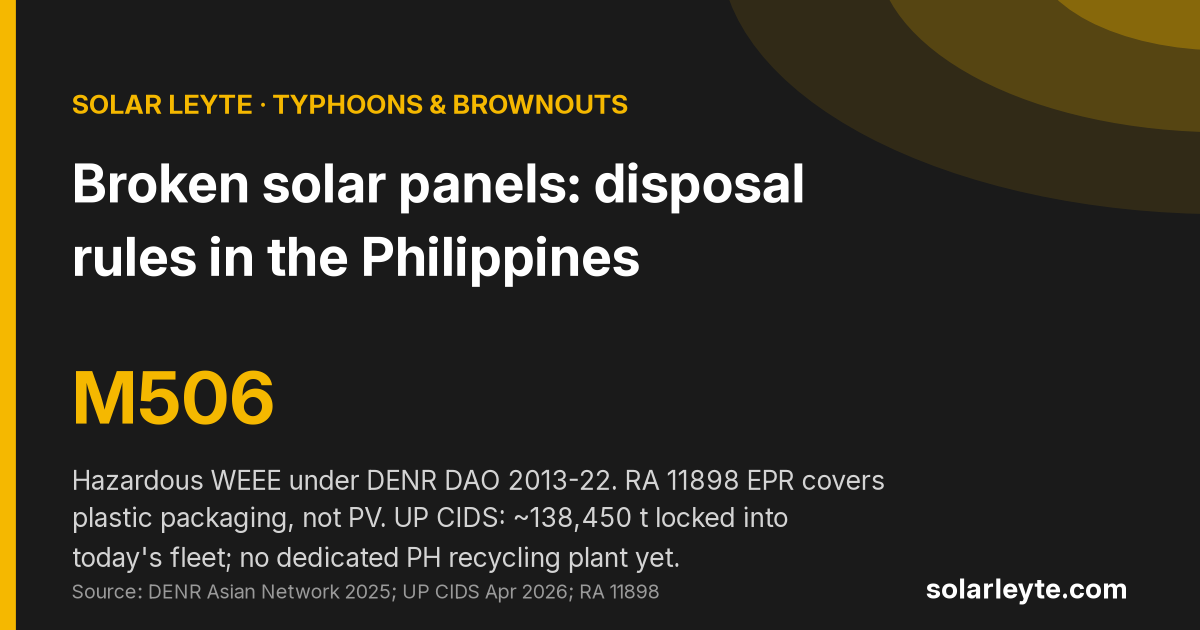
Don't put cracked or retired solar panels in the regular trash. In the Philippines they are treated as hazardous waste electrical and electronic equipment (WEEE), class M506, under DENR Administrative Order 2013-22, which implements Republic Act 6969. That means a licensed hazardous-waste path — not the barangay MRF, not the coastal dump, and not a backyard burn.
This matters more after typhoons. A cracked module can still look "okay" from the street while glass shards, lead solder and encapsulant sit exposed. The country also does not yet have a dedicated solar-panel recycling plant, and the Extended Producer Responsibility law you may have heard about (RA 11898) covers plastic packaging, not PV modules. So homeowners and installers share a gap: the rules say "hazardous," but the take-back shop on the corner does not exist yet.
Last checked: 17 October 2026 (Philippine time). Plain-language guide, not legal advice. Confirm with your installer and your DENR-EMB regional office before you move waste.
Short answer for homeowners
Situation | What to do | What not to do |
|---|---|---|
One or two panels cracked after a typhoon | Photo the damage; call your installer and insurer; leave panels secured or stacked safely until a licensed path is arranged | Throw them with household garbage or leave shattered glass on the roof |
Whole array retired after 25–30 years | Ask the original installer / supplier for a take-back or a DENR-registered transporter and TSD facility | Sell "scrap" modules to informal buyers who break glass by hand |
Inverter or lithium battery also damaged | Treat batteries as separate hazardous streams (also flagged as WEEE / Li-ion in DENR briefings) | Put Li-ion packs in ordinary e-waste bins |
You only have cardboard/plastic packaging from a new install | That packaging can fall under RA 11898 EPR for plastic — different law from the panels themselves | Assume EPR already forces the panel brand to collect old modules |
The rest of this post explains the laws, the numbers researchers are using, and a step-by-step after-storm checklist that links to our typhoon readiness guide, before/during/after checklist, insurance guide and lifespan/warranty guide without repeating them.
Why broken panels are not ordinary trash
A crystalline silicon module is mostly glass and aluminum, with a polymer encapsulant, copper wiring, silver contacts and small amounts of lead in solder. When the glass is intact and the laminate is sealed, those materials stay put. When a typhoon, falling branch or hail cracks the front glass, moisture gets in, output drops, and fragments can leach.
UP CIDS's April 2026 study on Philippine end-of-life (EOL) solar panels notes that material testing on PV modules has found several regulated heavy metals, with lead (Pb) above the US EPA 5.0 ppm threshold in the samples they discuss — one reason researchers treat landfilling as a public-health risk, not just a clutter problem.
DENR's own regional briefing for the Basel Convention Asian Network (2025 workshop materials) states plainly that lithium-ion batteries and solar panels, whether used or waste, are considered hazardous waste under WEEE classification M506. The same briefing lists the challenges that follow: absence of local recycling facilities for PV modules, limited technical capacity to dismantle them, high logistics costs, and no industry take-back schemes yet.
So the legal label is clear even while the physical recycling plant is missing. That combination is exactly why homeowners need a careful path, not improvisation.
The laws that actually apply (and one that does not)
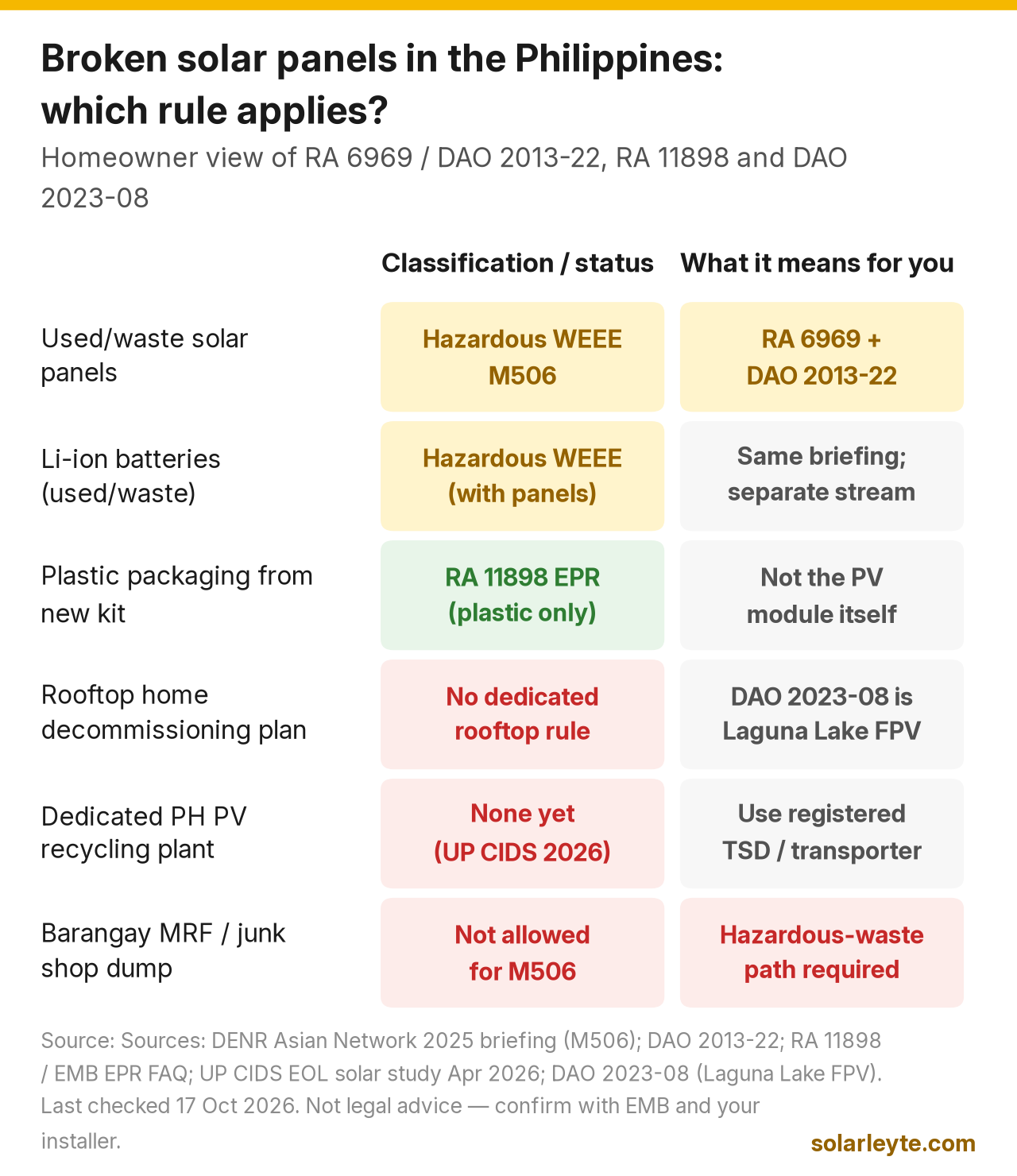
RA 6969 and DENR DAO 2013-22
Republic Act 6969 (Toxic Substances and Hazardous and Nuclear Wastes Control Act of 1990) gives DENR the lead on regulating hazardous wastes. DAO 2013-22 is the procedural manual: waste generators, transporters, and treatment, storage and disposal (TSD) facilities must register; shipments need the prescribed permits and waste transport records.
Under that manual, WEEE (M506) covers waste electrical and electronic equipment and components that can contain lead, cadmium and similar substances. DENR briefings and UP CIDS both place used or waste solar panels in that lane.
Practical meaning for a homeowner:
- You (or your installer, if they remove the modules) become part of a hazardous-waste chain.
- Moving cracked panels across provinces in an open pickup without paperwork is not a grey area — transporters of hazardous waste need DENR registration.
- A TSD facility must be DENR-registered for the waste codes it accepts. Lists change; we are not naming specific companies here because public TSD compilations online are often months or years old. Ask EMB Region VIII (Eastern Visayas) or your installer for the current registered options.
DAO 2023-08 — decommissioning exists, but not for your roof
DENR DAO 2023-08 sets ECC guidelines for floating photovoltaic plants in Laguna Lake. UP CIDS highlights it as the only Philippine policy that already anticipates plant decommissioning: owners must submit an abandonment plan covering dismantling, site restoration, and "collecting, transporting, and properly treating or disposing of any waste or debris, including the recycling, reusing, or recovery of materials" (sec. 5.4).
That is useful context — it shows DENR knows EOL solar is coming — but it does not create a take-back duty for a 5 kW rooftop in Naval or Tacloban. Rooftop homeowners still fall back on RA 6969 / DAO 2013-22 plus whatever their installer contract says.
RA 11898 EPR — plastic packaging, not PV
Republic Act 11898 (Extended Producer Responsibility Act of 2022) amends the Ecological Solid Waste Management Act to make large enterprises recover plastic packaging waste. EMB's EPR FAQ defines covered materials as sachets, laminates, rigid plastic containers, plastic bags, polystyrene and similar packaging — not solar modules.
UP CIDS explicitly recommends a future EPR for PV importers and manufacturers, and says the country should learn from how RA 11898 was rolled out for plastics. Until Congress or DENR extends EPR to modules, do not assume the brand sticker on your panel equals a free nationwide pickup.
How big is the Philippine waste pile?
UP CIDS (April 2026), using ICSC's July 2025 capacity figure of 1,846.08 MW of solar and IRENA's global benchmark of about 75 metric tons of PV waste per MW, projects roughly:
Figure | Source / note | What it means |
|---|---|---|
~138,450 metric tons | 1,846.08 MW × 75 t/MW (UP CIDS / IRENA / ICSC) | Lifetime waste locked into today's installed fleet if every module is eventually retired |
First big wave ~2041 | 25–30 year typical life from mid-2010s utility builds | Homeowners installing in 2026 should still plan EOL, but mass household retirements peak later |
~12,310 tons by 2040 | Cited via Bergado (2022) in UP CIDS | Volume some researchers say could justify a dedicated recycling plant |
Up to 962,000 tons by 2050 | Utility-scale pathway in UP CIDS | Policy problem for DOE–DENR, not only for one barangay |
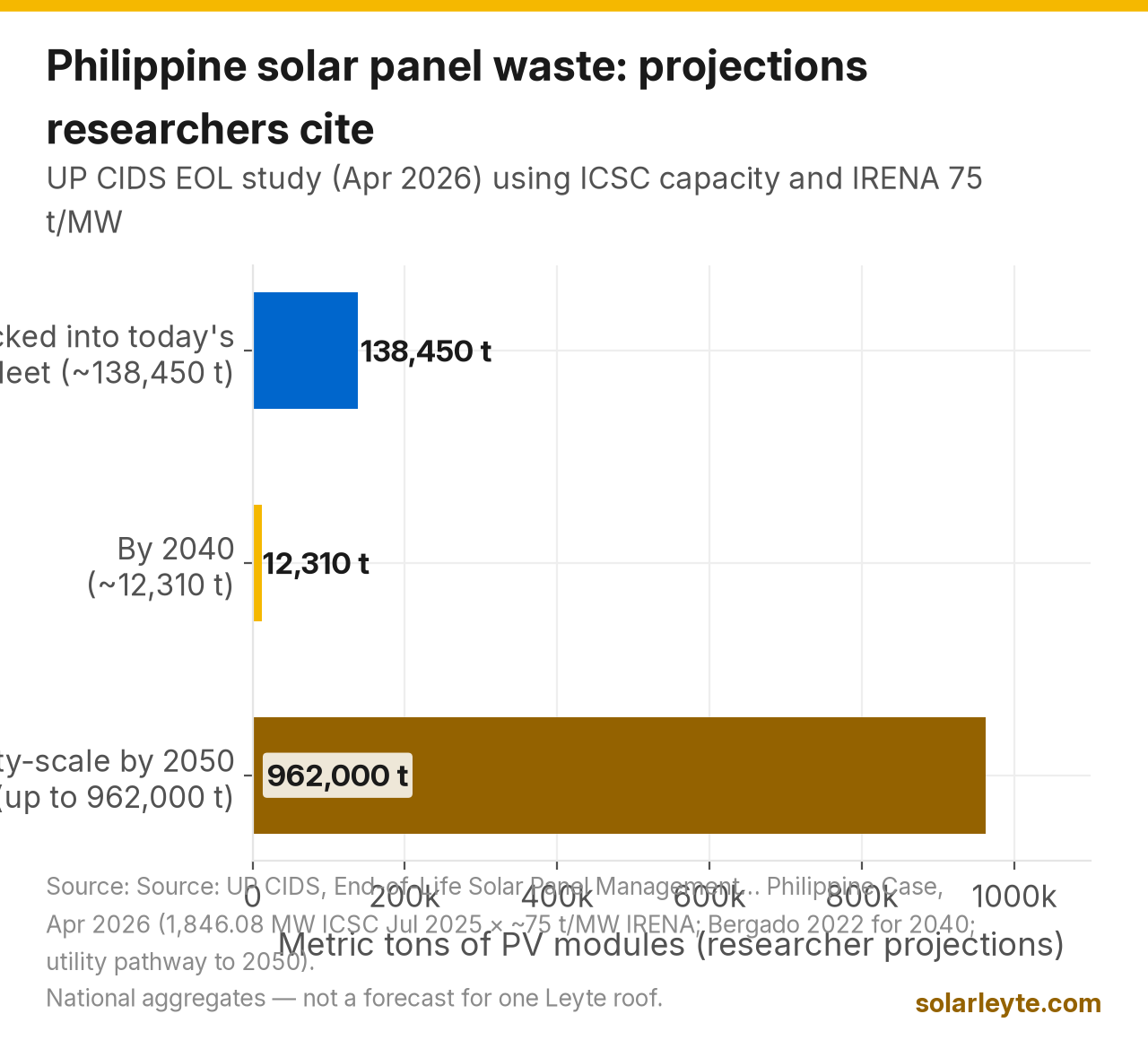
Example (labelled): if a Leyte home has a 5 kW rooftop of roughly ten 500 W modules, and you apply the same 75 t/MW benchmark, that is about 0.375 metric tons (375 kg) of eventual module mass for that system alone — mostly glass and aluminum. That is a Solar Leyte arithmetic check on the IRENA factor, not a weighing of your specific panels.
The study also stresses there is no dedicated solar-panel recycling facility in the country yet, public awareness is low, and RA 9513 (the renewable energy incentives law) has no EOL clause.
After a typhoon: disposal steps that do not cannibalize the checklist
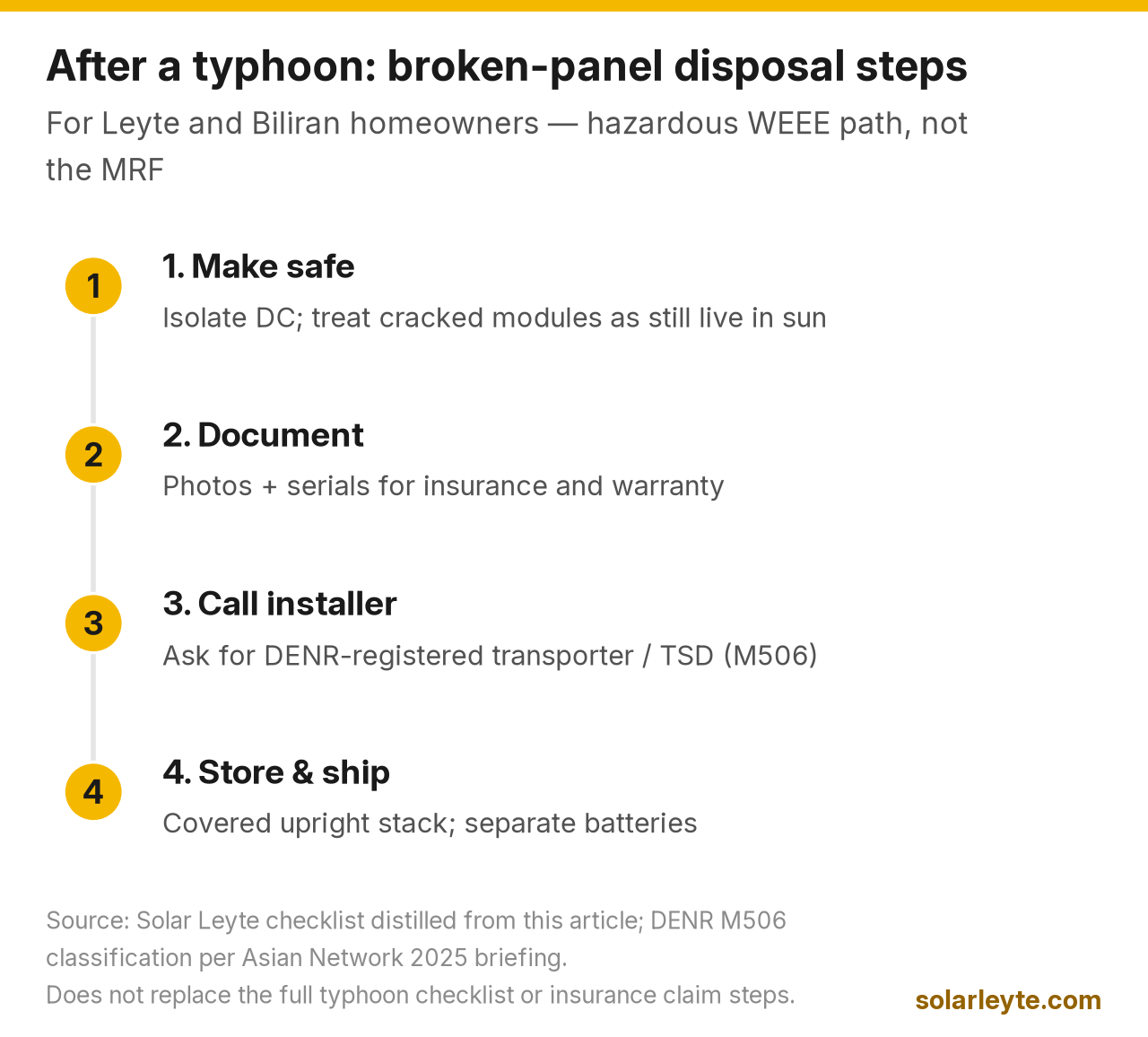
Our solar typhoon checklist covers shut-downs, photos and when it is safe to climb. Our insurance post covers deductibles and declarations. This section is only about what to do with the broken glass once the storm has passed.
- Make it safe first. If glass is hanging or a string is still live, stay off the roof. Isolate at the DC isolator / inverter per your installer's instructions. Treat every cracked module as still able to produce voltage in sunlight.
- Document for insurance and warranty. Clear photos of cracks, frame bends, water ingress and serial labels. Product warranties often exclude storm damage; performance warranties do not pay for a smashed laminate. See the lifespan and warranty guide.
- Call the installer before the scrap buyer. A reputable installer already works with electricians and, for larger removals, should know how to book a DENR-registered hazardous-waste transporter. Informal "we buy broken panels" offers often end in open dumping.
- Ask EMB or your PCO which TSD codes are open. Request facilities registered for M506 (and battery codes if packs are damaged). Prefer written confirmation of the waste code and the transporter's registration number. We are not publishing a named list here because online TSD tables go stale quickly; verify on the day you ship.
- Store short-term the right way. Keep modules stacked upright on pallets under cover, glass side protected, away from kids and animals. Do not hose leaded solder dust into the canal. Do not burn encapsulant.
- Separate the streams. Aluminum frames can have scrap value after proper dismantling at a permitted facility — not after you pry them off with a crowbar in the yard. Inverters and Li-ion / LiFePO4 batteries are their own hazardous lines.
- Only then talk "reuse." A lightly damaged module might still produce some power off-grid, but cracked glass is a cut and shock hazard. Second-life markets are a research recommendation in UP CIDS, not a safe DIY default after Yolanda-class winds.
What recycling would look like if the Philippines builds it
Elsewhere, PV recycling is a two-step story: (1) remove frames, junction boxes and glass; (2) recover silicon, silver, copper and aluminum with mechanical, thermal or chemical processes. Japan, the EU WEEE system and private US take-back schemes are the models UP CIDS reviews. Malaysia already has commercial PV recyclers; the Philippines does not, per the same study.
Until local capacity exists, "recycling" for a Biliran homeowner usually means legal collection and transport to a registered TSD that can store or preprocess WEEE, not a magic closed-loop factory next door. Export of hazardous waste has its own Basel / DAO 2013-22 rules — another reason not to freelance.
FAQ
Can I put broken solar panels in the barangay MRF or junk shop?
No. DENR classifies used or waste solar panels as hazardous WEEE (M506). Ordinary MRFs and informal junk shops are not TSD facilities for that code.
Does the panel brand have to take them back under EPR?
Not under today's RA 11898, which covers plastic packaging. A brand may offer a voluntary take-back; ask in writing. UP CIDS recommends a future PV-specific EPR — it is not law yet (last checked 17 October 2026).
My panels are only 8 years old but typhoon-cracked. Are they "end of life"?
For warranty and insurance they are storm-damaged, not age-retired. For waste rules, a cracked module that will not be repaired is still hazardous WEEE when you discard it. Age (25–30 years) matters for the national waste wave; a single storm can create EOL pieces much earlier.
What about the inverter and battery?
Treat them as separate hazardous items. DENR's 2025 Asian Network briefing groups Li-ion batteries with solar panels under WEEE concerns and notes limited specialised recycling capacity. Do not put swollen Li-ion packs in household trash.
Is there a recycling plant in Leyte or Biliran?
UP CIDS (April 2026) states the Philippines lacks a dedicated solar-panel recycling facility. Eastern Visayas homeowners should plan for registered transport to a permitted TSD elsewhere, coordinated by the installer or a Pollution Control Officer — not a local "solar junk" yard.
Get a free solar quote from MACC
Planning a new rooftop, or replacing storm-damaged modules the right way? Solar Leyte is run by MACC Systems & Energy Solutions Inc., a solar installer in Naval, Biliran. Send a recent electric bill, a roof photo, and what you need running in a brownout — we reply with a free, no-obligation written quote. We do not invent package prices here; every quote is site-specific.
- Call/Text: 0955 723 5093
- Email: official@macc-inc.com or benjie@macc-inc.com
- Website: www.macc-inc.com
- Office: Brgy. Talustusan, Naval, Biliran 6543
- Or use the site quote form: /quote
Related guides
- Solar in typhoon country: installing and protecting a system
- Solar panels and typhoons: before, during and after checklist
- Does home insurance cover solar panels?
- How long do panels, inverters and batteries last?
- How to choose a solar installer in Leyte and Biliran
Sources (all checked 17 October 2026)
- UP Center for Integrative and Development Studies (Political Economy Program), with CREST and FES, End-of-Life (EOL) Solar Panel Management from a Circular Economy Perspective: The Philippine Case (PDF dated 8 April 2026; public note 13 April 2026): 25–30 year life; 1,846.08 MW (ICSC, July 2025); IRENA ~75 t/MW; ~138,450 t from current fleet; ~2041 first mass wave; ~12,310 t by 2040 (via Bergado 2022); up to 962,000 t by 2050 utility-scale; no dedicated PH recycling facility; DAO 2023-08 sec. 5.4 abandonment plan; RA 6969 / DAO 2013-22 frame; RA 11898 as plastics EPR to learn from; lead >5.0 ppm note; recommends future PV EPR and DOE–DENR coordination
- UP CIDS news page, New Publication: Navigating the Future of Solar Power in the Philippines (13 April 2026)
- DENR Environmental Management Bureau presentation, Basel Convention Asian Network Annual Workshop 2025 Session 3 (PDF hosted by Japan's Ministry of the Environment): used/waste Li-ion batteries and solar panels classified as hazardous WEEE M506; challenges include absence of local PV recycling facilities, limited dismantling capacity, high logistics cost, lack of take-back schemes
- DENR Administrative Order 2013-22, Revised Procedures and Standards for the Management of Hazardous Wastes: WEEE (M506) definition; generator / transporter / TSD duties
- Republic Act 6969 (1990), Lawphil
- Republic Act 11898 (2022), Lawphil — EPR on plastic packaging waste; Sec. 44-C packaging definition
- EMB EPR portal, FAQ — covered plastic packaging types (sachets, rigid plastics, bags, polystyrene, etc.)
- DENR EIA division list of PEISS issuances, including DAO 2023-08 and DAO 2024-05 (floating PV ECC guidelines, Laguna Lake)
- BusinessMirror, DENR issues guidelines for floating solar projects in Laguna de Bay (2 August 2023) — secondary report on DAO 2023-08 decommissioning expectations
- EMB Hazardous Waste Management Section page, emb.gov.ph — points to DAO 2013-22 enforcement
- Example arithmetic (Solar Leyte): 5 kW × 75 t/MW = 0.375 t eventual module mass — illustrative only, using UP CIDS / IRENA factor
Solar Leyte is run by MACC Systems & Energy Solutions Inc., a solar installer in Naval, Biliran.