Most rooftop solar panels sold in the Philippines in 2026 are 1,134 mm (113.4 cm) wide, and their length depends on the wattage: about 1.72 m for a 440 W panel, 2.28 m for a 580 to 600 W panel, and 2.38 to 2.47 m for 610 to 620 W panels. A typical 600 W panel measures 2278 × 1134 × 30 mm (about 7.5 × 3.7 ft) and weighs about 31 kg. Whatever the wattage, a modern panel needs roughly 4.3 to 4.6 m² of panel area per kilowatt.
The surprise for many homeowners: the biggest panel isn't always the best fit. On a short roof slope, a 2.4 m panel can leave a strip of wasted roof that a smaller panel would have used. We show that with worked examples below.
This post is about size and roof space only. For what these panels cost, see our 550W, 600W and 620W price guide and the solar panel price guide.
Last checked 28 October 2026. Dimensions come from manufacturer datasheets or, where marked, a Philippine seller's listing. Brands are named only because their specs are public. This isn't an endorsement, and nothing here is a MACC product list or quote.
Solar panel size chart by wattage
Panel (example model) | Size L × W × D (mm) | In cm | In feet | Weight | Area | Area per kWp |
|---|---|---|---|---|---|---|
100 W mono (SolarHome, seller listing) | 720 × 765 × 30 | 72.0 × 76.5 | 2.36 × 2.51 | 5.8 kg | 0.55 m² | 5.5 m² |
150 W mono (SolarHome, seller listing) | 1045 × 765 × 30 | 104.5 × 76.5 | 3.43 × 2.51 | 8.25 kg | 0.80 m² | 5.3 m² |
200 W mono (SolarHome, seller listing) | 1480 × 1000 × 30 | 148.0 × 100.0 | 4.86 × 3.28 | 11.4 kg | 1.48 m² | 7.4 m² |
420 W, Trina Vertex S (seller listing) | 1762 × 1134 × 30 | 176.2 × 113.4 | 5.78 × 3.72 | 21.3 kg | 2.00 m² | 4.8 m² |
440 W, Jinko Tiger Neo 54HL4 (108 half-cells) | 1722 × 1134 × 35 | 172.2 × 113.4 | 5.65 × 3.72 | 22 kg | 1.95 m² | 4.4 m² |
500 W, Trina Vertex N (seller listing) | 1961 × 1134 × 30 | 196.1 × 113.4 | 6.43 × 3.72 | not listed | 2.22 m² | 4.4 m² |
580 W, LONGi Hi-MO 7 (144 half-cells) | 2278 × 1134 × 30 | 227.8 × 113.4 | 7.47 × 3.72 | 31.8 kg | 2.58 m² | 4.5 m² |
600 W, Jinko Tiger Neo 72HL4 (144 half-cells) | 2278 × 1134 × 30 | 227.8 × 113.4 | 7.47 × 3.72 | 31.0 kg | 2.58 m² | 4.3 m² |
610 W, Jinko Tiger Neo 78HL4 (156 half-cells) | 2465 × 1134 × 35 | 246.5 × 113.4 | 8.09 × 3.72 | 34.6 kg | 2.80 m² | 4.6 m² |
620 W, Trina Vertex N 590–620 W | 2382 × 1134 × 30 | 238.2 × 113.4 | 7.81 × 3.72 | 33.0 kg | 2.70 m² | 4.4 m² |
730 W, Trina Vertex N 715–740 W (132 half-cells) | 2384 × 1303 × 33 | 238.4 × 130.3 | 7.82 × 4.27 | 38.3 kg | 3.11 m² | 4.3 m² |
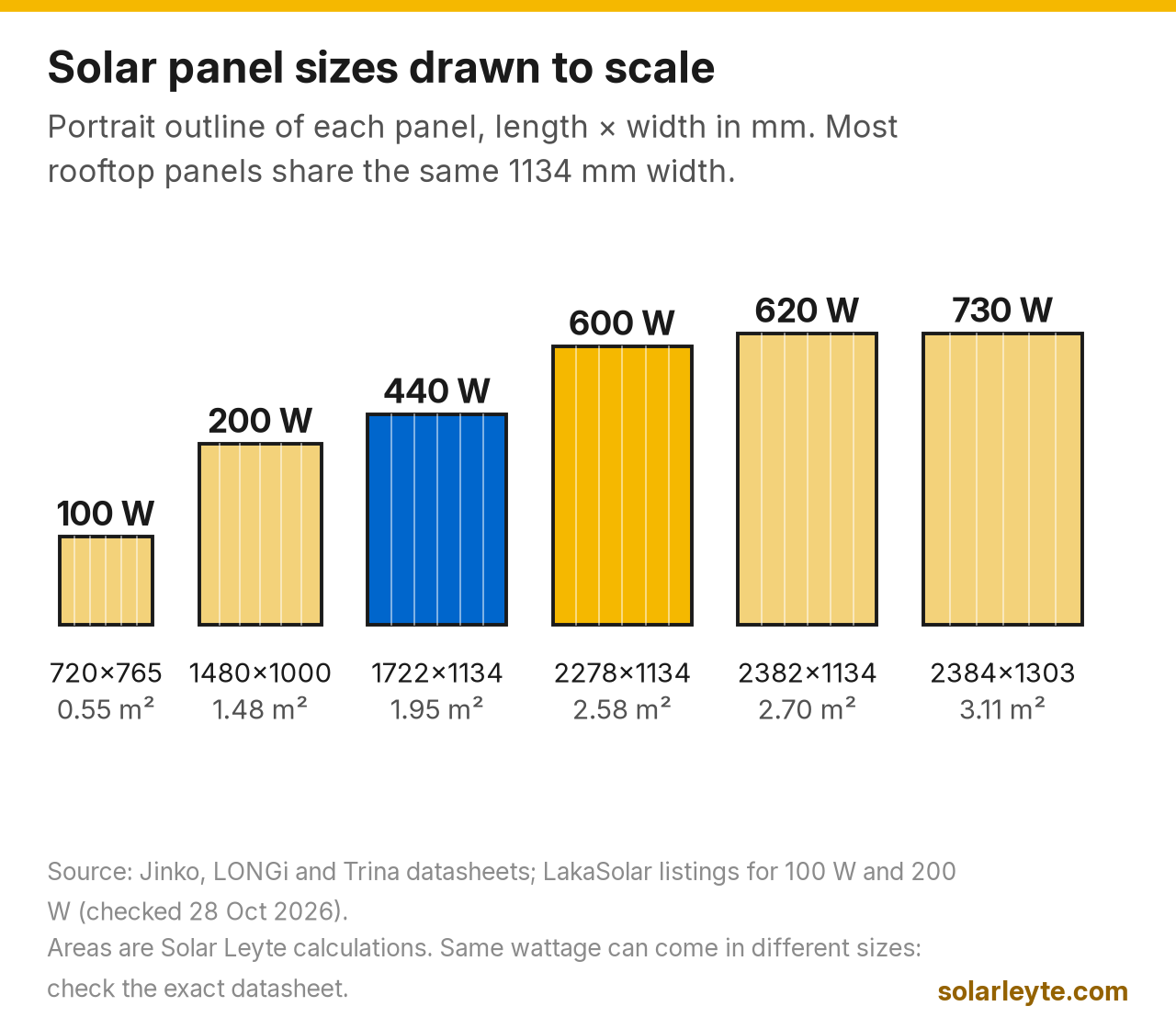
Sizes and weights are from the datasheets and listings in the Sources. Feet, area and area per kWp are Solar Leyte calculations (1 ft = 304.8 mm). Area per kWp is the panel's own area divided by its rated kilowatts; real roofs need extra space for gaps and edges.
Two things jump out. First, almost every modern rooftop panel shares the same 1134 mm width, so length is what changes with wattage. Second, the "per kilowatt" space barely moves between 440 W and 730 W. Bigger panels give you more watts per panel, not much more watts per square metre. The small 100 to 200 W panels need more room per kilowatt because they are less efficient, which is fine for a sari-sari store light or a small off-grid kit but not ideal for a whole roof.
Why the same wattage can come in different sizes
Wattage alone doesn't tell you the size. Panel makers build families around a cell size and a cell count:
- 108 half-cells (about 1722 × 1134 mm): the "54-cell" family, usually 420 to 450 W. Easier to carry and easier to fit on small roofs.
- 144 half-cells (2278 × 1134 mm): the "72-cell" family, roughly 560 to 600 W in the current n-type models.
- 156 half-cells (2465 × 1134 mm): the "78-cell" family, around 590 to 610 W in Jinko's range.
- 132 larger half-cells (2382 × 1134 mm or 2384 × 1303 mm): Trina's rectangular- and 210 mm-wafer families, from about 590 W up to 740 W.
So a "600 W panel" could be 2.28 m or 2.47 m long depending on the model. Before you plan a layout, ask your supplier for the exact datasheet of the panel they'll deliver, not just the wattage.
How much roof space do you need per kilowatt?
From the chart, a modern 420 to 730 W panel needs about 4.3 to 4.6 m² of panel area per kWp. Add gaps between panels and a clear strip at the roof edges, and a useful planning figure is about 5 to 6 m² of roof per kWp on a simple, unshaded roof face. This is our rule of thumb from the examples below, not a code requirement.
System size | Panel area only (approx.) | Planning roof area (approx.) |
|---|---|---|
3 kWp | 13 to 14 m² | 15 to 18 m² |
5 kWp | 22 to 23 m² | 25 to 30 m² |
8 kWp | 34 to 37 m² | 40 to 48 m² |
10 kWp | 43 to 46 m² | 50 to 60 m² |
Solar Leyte calculations from the chart above. Shade, vents, skylights, hips and valleys all reduce what you can use.
Not sure what size you need in the first place? Start with our how many solar panels do I need guide, which works it out from your BILECO or LEYECO bill.
Worked examples: how many panels fit on one roof face
These are examples, not a design. Assumptions: a plain rectangular roof face with no shade or vents, a 0.5 m clear strip on every edge, 20 mm gaps between panels, and only whole panels. "Length" is along the ridge and "slope" is from eaves to ridge. Portrait means the panel's long side runs up the slope; landscape means it runs along the ridge.
Example A: small bungalow roof face, 6 m × 4 m
That leaves a usable area of 5 m × 3 m.
Panel | Portrait | Landscape | Best fit |
|---|---|---|---|
440 W (1722 × 1134) | 4 panels | 4 panels | 4 × 440 W = 1.76 kWp |
600 W (2278 × 1134) | 4 panels | 4 panels | 4 × 600 W = 2.40 kWp |
620 W (2382 × 1134) | 4 panels | 4 panels | 4 × 620 W = 2.48 kWp |
730 W (2384 × 1303) | 3 panels | 4 panels | 4 × 730 W = 2.92 kWp |
On a small roof where the panel count is the same, the higher-wattage panel wins.
Example B: medium roof face, 8 m × 5 m
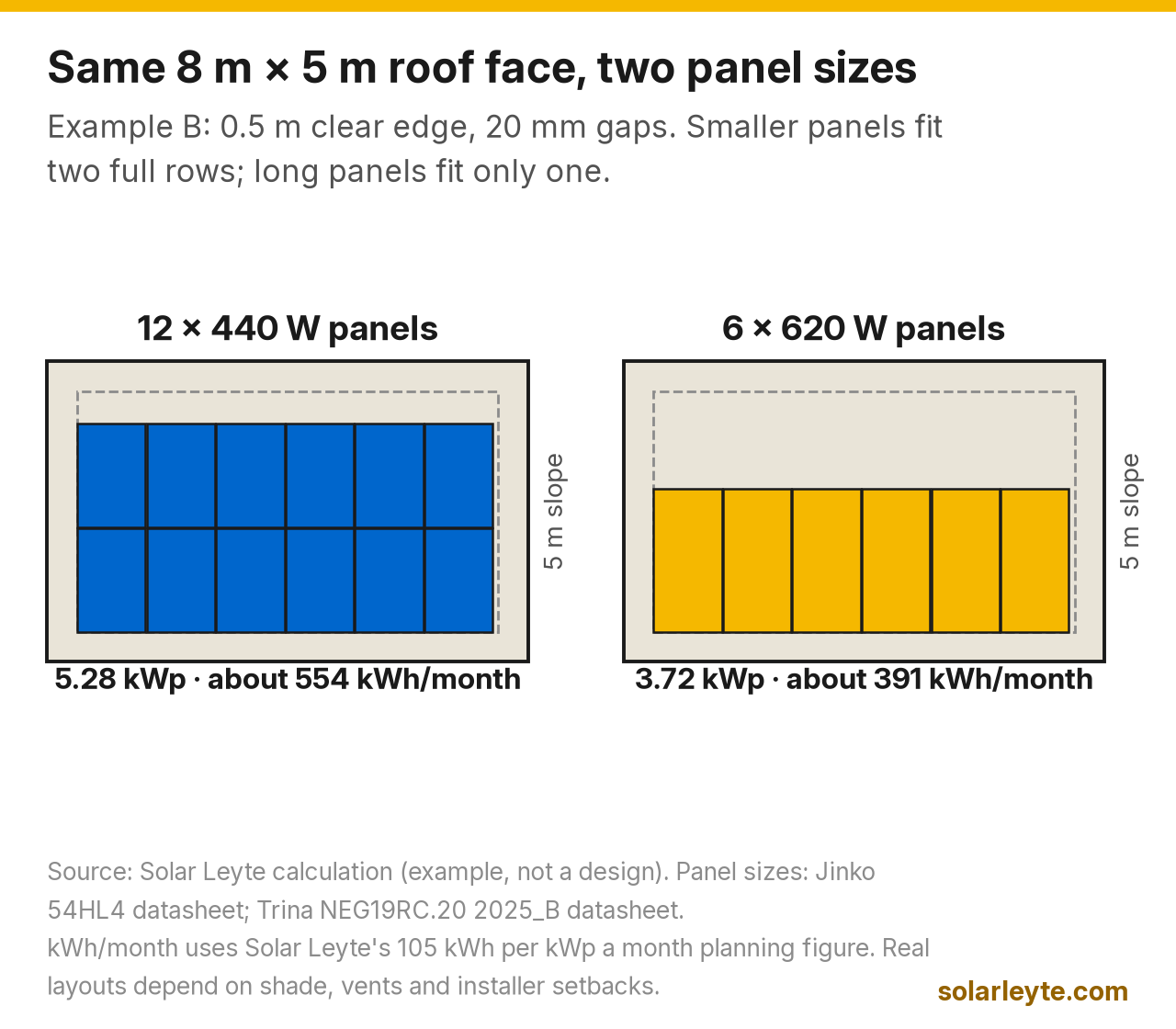
Usable area 7 m × 4 m. This is where size matters.
Panel | Portrait | Landscape | Best fit |
|---|---|---|---|
440 W (1722 × 1134) | 12 panels (2 rows of 6) | 12 panels | 12 × 440 W = 5.28 kWp |
600 W (2278 × 1134) | 6 panels (1 row) | 9 panels (3 rows of 3) | 9 × 600 W = 5.40 kWp |
620 W (2382 × 1134) | 6 panels | 6 panels | 6 × 620 W = 3.72 kWp |
730 W (2384 × 1303) | 5 panels | 6 panels | 6 × 730 W = 4.38 kWp |
A 4 m usable slope fits only one row of 2.38 m panels in portrait, and the 7 m length fits only two in landscape. The smaller 440 W panels fit two full rows and end up with about 42% more capacity than the 620 W panels on the same roof (5.28 vs 3.72 kWp). At our planning figure of about 105 kWh per kWp a month, that's roughly 554 kWh vs 391 kWh a month.
Example C: large roof face, 10 m × 6 m
Usable area 9 m × 5 m.
Panel | Portrait | Landscape | Best fit |
|---|---|---|---|
440 W (1722 × 1134) | 14 panels | 20 panels | 20 × 440 W = 8.80 kWp |
600 W (2278 × 1134) | 14 panels | 12 panels | 14 × 600 W = 8.40 kWp |
620 W (2382 × 1134) | 14 panels | 12 panels | 14 × 620 W = 8.68 kWp |
730 W (2384 × 1303) | 12 panels | 9 panels | 12 × 730 W = 8.76 kWp |
On a big, simple roof the results are close, and the choice comes down to price per watt, fewer clamps and rails with bigger panels, and how easily your installer can lift them.
All three examples are Solar Leyte calculations. Monthly kWh uses the 105 kWh per kWp a month planning figure from our panel count guide. Landscape mounting is common, but check the maker's installation manual for the allowed clamp positions in each orientation.
The lesson: measure the slope length of each roof face (eaves to ridge) before you choose a panel. If the usable slope is just under two panel lengths, a shorter panel can add a whole extra row.
How to measure your roof for panels
- Measure each roof face separately. Note the length along the ridge and the slope length from eaves to ridge. You can measure the slope from a ladder at the gable end, or ask your installer to do it on the site visit.
- Note the direction each face points. In Leyte and Biliran, faces pointing south, east or west are all usable; see our tilt and direction guide.
- Mark obstacles and shade: water tanks, vents, antennas, coconut trees and taller neighbouring houses. Shade on one panel can drag down a whole string.
- Subtract the edges. Roof edges and ridges get the strongest wind uplift in a typhoon, so installers usually keep panels back from them. Ask your installer what clearance they use for your roof and wind zone.
- Check the roof itself. Panels add about 11 to 12 kg per m² (from the chart), plus rails. Old or rusted GI sheets and weak purlins should be fixed first. Our roof installation guide covers longspan, concrete and tile roofs.
Handling and transport in Leyte and Biliran
A 2.3 to 2.5 m panel weighing 31 to 38 kg is a two-person lift, and it acts like a sail in the wind. A few practical points:
- Transport flat on a pallet or in the box, not standing loose in a multicab or on a habal-habal. Cracked cells don't always show from the outside.
- Plan the lift. Narrow alleys, low eaves and steep roofs in Tacloban, Ormoc or Naval may make 2.4 m panels hard to carry up. Smaller 1.7 m panels can be the easier choice on tight sites.
- Don't install on windy afternoons or when a storm signal is up. See our typhoon checklist.
- Buying online? Long panels are often shipped by freight, not standard courier. Our Lazada and Shopee buying guide covers what to check on delivery.
FAQ
What is the standard size of a solar panel in the Philippines?
There isn't one legal standard, but most rooftop panels on sale are 1134 mm wide. The two most common lengths are about 1722 mm (420 to 450 W) and 2278 mm (560 to 600 W), with some 610 to 620 W models at 2382 to 2465 mm.
What are the dimensions of a 550 W solar panel?
Most current 550 to 600 W panels with 144 half-cells measure about 2278 × 1134 × 30 to 35 mm, which is about 7.5 × 3.7 ft or 2.28 × 1.13 m, and weigh about 31 to 32 kg. Always check the exact datasheet, because some models are longer.
How many solar panels can fit on my roof?
Divide the usable roof area by about 5 to 6 m² per kWp for a quick estimate, then do a layout using the real panel size. As Example B shows, a short roof slope can fit more capacity with smaller panels.
Is a bigger solar panel always better?
No. Bigger panels mean fewer panels and clamps per kilowatt, but they need about the same roof area per kWp and are harder to carry. On a short or awkward roof, a smaller panel can give you more total kilowatts.
How heavy is a solar panel?
From the datasheets above, a 440 W panel weighs about 22 kg, a 580 to 600 W panel 31 to 32 kg, and a 730 W panel about 38 kg. That works out to roughly 11 to 12 kg per square metre, before rails and clamps.
Solar Leyte is run by MACC Systems & Energy Solutions Inc., a solar installer in Naval, Biliran.
Get a free solar quote from MACC
Not sure which panel size suits your roof in Leyte or Biliran? Send us your roof measurements or a few photos and a recent BILECO or LEYECO bill. We'll suggest a layout and system size, with no obligation.
- Call/Text: 0955 723 5093
- Email: official@macc-inc.com or benjie@macc-inc.com
- Website: www.macc-inc.com
- Request a quote online: solarleyte.com/quote
- Office: Brgy. Talustusan, Naval, Biliran 6543
Sources (all checked 28 October 2026)
- Jinko Solar, Tiger Neo N-type 54HL4 420–440 W datasheet (distributor-hosted copy): 1722 × 1134 × 35 mm, 22 kg, 108 cells.
- Jinko Solar, JKM575-600N-72HL4-BDV datasheet: 2278 × 1134 × 30 mm, 31.0 kg.
- Jinko Solar, JKM590-610N-78HL4-BDV datasheet: 2465 × 1134 × 35 mm, 34.6 kg.
- LONGi, Hi-MO 7 LR5-72HGD 560–590M datasheet: 2278 × 1134 × 30 mm, 31.8 kg.
- Trina Solar, Vertex N TSM-NEG19RC.20 590–620 W datasheet, version 2025_B: 2382 × 1134 × 30 mm, 33.0 kg.
- Trina Solar, Vertex N TSM-NEG21C.20 715–740 W datasheet, version 2025_C: 2384 × 1303 × 33 mm, 38.3 kg, 132 cells.
- LakaSolar, SolarHome 100 W panel listing: 720 × 765 × 30 mm, 5.8 kg.
- LakaSolar, SolarHome 150 W panel listing: 1045 × 765 × 30 mm, 8.25 kg.
- LakaSolar, SolarHome 200 W panel listing: 1480 × 1000 × 30 mm, 11.4 kg.
- LakaSolar, Trina Vertex S 420 W listing: 1762 × 1134 × 30 mm, 21.3 kg.
- LakaSolar, Trina Vertex N 500 W listing: 1961 × 1134 × 30 mm.
- Solar Leyte, How many solar panels do I need?: the 105 kWh per kWp a month planning figure.
- Unit conversions, areas, kWp per roof and all worked examples are Solar Leyte calculations from the figures above.