
On 16 October 2026, a Solar Hub PH 30 W solar roof ventilator was listed at ₱15,800 (down from ₱25,000), and its 30 W wall exhaust at ₱10,800. A Pampanga brand, Kool Vents, showed roof units at ₱19,800 (25 W) to ₱23,800 (40 W) on an archived product page. So the peso ask for a proper roof or wall solar ventilator in the Philippines sits roughly in the ₱10,000–₱24,000 band for 20–40 W kits from local solar shops — not the ₱2,000 shed toys that look similar in search ads.
Are they worth it? The honest answer from published research is: they cool the attic air a lot, and the living-space bill a little. The Florida Solar Energy Center (FSEC) measured two solar attic fans on a Central Florida house and saw peak attic temperatures drop by more than 20°F (about 11°C), with air-conditioning use down about 6%, or roughly 460 kWh a year at that house. Payback at Florida prices was over 20 years. Building America's DOE-backed guide adds that most heat from a hot roof to the ceiling is radiant, so fans that only move air don't cut as much load as insulation, a radiant barrier or a cooler roof.
For Leyte and Biliran — hot GI roofs, humid air, typhoon season — a solar attic fan can still make sense as a comfort and heat-extraction add-on if you seal the roof cut properly and keep soffit intake open. It is a weak substitute for aircon on solar if what you really want is a cool bedroom. It also punches a hole in your roof, so read the typhoon notes before you buy.
This article covers Philippine list prices we could verify, maker airflow benchmarks, the FSEC and Building America findings, and how to think about metal roofs and storms. For the wider storm prep picture, see our solar typhoon preparedness guide and the typhoon checklist.
What a solar attic fan actually does
A solar attic (or roof) ventilator is a DC exhaust fan powered by a small PV panel, usually mounted on or next to the unit. It pulls hot attic air out through the roof (or a wall) and expects cooler outdoor air to enter through soffit, eave or gable intakes. It does not cool the living rooms the way an air conditioner does. It cools the unconditioned attic space above the ceiling.
Building America's attic ventilation fans guide (Pacific Northwest National Laboratory / DOE Building America Solution Center) is clear on three points that matter here:
- Fans remove attic heat, and can reduce cooling load a little compared with passive vents alone.
- The incremental benefit is usually not large, because most heat transfer from roof deck to ceiling insulation is radiant, not convective.
- If you use a powered fan at all, a solar-powered unit is preferred: it runs only when the sun is up (so it doesn't pull humid night air), it has no grid electricity cost, and solar models often move less air than large AC attic fans, so they create less negative pressure that can suck conditioned air up through ceiling gaps.
That last point is why "solar" matters beyond the marketing. An ordinary AC-powered attic fan can burn more electricity than it saves (FSEC and older US studies). A PV fan avoids that trap.
PH prices we verified (16 October 2026)
Seller / product | Panel | Type | List price (PHP) | Notes (seller page) |
|---|---|---|---|---|
30 W poly (495×415×25 mm) | Roof mount | ₱15,800 (was ₱25,000) | 19.5 V IP68 brushless motor; 14″ blades; air duct Ø 368 mm; galvanized case 600×600×255 mm; 18.3 kg; 3 m AC/DC adapter so it can run when the sun is weak; panel angle 15°/30°/45° | |
30 W poly | Wall mount | ₱10,800 (was ₱16,500) | IP63 brushless; 12″ ABS blades; host 390×390×145 mm; 10 m panel cable; AC/DC adapter; no large roof cut | |
Solar Hub PH — Solar Fan 10 Inch (category) | not stated on category card | Small fan | ₱2,450 | Budget Solar Hub listing; not a full attic roof ventilator |
Kool Vents — roof fixed 25 W | 25 W | Roof | ₱19,800 | Archived product page; "direct south" roof installs; Sta. Ana, Pampanga |
Kool Vents — roof adjustable 40 W | 40 W | Roof | ₱23,800 | 360° rotation, 35° tilt |
Kool Vents — wall 20 / 30 / 40 W | 20–40 W | Wall | ₱16,800 / ₱21,800 / ₱23,800 | Wall mount; kitchen/basement/commercial use listed |
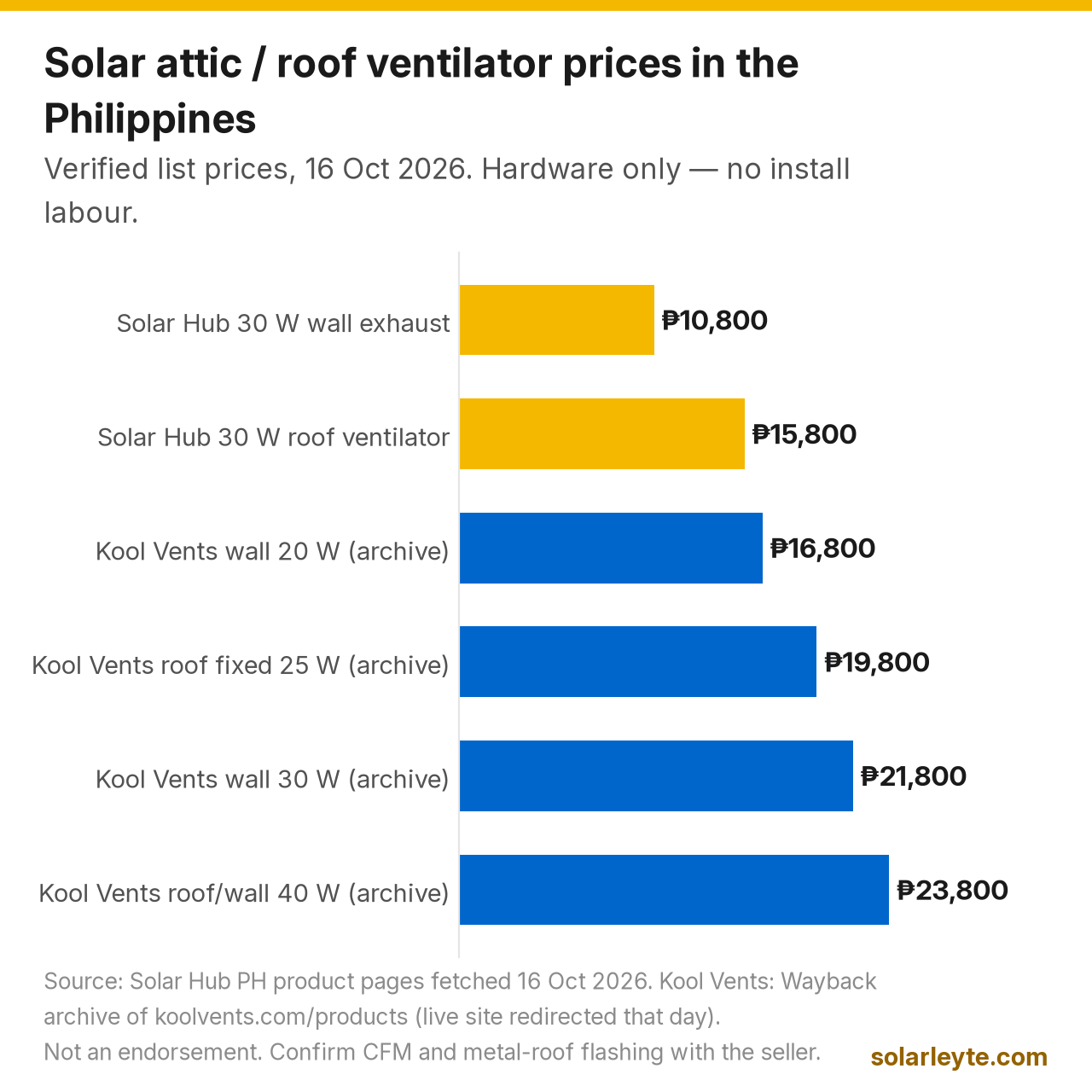
Sources: Solar Hub product and category pages fetched 16 Oct 2026. Kool Vents prices from a Wayback Machine capture of koolvents.com/products (the live site redirected to a lander page when we checked the same day — treat those peso figures as the last archived list prices, and confirm with the seller before you buy).
What the table says:
- A serious roof or wall solar ventilator from a PH solar shop is five figures, not ₱2,000. The ₱2,450 Solar Hub 10″ fan is a different product class.
- Wall units avoid a roof hole. That matters in typhoon country. You still need a sealed wall opening and weather louvers.
- Neither Solar Hub nor the Kool Vents archive published CFM (airflow) on the pages we saved. Ask the seller for airflow in CFM or m³/h before you compare brands. US makers publish it; see the benchmark table below.
- Prices move. Solar Hub's roof unit was marked down from ₱25,000 to ₱15,800 on the day we checked. Re-check before you order.
We did not invent a MACC install price for these fans. MACC is a rooftop solar installer; this post is about third-party ventilators you can buy yourself or have a roofer fit.
Maker airflow benchmarks (US brands — for scale)
Because local listings often skip CFM, here is what established US solar attic fan makers claim, so you know what "high CFM" marketing means:
Brand / model class | Solar panel | Claimed airflow | Claimed attic coverage |
|---|---|---|---|
Kennedy 32 W | 32 W | up to 1,560 CFM | up to 2,200 sq ft |
Kennedy 35 W | 35 W | up to 1,599 CFM | up to 2,400 sq ft |
Kennedy 48 W | 48 W | up to 1,881 CFM | up to 2,825 sq ft |
Kennedy 65 W | 65 W | up to 2,105 CFM | up to 3,350 sq ft |
FSEC test fans (Solar Dynamic SDF-10, 1997 case study) | ~10 W thin-film each | 600–800 CFM at ~1,000 W/m² sun | two units on a ~1,045 sq ft Florida house |
Sources: Kennedy performance page; FSEC-GP-171-00. Checked 16 Oct 2026.
CFM is cubic feet of air moved per minute. More CFM moves more attic air — and can also pull harder on the house if the ceiling isn't sealed and soffit intake is too small. Building America suggests targeting about 50 CFM per 1,000 sq ft of attic floor if you use a fan at all, and making sure intake area is ample. A 1,500 CFM unit on a small Filipino roof with weak soffit vents is overkill and can backfire.
Are solar attic fans worth it? What the research says
FSEC Central Florida case study (the main number)
Parker and Sherwin at the Florida Solar Energy Center instrumented an occupied Cocoa, Florida home (~1,045 sq ft conditioned, R-19 ceiling, radiant barrier already installed, dark asphalt shingles). On 6 August 1997 they added two PV attic ventilators (~10 W each, 600–800 CFM at peak sun). Comparing weather-matched periods before and after:
Result | Measured value |
|---|---|
Peak attic air temperature drop | average ~22°F (about 12°C) lower daily peak |
Space cooling electricity | ~6.0% less (2.8 kWh/day) |
Estimated annual cooling savings | ~460 kWh/year |
Hardware cost then | ~US$300 per fan; ~US$600 for the pair; ~US$850 installed |
Simple payback at then-current Florida rates | over 20 years (~US$37/year of electricity) |
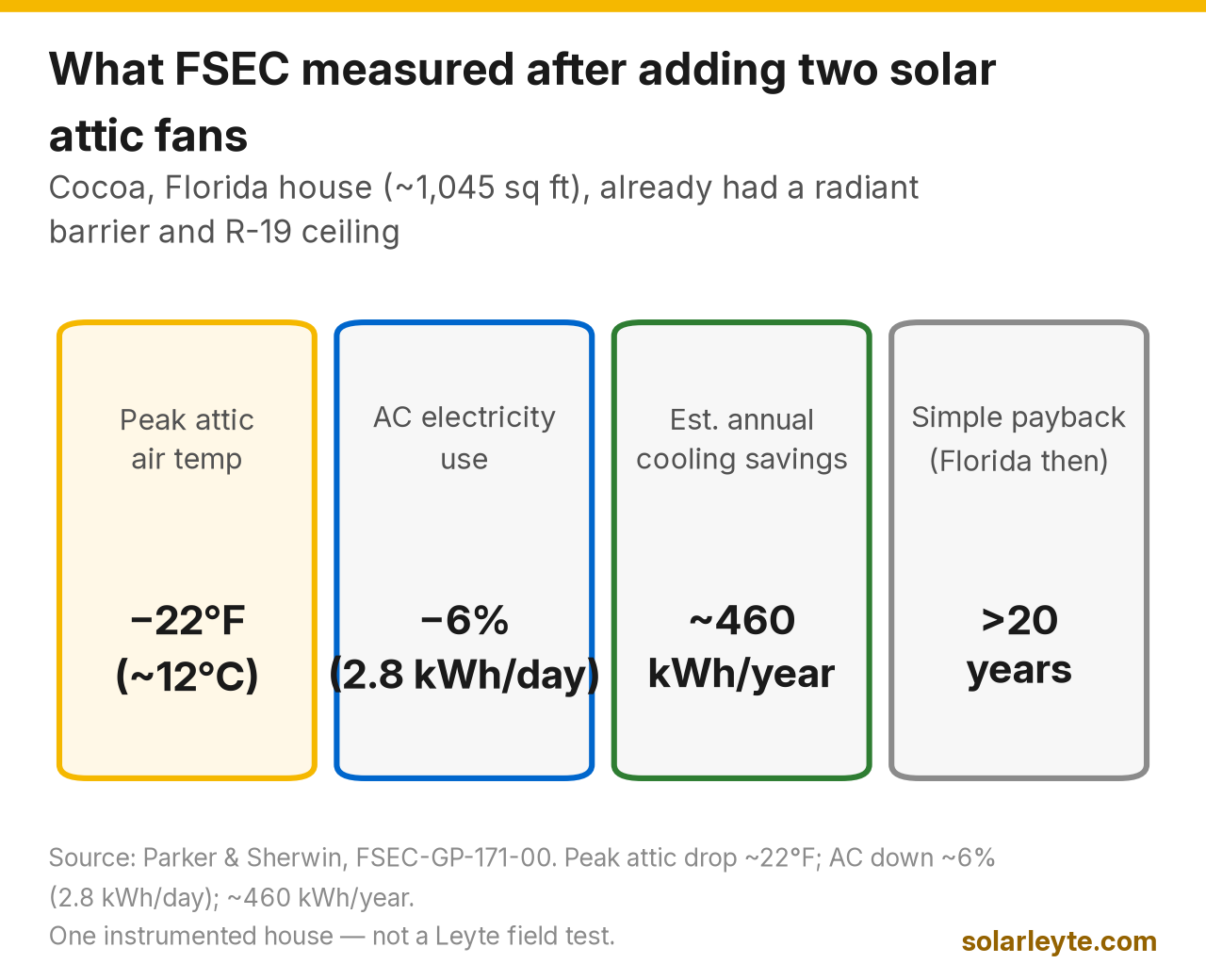
Source: Danny S. Parker & John R. Sherwin, "Performance Assessment of Photovoltaic Attic Ventilator Fans", FSEC-GP-171-00. PDF copy saved in our research folder.
FSEC's own conclusion: the fans clearly cooled the attic, the seasonal cooling impact with a well-insulated attic was fairly modest, and other measures (more insulation, radiant barrier, reflective roof) are often better value for heat control. The homeowner did report better comfort without changing the thermostat — possibly from a lower mean radiant temperature at the ceiling.
Building America / DOE (why the savings stay small)
The Building America Solution Center summary cites FSEC and related work and notes:
- Heat from the roof deck to the insulation is mostly radiant, so moving attic air helps less than people expect.
- Grid-powered attic fans often use more electricity than they save.
- Risks of negative pressure (pulling house air into the attic, moisture issues) are real; thorough ceiling air sealing and enough intake vents reduce them.
- Solar-powered fans are the least-bad powered option if you insist on a fan: daytime-only, no parasitic load, usually lower CFM.
Source: Attic Ventilation Fans, Building America Solution Center (PNNL), accessed 16 Oct 2026.
Labelled example: 460 kWh at a Biliran rate
This is a Solar Leyte calculation for illustration only — not a measured Leyte field result.
If a house somehow saved the same 460 kWh/year FSEC estimated, at BILECO's September 2026 residential rate of about ₱18.93/kWh (as tracked on our BILECO rate post), that would be about ₱8,700/year of bill value (460 × 18.93 ≈ ₱8,708).
Against a ₱15,800 Solar Hub roof list price (hardware only, no labour), a naive payback would look like about 1.8 years — much better than Florida's 1990s dollar math. Do not take that as a promise. Reasons it can fall apart:
- FSEC's house already had a radiant barrier and R-19 insulation; your GI roof and ceiling build-up will differ.
- Many Leyte houses don't run central air 7,730 kWh/year like that Florida test home. If you cool with one window inverter, absolute kWh savings shrink with the bill.
- Install labour, flashings and typhoon-grade sealing cost extra.
- If the attic is already open to the eaves and the ceiling is well insulated, the next peso may be better spent on insulation, a radiant barrier foil, or right-sizing solar for the aircon.
Honest takeaway: buy a solar attic fan for attic heat extraction and comfort, not as a guaranteed short payback gadget. Expect a small cut in cooling load if you run aircon under a hot roof; expect a noticeable drop in how hot the attic feels on a sunny afternoon.
Typhoon fit: roof holes, sealing and metal roofs
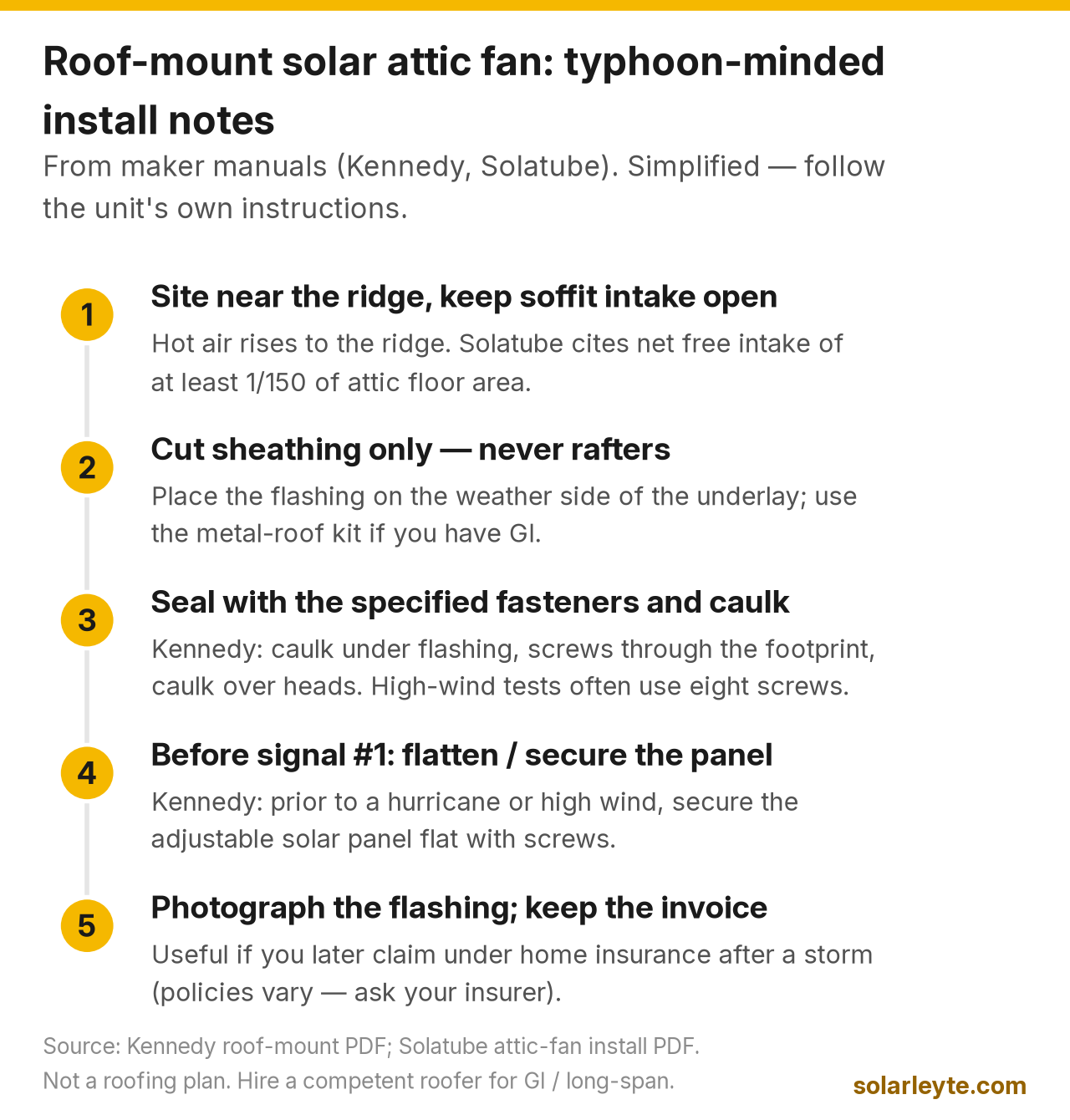
Leyte and Biliran sit in typhoon country. A roof-mounted ventilator is a penetration through the waterproofing. Maker install manuals (US brands we archived) keep repeating the same rules:
- Cut sheathing, not rafters. Place the unit near the ridge where hot air collects (Solatube install guide).
- Use the specified fasteners and sealant. Kennedy's roof-mount instructions call for caulk under the flashing, screws through the flashing footprint, and caulk over exposed screw heads. For Florida / high-wind code compliance they and Solatube reference eight flashing screws on tested assemblies — more than a casual "four screws and hope" DIY job (Kennedy roof-mount PDF; Solatube parts list: eight #10 × 2″ flashing screws).
- Flatten adjustable solar panels before a storm. Kennedy's manual says explicitly: prior to an anticipated hurricane or high wind event, the solar panel must be secured with screws in the flat position. Treat a signal #1 the same way you'd prepare panels on a rooftop array — see our typhoon checklist.
- Keep soffit / eave intake open. Solatube cites a net free intake of at least 1/150 of attic floor area (or local code). A powerful exhaust with blocked eaves just pulls house air through ceiling gaps.
- Metal roof panels need a compatible flashing kit. Solatube lists metal roof panels among supported roof types, but that means the right flashing, not a shingle kit forced onto GI. Ask the seller for a metal-roof install detail before you cut.
- Wall units dodge the ridge cut. A wall exhaust still needs a sealed opening and storm-rated louvers, but it doesn't interrupt ridge or mid-slope waterproofing.
After install, photograph the flashing and keep the invoice. If a typhoon later lifts the unit, your home insurance questions get easier with that paperwork — rooftop ventilators are often treated like other roof fixtures, but policies vary; ask your insurer before storm season.
Leyte and Biliran: when it helps, when it doesn't
More likely to help
- Hot, poorly ventilated attic or roof cavity under dark GI, with rooms that feel radiant-hot in the afternoon even when the AC runs.
- You already run an inverter aircon and want a modest cut in how hard it works midday (FSEC-scale: single-digit percent, not half the bill).
- You can keep eaves open and seal the ceiling plane (no big gaps around downlights and joists).
Less likely to help / wrong tool
- You mainly want a cool bedroom at night — get the right HP aircon and, if bills hurt, look at solar for aircon or a hybrid rooftop system instead.
- The roof is about to be replaced — fix insulation / radiant barrier / colour while the sheets are off; a fan alone is backwards.
- You can't get a competent roofer for typhoon-grade flashing — a wall unit or passive ridge/soffit vents are safer than a leaky roof cut.
- Brownout resilience is the goal — a ventilator doesn't keep the lights on; see the Visayas grid alert explainer and battery options elsewhere on the site.
Buying checklist (Philippines)
- Confirm CFM or m³/h in writing — not just "powerful cooling".
- Confirm panel watts, motor IP rating, and whether an AC/DC adapter is included (Solar Hub's roof and wall units include one).
- Ask for metal-roof flashing instructions if you have GI or long-span.
- Plan intake vents before you cut the exhaust hole.
- Budget labour and sealant, not only the unit price.
- Storm drill: who flattens or removes the panel when PAGASA raises signals?
- Compare against insulation / radiant barrier quotes for the same roof — FSEC and Building America both put those higher on the value ladder for heat control.
FAQ
How much is a solar attic fan in the Philippines? On 16 October 2026, Solar Hub listed a 30 W roof ventilator at ₱15,800 and a 30 W wall exhaust at ₱10,800. Archived Kool Vents list prices ranged from ₱16,800 (20 W wall) to ₱23,800 (40 W roof or wall). Small 10″ solar fans start much lower (~₱2,450 at Solar Hub) but are not full attic roof ventilators.
Do solar attic fans really save electricity? Published data says a little. FSEC measured about 6% less air-conditioning use (~460 kWh/year) after adding two solar attic fans on one Florida house. Grid-powered attic fans often fail a net-savings test; solar avoids the fan's own electricity use.
Are solar attic fans worth it in Leyte's heat? For attic heat extraction and comfort under a hot metal roof, they can help. For a big cut in your bill, insulation, a radiant barrier, a cooler roof colour, or solar that offsets the aircon usually matter more. We don't have a published Leyte field study with the same meters FSEC used — so treat US percentages as guidance, not a guarantee.
Will a solar attic fan survive a typhoon? Only if it's installed with proper flashing, fasteners and sealant, and adjustable panels are flattened or secured before high winds (per maker manuals). A roof penetration that leaks after Yolanda-class rain is worse than a hot attic. Wall-mounted units avoid the ridge cut.
Roof mount or wall mount? Roof mounts sit where the hottest air pools (near the ridge) and need careful waterproofing. Wall mounts skip the roof hole and suit kitchens, stores or industrial spaces; Solar Hub's wall unit was ₱10,800 on our check day vs ₱15,800 for their roof unit.
How many CFM do I need? Building America cites about 50 CFM per 1,000 sq ft of attic floor as a modest target when a fan is used. US residential solar attic fans often advertise 600–2,000+ CFM — ask what your PH unit actually delivers, and match intake vent area so you aren't depressurising the house.
Solar Leyte is run by MACC Systems & Energy Solutions Inc., a solar installer in Naval, Biliran.
Get a free solar quote from MACC
Hot roof, high aircon bills, or a house you're preparing for typhoon season? Tell us your roof type (GI, long-span, tile), roughly how many square metres, and whether you already run inverter aircon. We'll say whether a ventilator, better roof-side heat control, or a rooftop solar system is the better next step. No made-up MACC attic-fan price list in this article — only third-party shop prices we could document.
- Call/Text: 0955 723 5093
- Email: official@macc-inc.com or benjie@macc-inc.com
- Website: www.macc-inc.com
- Office: Brgy. Talustusan, Naval, Biliran 6543
- Or use the site quote form: /quote
Sources (all checked 16 October 2026)
- Solar Hub PH: 30 W Solar Powered Roof Ventilator, 30 W Solar Wall Exhaust Fan, Solar Fans category
- Kool Vents product prices: Wayback capture of koolvents.com/products (live site redirected on our check day)
- Florida Solar Energy Center: Parker & Sherwin, FSEC-GP-171-00 — Performance Assessment of Photovoltaic Attic Ventilator Fans (HTML + PDF)
- US DOE Building America Solution Center (PNNL): Attic Ventilation Fans
- Kennedy Skylights: solar attic fan performance / CFM chart, roof-mount installation PDF (hurricane panel-flatten note)
- Solatube: Solar Powered Attic Fan installation instructions (PDF) (eight flashing screws; 1/150 intake; metal roof panels listed)
- BILECO rate cross-check: BILECO rate per kWh 2026 (₱18.93/kWh Sep 2026 residential via PRESYO-PH, as cited there)
- ₱8,708/year illustration and 1.8-year naive payback: Solar Leyte calculations labelled in this article
- Related on Solar Leyte: typhoon preparedness guide, typhoon checklist, solar panel insurance, solar aircon, solar for aircon, Visayas grid alerts, panel cleaning