On 17 October 2026, Philippine shops listed solar electric fans from ₱999 for a small 8-inch Akari to ₱4,999 for a 16-inch Akari stand fan. Firefly's 12-inch desk fan with a solar panel was ₱3,000 to ₱3,300, and Solar Hub's 10-inch solar fan was ₱2,450. The stand fans in our list hold about 27 to 74 watt-hours (Wh) of battery. That's enough to run one fan through a typical 4-hour evening brownout on medium or high (depending on the model), or all night on low. Refilling the battery from the fan's own panel takes about one average December day in Naval for most of them. The ones sold with tiny 3–5 W panels take about two.
The short version: don't buy by the mAh number on the box. Multiply the battery voltage by the mAh, check the panel's watts, and read the run time for the speed you'll actually use. We did that maths for 10 models below.
Last checked: 17 October 2026.
This post is about fans with their own battery and panel. Roof and wall exhaust fans that pull heat out of a GI roof are in our solar attic fan guide. How much a regular plug-in fan costs to run is in our appliance kWh post. If you want one battery for the fridge, fans, lights and Wi-Fi together, compare portable power stations instead. The overview of all of these is our solar generators and portable power guide.
Three kinds of "solar fan"
Shops use the same words for three very different things:
- Rechargeable fan with a solar panel (the common one). A DC fan with a built-in battery. You charge it from the wall or from a small panel that comes in the box, then run it at night or in a brownout. Almost everything in our price table is this type.
- Rechargeable fan with a solar port but no panel, or a tiny built-in panel. Some fans list a "12V DC solar charging port" but ship without a panel. Akari's ARF-SNG box fan has its panel built in and says solar charging takes "up to 24 hours" of direct sunlight. That's several Philippine days. Treat these as plug-in rechargeable fans that can top up from the sun.
- Panel-direct fans with no battery. These run only while the sun shines, or from an adapter. Solar Hub's 60-inch solar ceiling fan (₱18,500, down from ₱35,000) runs a 24 V brushless motor from a 40 W panel, with an AC/DC adapter for "sunless periods". Useful for a daytime cottage or a farm shed. No use at 8 pm in a brownout unless the grid is on.
Solar electric fan prices in the Philippines (listed 17 October 2026)
Prices and specs are copied from the sellers' own pages on 17 October 2026. "Battery in Wh" is our calculation (volts × amp-hours). Run times are the seller's "up to" figures.
Fan | Listed price | Battery as stated | Battery in Wh (our calc) | Solar panel (as listed) | Stated run time | Seller |
|---|---|---|---|---|---|---|
Akari 8" Solar LED Fan (ARF-S8318) | ₱999 | 2 × 3.7 V 1,200 mAh lithium-ion | about 8.9 Wh | 3 W, 6 V, comes with the fan | High 1.7 h, low 7 h | Akari Store |
Gold Star 16" Solar Fan | ₱1,779 (reference price) | 7.4 V 10,000 mAh | 74 Wh | 12 W, 9 V | Not given | mybest PH (Shopee reference price) |
Akari 12" Rechargeable Fan (ARF-5313F) + 5 W panel bundle | ₱2,499 (was ₱3,598) | 6 V 4.5 Ah sealed lead-acid | 27 Wh | 5 W, 9 V, in the bundle | Not given | Akari Store |
Solar Hub Solar Fan 10" | ₱2,450 (was ₱3,800) | 11.1 V 5 Ah lithium-ion | 55.5 Wh | 30 W, 15 V | 6–8 h (speed not stated) | Solar Hub PH |
Akari Solar Rechargeable Box Fan (ARF-SNG) | ₱2,799 | 3.7 V 10,000 mAh lithium-ion | 37 Wh | Built in, watts not stated | High 3.5 h, low 14 h | Akari Store |
Firefly 12" Rechargeable Desk Fan with Solar Panel and Lamps (FEL6116) | ₱3,000 to ₱3,300 | 6 V 4.5 Ah lead-acid | 27 Wh | Comes with a panel; 9 V input, watts not stated | High 3 h, mid 8 h, low 10 h | powertool.ph, FELCO Store |
Akari 12" Solar Rechargeable Fan (ASF-12) | ₱3,999 (was ₱4,999) | 6 × 3.7 V 2,200 mAh lithium-ion | about 48.8 Wh | 18 W, 14 V | High 5 h, low 30 h | Akari Store |
Akari 16" Solar Wall Fan (ARWF-S01B) | ₱4,299 (sold out) | 11.1 V, 6 × 2,200 mAh lithium-ion | about 48.8 Wh | 20 W, 14 V | Up to 13 h | Akari Store |
Akari Solar Stand Fan (ARSF-S16W) | ₱4,999 | "11.1 V 13,200 mAh" lithium-ion | 146.5 Wh as written, about 48.8 Wh on our reading (see below) | 18 W, 14 V | High 3.5 h, medium 10 h, low 69 h | Akari Store |
Akari 16" Solar Rechargeable Fan (ASF-16) | ₱4,999 (out of stock) | 9 × 3.7 V 2,200 mAh lithium-ion | about 73.3 Wh | 25 W, 14 V | High 5 h, low 30 h | Akari Store |
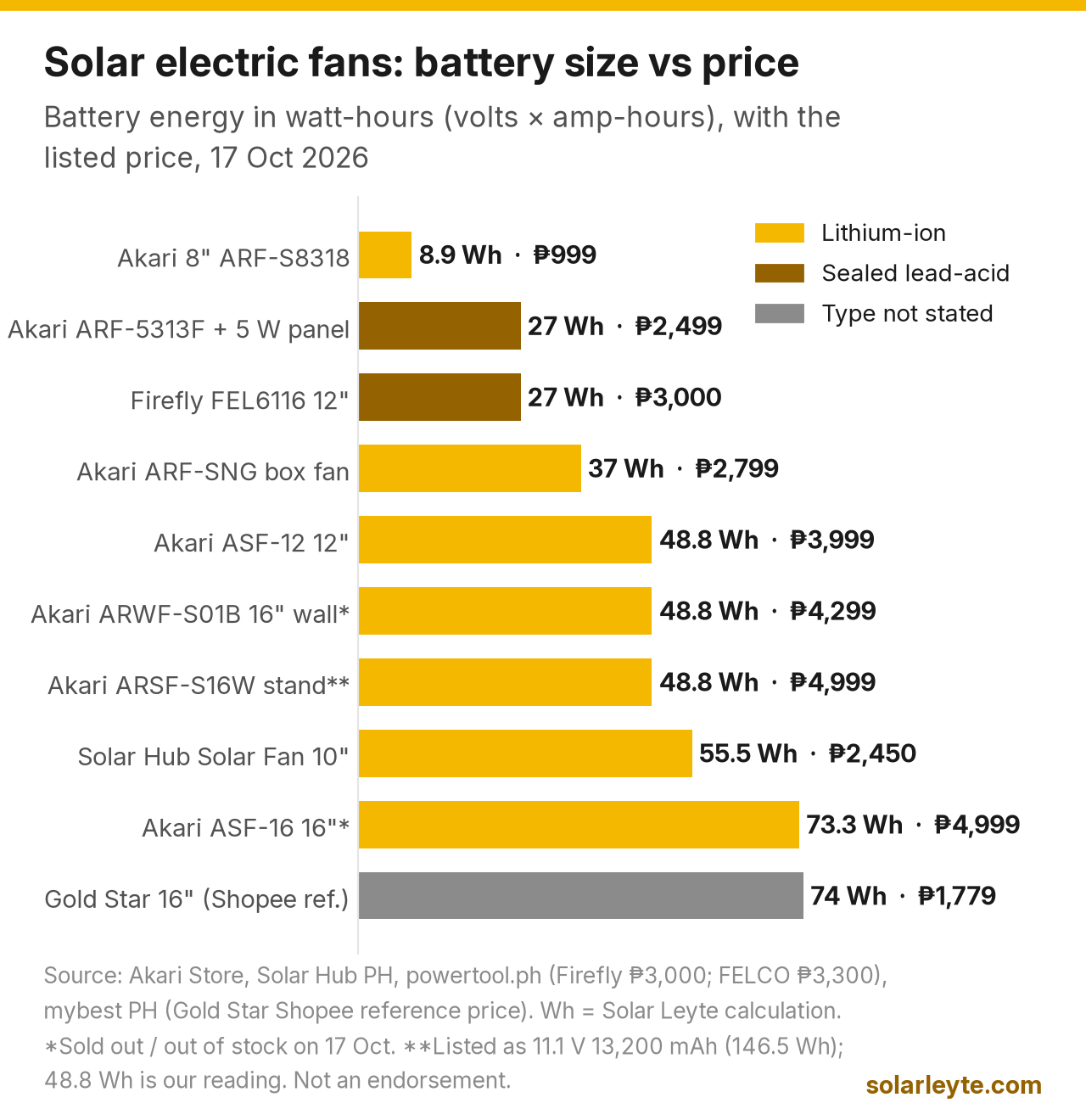
A few things stand out:
- Price doesn't track battery size. The ₱1,779 Gold Star lists the biggest battery here (74 Wh). The ₱3,000–₱3,300 Firefly lists one of the smallest (27 Wh), and it's lead-acid.
- Panel sizes vary tenfold. Listed panels range from 3 W to 30 W. That matters more than anything else if you plan to charge from the sun, and we'll show why below. Check that the panel is actually in the box; some listings only mention a solar port.
- None of the listings give airflow. We found no CFM or metres-per-minute figure for the stand fans, so we can't tell you which one gives the strongest breeze. The run times and the battery maths are what we can check.
Not an endorsement. These are the listings we could read on 17 October. Stock and prices change often, and Lazada or Shopee sellers may price the same model differently.
Read the battery in Wh, not mAh
A mAh number means nothing without its voltage. 10,000 mAh at 3.7 V is 37 Wh. 10,000 mAh at 7.4 V is 74 Wh, twice the energy. The simple formula:
Wh = volts × mAh ÷ 1,000
So the Gold Star's 7.4 V × 10,000 mAh ÷ 1,000 = 74 Wh. Akari's ASF-12 lists six 3.7 V 2,200 mAh cells: 6 × 3.7 × 2.2 = 48.8 Wh.
Then sanity-check the run time. Battery Wh ÷ stated hours on high = the average watts the fan must be drawing on high. For most models the answer is sensible:
Fan | Battery (Wh) | Stated hours on high | Average draw on high (our calc) | Rated power on the label |
|---|---|---|---|---|
Akari 8" ARF-S8318 | 8.9 | 1.7 | about 5.2 W | 6 W |
Firefly FEL6116 | 27 | 3 | about 9 W | 18 W |
Akari ARF-SNG box fan | 37 | 3.5 | about 10.6 W | 12 W |
Akari ASF-12 | 48.8 | 5 | about 9.8 W | 20 W |
Akari ASF-16 | 73.3 | 5 | about 14.7 W | 30 W |
Akari ARSF-S16W, as written | 146.5 | 3.5 | about 41.9 W | 19 W |
Akari ARSF-S16W, on our reading | 48.8 | 3.5 | about 14 W | 19 W |
The ARSF-S16W line doesn't add up as written. An 11.1 V 13,200 mAh battery would hold 146.5 Wh. Running that flat in 3.5 hours means drawing about 42 W, more than twice the fan's 19 W rating. Our reading: 13,200 mAh is six 2,200 mAh cells added together, which is how Akari describes the battery on its ASF-12 (6 × 3.7 V 2,200 mAh) and its 16-inch wall fan (11.1 V, 6 × 2,200 mAh). Six of those cells hold about 48.8 Wh. At that size, 3.5 hours on high works out to about 14 W, which fits the 19 W rating. That's our inference, not Akari's statement. If the real Wh matters to you, ask the seller before you buy.
Also notice that the Firefly and the bigger Akari solar fans draw only about half their label watts on high. The label figure may include charging while running, but none of the listings say. Trust the stated hours and the battery Wh more than the label watts.
For comparison, Meralco's tests put a regular plug-in 16-inch stand fan at 50–60 W (Meralco). That's why a plug-in AC fan can't run long on a small battery, and why rechargeable fans use low-power DC motors.
Will it last through a brownout?
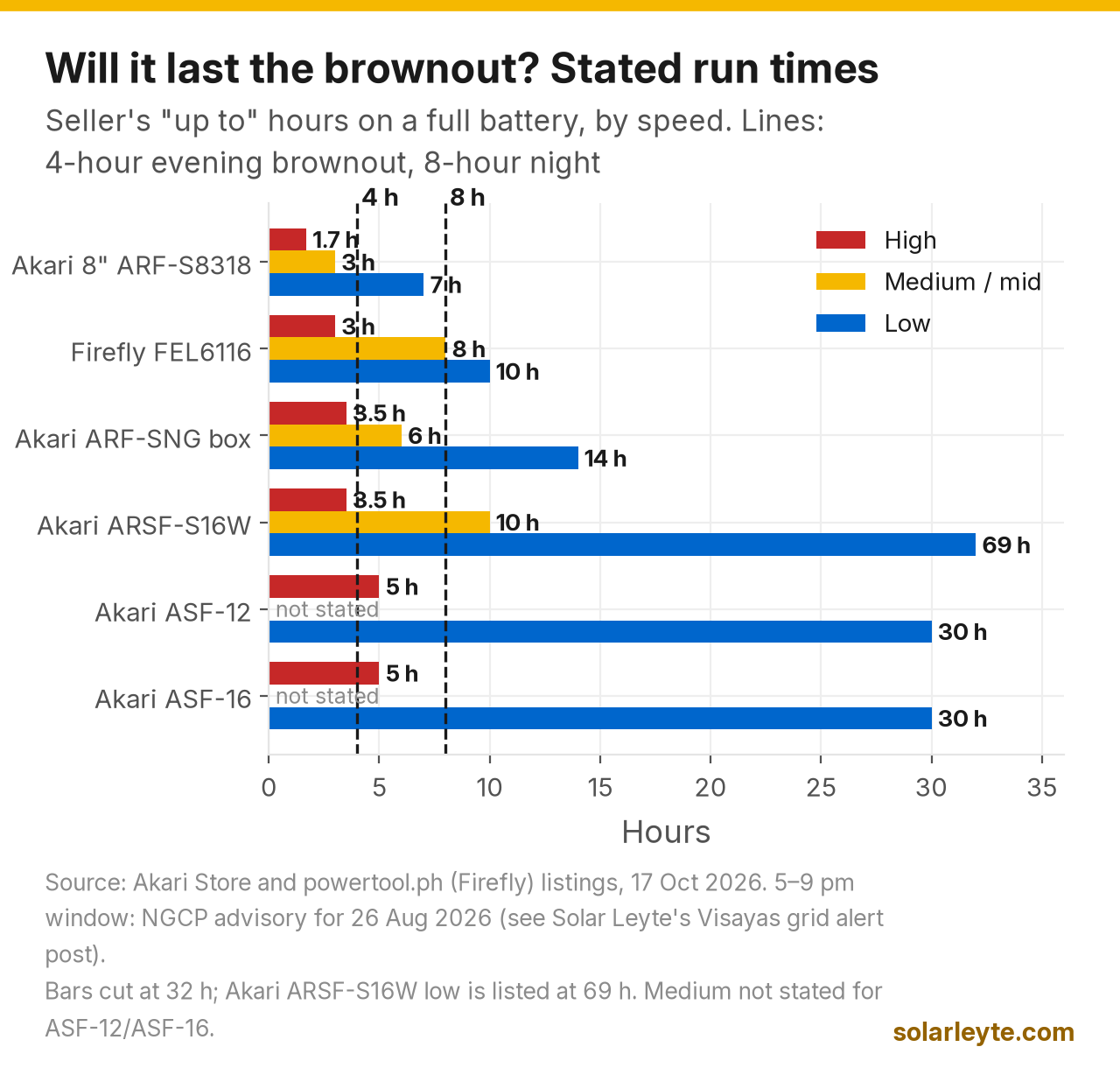
The 2026 load-dropping windows we found for Leyte, Biliran and Samar co-ops ran in the late afternoon and evening. NGCP's 26 August advisory was for 5 pm to 9 pm (details in our Visayas grid alert post). So a useful test is: can it run 4 hours on a setting you'd actually sleep or sit through? And for a whole night: 8 hours?
From the sellers' own run times, with a full battery:
- Four hours on high: only the Akari ASF-12 and ASF-16 (5 h) state that. The Firefly (3 h), the ARF-SNG (3.5 h) and the ARSF-S16W (3.5 h) fall a little short on high, but the Firefly lasts 8 h on mid, the ARF-SNG 6 h on mid and the ARSF-S16W 10 h on medium. The 8-inch ARF-S8318 (1.7 h on high) is a bedside fan, not a brownout fan.
- Eight hours overnight: fine on low for every desk, box or stand fan that states a low time (10 to 69 hours). Medium is the honest setting to check, and only the Firefly (8 h), the ARSF-S16W (10 h) and the ARF-SNG (6 h) state it.
Worked example 1 (example only): one evening brownout
Assumptions: an Akari ASF-12 (48.8 Wh, 5 h on high, 30 h on low), fully charged before 5 pm, a 5–9 pm rotating brownout.
- Four hours on high uses about 4 ÷ 5 = 80% of the battery. You'd have roughly an hour of high left, or several hours on low, for after the grid comes back if it's late.
- If you sleep with it on low for 8 hours instead, that's 8 ÷ 30 = about 27% of the battery.
- The next question is whether the panel can put that back before the next evening. That depends on the month and the panel size, which is the next section.
How long does the panel take to refill it in Biliran?
We ran the European Commission's PVGIS model for Naval on 17 October 2026. A panel lying flat makes, on average, 3.28 kWh per kW of panel per day in December, 3.31 in January, 4.85 in April and 4.01 across the year, after PVGIS's standard 14% system losses (PVGIS 5.3). We took off another 20% for the fan's small charger and battery. That's our assumption, and a lead-acid fan may lose more.
That works out to about 2.6 Wh into the battery per panel watt on an average December day, and about 3.9 Wh in April. Here's what that means for each fan with a stated panel size:
Fan | Battery (Wh) | Panel | Into battery, average December day | Days to fill from empty, December | Days to fill from empty, April |
|---|---|---|---|---|---|
Akari 8" ARF-S8318 | 8.9 | 3 W | 7.9 Wh | 1.1 | 0.8 |
Akari ARF-5313F bundle | 27 | 5 W | 13.1 Wh | 2.1 | 1.4 |
Solar Hub Solar Fan 10" | 55.5 | 30 W | 78.7 Wh | 0.7 | 0.5 |
Akari ASF-12 | 48.8 | 18 W | 47.2 Wh | 1.0 | 0.7 |
Akari ARWF-S01B wall fan | 48.8 | 20 W | 52.5 Wh | 0.9 | 0.6 |
Akari ARSF-S16W (our 48.8 Wh reading) | 48.8 | 18 W | 47.2 Wh | 1.0 | 0.7 |
Akari ASF-16 | 73.3 | 25 W | 65.6 Wh | 1.1 | 0.8 |
Gold Star 16" | 74 | 12 W | 31.5 Wh | 2.4 | 1.6 |
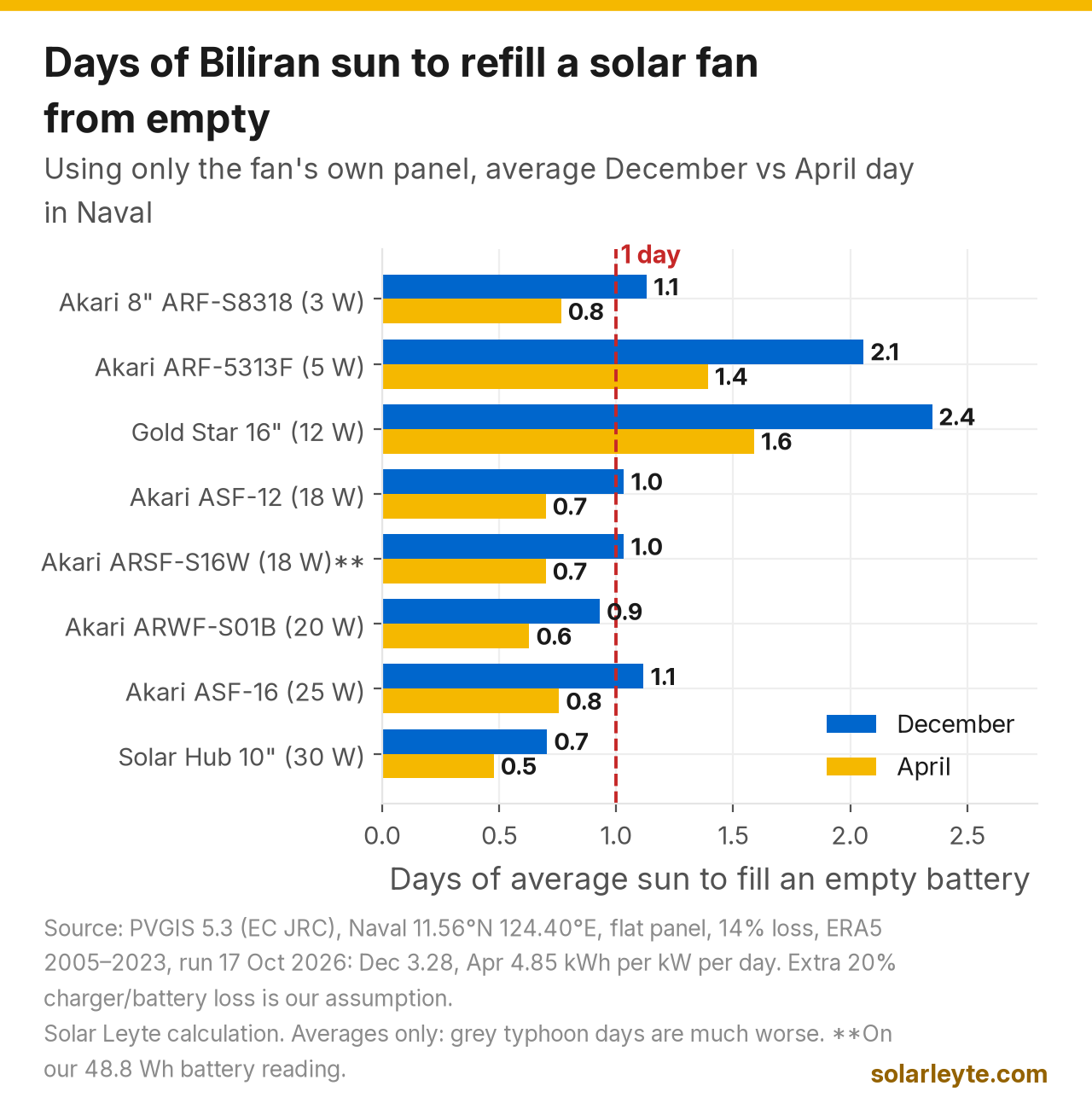
Solar Leyte calculation from PVGIS averages. Real days vary: a clear April day does better, and a grey day during a typhoon week does far worse. PVGIS gives averages, not the worst week. Our off-grid solar post looks at runs of dark days in Naval.
A rule of thumb from these numbers: to refill an empty battery in one average December day in Biliran, the panel's watts should be at least about 40% of the battery's Wh (1 ÷ 2.6). A 48.8 Wh fan wants a panel of about 19–20 W, which is what Akari pairs with its ASF-12 and wall fan. A 74 Wh fan with a 12 W panel needs more than two days. A 27 Wh lead-acid fan with a 5 W panel needs about two.
Worked example 2 (example only): a week of nightly use
Assumptions: a fan averaging 5 W (somewhere between the low and high draws worked out above) for 8 hours every night = 40 Wh a night, with the battery topped up only by its own panel in an average December.
Panel | Into battery per average December day | Balance each day |
|---|---|---|
5 W | about 13 Wh | short by about 27 Wh. The battery runs down within a night or two |
12 W | about 31 Wh | short by about 8–9 Wh. Lasts several nights, then the run time shrinks |
18 W | about 47 Wh | covers it, with a little spare on average days |
30 W | about 79 Wh | covers it, with room for grey days and phone charging |
The lesson: for nightly use, buy for the panel, not for the battery. A big battery with a small panel just takes longer to go flat.
Lithium or lead-acid?
Two of the fans in our table (Firefly FEL6116 and Akari ARF-5313F) use 6 V 4.5 Ah sealed lead-acid batteries. The rest are lithium-ion.
- Charging time: Firefly lists 12–15 hours to charge, from the wall or the panel. The lithium Akari solar fans list up to 4–5 hours on the adaptor (7 hours by USB-C for the ARF-SNG box fan) and up to 7 hours on solar for the ASF-12 and ASF-16.
- Don't leave a lead-acid fan flat. Yuasa's handbook for its NP sealed lead-acid batteries says self-discharge is about 3% a month at 20°C, and faster when it's warmer. A battery left discharged for long can "sulphate" and stop taking a charge. Deeper discharges also mean fewer charge cycles over its life (Yuasa NP handbook). In practice: recharge right after every brownout, and if the fan sits in a cabinet between typhoon seasons, top it up every month or two. That interval is our rule of thumb for Philippine heat, not Yuasa's figure.
- Lithium charges faster, but check the battery too. The battery is still the part most likely to fail first in any of these fans, and the listings we read don't say whether it can be replaced. Ask the seller about battery warranty and spare batteries before you pay.
Does a solar fan save money on your bill?
A little, if you use it every night instead of a plug-in fan. It's mainly a brownout tool, though.
Worked example 3 (example only): replacing a plug-in fan
Assumptions: a regular 16-inch stand fan on medium uses about 0.048 kWh an hour (Meralco test, see our appliance post), run 8 hours a night, every night, at BILECO's September 2026 residential rate of ₱18.93/kWh (PRESYO-PH, see our BILECO rate tracker).
- One night: 0.048 × 8 = 0.38 kWh, about ₱7.20.
- One year of nights: about ₱2,630.
- A ₱3,999 Akari ASF-12 running only on its own panel would take about 1.5 years to pay for itself that way. That assumes it fully replaces the plug-in fan every night, the panel keeps up (it does on average, per the table above), and the battery lasts. We don't know the battery's life from the listing.
If you already have a regular fan and only need cover for a few brownouts a month, the bill savings are small. The value is staying cool when the grid is down.
What to check before you buy
- Battery voltage and mAh, so you can work out Wh. If the listing gives mAh with no voltage, ask. If the hours on high multiplied by the label watts come to more than the battery's Wh, ask again.
- Panel watts and whether it's included. Aim for about 40% of the battery's Wh if you'll rely on solar (our rule of thumb above). For mono vs poly and what panel ratings really mean, see our small solar panels post.
- Run time on medium, not just "up to" on low. Low-speed figures like 30 or 69 hours look great on a box, but most people sleep on medium.
- Battery type and warranty. Lithium charges faster. Lead-acid needs recharging after every use. Ask if the battery is replaceable.
- Cable length and weather rating. Akari lists a 3-metre cord and an IP54 rating on its 5 W panel. You want the panel in the sun and the fan inside, so measure. Bring the panel in before a typhoon, as you would anything loose on the roof or in the yard (see our typhoon checklist).
- AC/DC. Most of these can also run and charge from the wall, so the fan is still useful on normal days.
Solar fan, power station or hybrid system?
- One room, one fan, maybe a phone: a solar electric fan in the ₱2,500–₱5,000 range is the cheapest way to cover an evening brownout.
- Fan, lights, Wi-Fi and the fridge: our power station comparison found a 1 kWh unit covers a fridge, two fans, lights and Wi-Fi through a 4-hour brownout, at ₱29,990 to ₱46,900.
- The whole house, every brownout: that's a hybrid solar system with a battery. Start with our solar battery price guide.
FAQ
How long does a solar electric fan last on a full charge? From the listings we read on 17 October 2026: about 3 to 5 hours on high for most stand fans (Firefly 3 h, Akari ASF-12 and ASF-16 5 h), and 10 to 30 hours or more on low. Small 8-inch fans manage under 2 hours on high.
Can a solar fan run all night? Yes, on low or medium, if the battery started full. Every stand fan in our table that states a low-speed time lists 10 hours or more. Whether it runs all night again tomorrow depends on the panel. In Naval, a panel needs about 40% of the battery's Wh in watts to refill it in an average December day.
Does a solar fan charge on cloudy days? Yes, but slowly. PVGIS averages for a flat panel in Naval are about a third lower in December and January than in April, and a heavily overcast typhoon day gives much less than the average. Charge from the wall whenever the grid is on.
What's a good solar electric fan price in the Philippines? In our 17 October 2026 list, 12–16-inch fans with a panel ran from ₱1,779 to ₱4,999. Compare them by battery Wh and panel watts, not by price or mAh. The ₱1,779 Gold Star listed the biggest battery but a 12 W panel, and the ₱2,450 Solar Hub fan listed the biggest panel (30 W).
Is lithium or lead-acid better in a rechargeable fan? Lithium charges faster (up to 4–7 hours on the Akari listings vs 12–15 hours on the Firefly). A sealed lead-acid fan works too, but recharge it after every use. Battery makers like Yuasa warn that leaving lead-acid discharged shortens its life.
Solar Leyte is run by MACC Systems & Energy Solutions Inc., a solar installer in Naval, Biliran.
Get a free solar quote from MACC
Tired of brownout fans and want power for the whole house? Send us a recent electric bill, a photo of your roof, and a list of what you want running during a brownout. We'll get back to you with a free, no-obligation written quote.
- Call/Text: 0955 723 5093
- Email: official@macc-inc.com or benjie@macc-inc.com
- Website: www.macc-inc.com
- Office: Brgy. Talustusan, Naval, Biliran 6543
- Or use the site quote form: /quote
Related guides
- Solar generators and portable power stations: when they make sense
- EcoFlow and solar generator prices in the Philippines
- How many kWh do your appliances use?
- Small solar panels: 50 W to 200 W prices and what they can run
- MPPT vs PWM charge controllers
Sources (all checked 17 October 2026)
- Akari Store, Akari 8" Solar LED Fan ARF-S8318: ₱999; 6 W; 2 × 3.7 V 1,200 mAh; 3 W 6 V panel; high 1.7 h, medium 3 h, low 7 h; charging up to 6 h
- Akari Store, Akari 12" Rechargeable Oscillating Fan ARF-5313F + 5 W solar panel: ₱2,499 (was ₱3,598); 20 W; 6 V 4.5 Ah sealed lead-acid; 12 V DC solar port; 5 W panel, 9 V cable, 3 m cord, IP54
- Akari Store, Akari Solar Rechargeable Box Fan ARF-SNG: ₱2,799; 12 W; 3.7 V 10,000 mAh; Type-C charging up to 7 h; solar charging up to 24 h in direct sunlight; high 3.5 h, mid 6 h, low 14 h
- Akari Store, Akari 12" Solar Rechargeable Fan ASF-12: ₱3,999 (was ₱4,999); 20 W; 18 W 14 V panel; 6 × 3.7 V 2,200 mAh; adaptor up to 5 h, solar up to 7 h; high 5 h, low 30 h
- Akari Store, Akari 16" Rechargeable Solar Wall Fan ARWF-S01B: ₱4,299 (sold out on 17 October); 20 W; 20 W 14 V panel; 11.1 V 6 × 2,200 mAh; up to 13 h
- Akari Store, Akari Rechargeable Solar Stand Fan ARSF-S16W: ₱4,999; 19 W; 11.1 V 13,200 mAh; 14 V 18 W panel; charging up to 4 h; high 3.5 h, medium 10 h, low 69 h
- Akari Store, Akari 16" Solar Rechargeable Fan ASF-16: ₱4,999 (was ₱5,999, out of stock on 17 October); 30 W; 25 W 14 V panel; 9 × 3.7 V 2,200 mAh; high 5 h, low 30 h
- powertool.ph, Firefly FEL6116 12" Rechargeable Desk Fan with Emergency Solar Panel and Lamps: ₱3,000; 9 V solar socket; 6 V 4.5 Ah lead-acid; charging 12–15 h; fan 10 h low, 8 h mid, 3 h high
- FELCO Store, Firefly Rechargeable Desk Fan with Solar Panel (SKU FEL6116): ₱3,300; 18 W; 230 V or 9 V DC; 6 V 4,500 mAh lead-acid; AC and DC charging 12–15 h
- Solar Hub PH, Solar Fan 10 Inch: ₱2,450 (was ₱3,800); 15 V 30 W polycrystalline panel; 11.1 V 5 Ah lithium-ion; charging 2–3 h; discharging 6–8 h
- Solar Hub PH, 60 inch Solar Powered Ceiling Fan: ₱18,500 (was ₱35,000); 40 W panel; 24 V brushless DC motor; AC/DC adapter
- mybest Philippines, 10 Best Solar Electric Fans in the Philippines: Gold Star 16" Solar Fan reference price ₱1,779 (Shopee) as shown on 17 October, 7.4 V 10,000 mAh battery, 9 V 12 W panel, included panel per its review summary
- European Commission JRC, PVGIS 5.3 PVcalc for Naval, Biliran (11.56°N, 124.40°E), 0° and 20° tilt, 14% system loss, PVGIS-ERA5 2005–2023, run 17 October 2026
- Meralco, We've got the power to be energy savers!: 16" stand fan (50–60 W) ₱0.50 / ₱0.58 / ₱0.67 an hour at the 2024 average rate of ₱12.1817/kWh
- Yuasa, NP valve-regulated lead-acid battery handbook: self-discharge about 3% a month at 20°C, sulphation when stored discharged, cycle life falls with depth of discharge
- PRESYO-PH (ICSC), national electricity rates: BILECO September 2026 residential rate ₱18.93/kWh