"Tier 1" doesn't mean a solar panel is high quality. It's BloombergNEF's list of panel makers whose own-brand panels went into at least six large solar farms that were financed by six different commercial banks in the past two years. BNEF itself says not to use it as a measure of quality. It shows banks were willing to lend against that maker's panels, and nothing about the exact panel on your roof.
So when a listing says "Tier 1", treat it as a sales word. Three things tell you more: the panel's IEC 61215 and IEC 61730 certificates, independent test results such as Kiwa PVEL's Scorecard, and a warranty document that names who handles your claim in the Philippines.
Definitions are from BNEF's methodology paper (4 September 2026). Prices were checked on sellers' websites on 25 October 2026. Listings aren't endorsements or MACC prices, and we earn nothing from these links.
Last checked: 25 October 2026
What BNEF's Tier 1 list actually measures
BloombergNEF (BNEF), Bloomberg's research arm, builds its Tier 1 list from solar farm financing deals. According to BNEF's Tier 1 methodology, a maker is Tier 1 if:
- it supplied its own brand, made in its own factories, to at least six different projects;
- those projects were financed non-recourse by six different commercial banks (development banks and export-import banks don't count);
- the deals happened in the past two years; and
- each deal was over 10 MW. That threshold applies from the second quarter of 2025. It used to be 5 MW, and 1.5 MW before 2024.
More from the same paper:
- It's a bank-acceptance list, not a quality list. BNEF calls Tier 1 "purely a measure of industry acceptance" that "does not directly account for product quality or financial strength", and adds that there are "many documented examples of quality issues or bankruptcy of tier 1 manufacturers."
- There's no Tier 2 or Tier 3. BNEF only publishes Tier 1. A seller who says "Tier 2 panel, cheaper" is using a made-up grade.
- It changes every quarter (around 18 February, May, August and November), and only the latest list counts.
- It's for paying clients only. BNEF warns that copies online "may have been doctored", and company claims "do not constitute evidence".
- Brand-only sellers aren't tiered. Panels made by someone else under your label don't count.
The smallest deal BNEF counts, 10 MW, is about 2,000 five-kilowatt home systems (our calculation). Tier 1 is about solar farms, not the model, factory or batch that ends up on a roof in Naval or Ormoc.
Tier 1 vs the checks that actually matter
What you're told | What it really covers | What it doesn't cover |
|---|---|---|
"Tier 1" | The maker's panels were used in 6+ bank-financed projects over 10 MW in the past 2 years (BNEF) | Quality, the exact model, the factory, the warranty, or the maker's finances |
"IEC 61215 certified" | Design qualification: a sample of that model passed a lab test sequence for long-term outdoor use (IEC) | Lifetime. IEC says results are "not construed as a quantitative prediction of module lifetime" |
"IEC 61730 certified" | Safety: construction and tests to prevent electric shock, fire and injury (IEC) | Long-term output |
"Kiwa PVEL Top Performer" | One specific bill of materials (BOM) did well in extended lab tests, such as 600 thermal cycles and 2,000 hours of damp heat (Kiwa PVEL) | Other BOMs of the same model, or other factories |
"25-year warranty" | Whatever the warranty PDF says, for the territory it names | Anything not written in that document |
For a home buyer, the certificate and the warranty paper matter most. Kiwa PVEL results are a bonus.
Why the extended tests matter in Leyte and Biliran
Leyte and Biliran are hot and humid all year, which is what damp-heat testing simulates. Kiwa PVEL runs it for 2,000 hours, "double the duration of the IEC/UL certification test" (Kiwa PVEL damp heat). Its thermal cycling test goes from the certification test's 200 cycles to 600 (Kiwa PVEL thermal cycling).
Test | Certification test (IEC/UL) | Kiwa PVEL extended test |
|---|---|---|
Damp heat (heat + humidity) | 1,000 hours | 2,000 hours |
Thermal cycling (hot-cold swings) | 200 cycles | 600 cycles |
Source: Kiwa PVEL 2026 PV Module Reliability Scorecard (damp heat and thermal cycling pages).
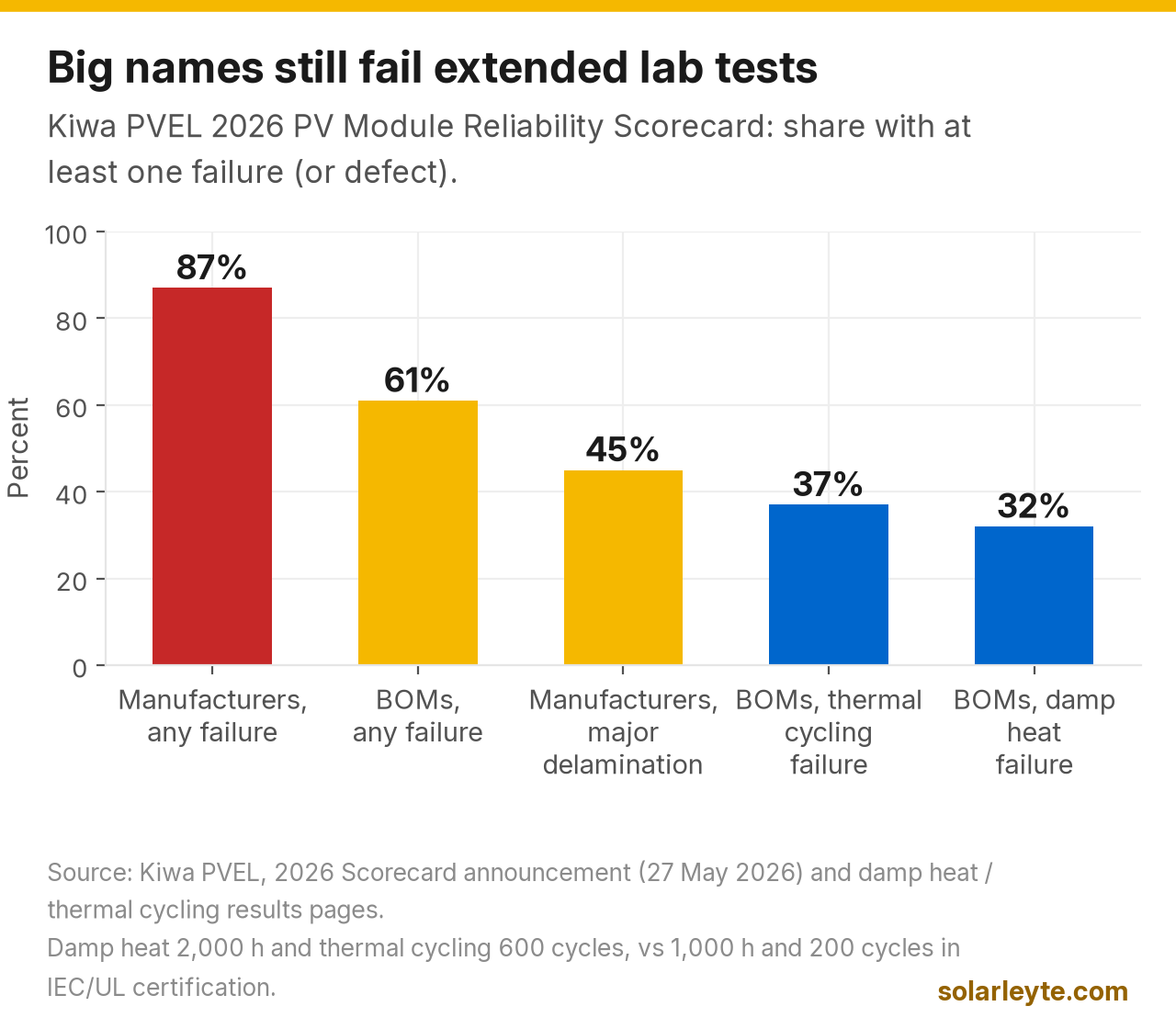
The 2026 Scorecard shows why a big name isn't enough. According to Kiwa PVEL's announcement, 87% of manufacturers and 61% of BOMs tested had at least one failure, and 45% of manufacturers had at least one major delamination defect (layers separating). In damp heat, 32% of BOMs had a failure, including 23% with delamination; in thermal cycling, 37% did. The chart below shows those failure rates side by side.
Still, 43 manufacturers (246 BOMs) were Top Performers in at least one test, though for the first time no model topped every test. Brands sold here such as Aiko, JA Solar, Jinko, LONGi and Trina appear for specific BOMs (Top Performers search), which isn't the same as every panel with that logo. Makers must enter factory-witnessed samples, so a missing brand may simply not have entered. An update is due November 2026.
"Tier 1" listings and prices in the Philippines (25 October 2026)
Here's what we found on 25 October 2026, with price per watt so different sizes compare fairly:
Panel (as listed) | Seller | Listed price | ₱ per watt (our calculation) | Says "Tier 1"? |
|---|---|---|---|---|
Letovo 550 W half-cell | ₱4,800 | ₱8.73 | No | |
Letovo 620 W half-cell | ₱5,700 | ₱9.19 | No | |
Seraphim 630 W bifacial | ₱5,800 | ₱9.21 | No | |
JA Solar 630 W bifacial | ₱6,350 | ₱10.08 | No | |
Aiko 650 W bifacial | ₱7,590 | ₱11.68 | No | |
Aiko 660 W bifacial ABC | ₱8,625 | ₱13.07 | No | |
Jinko "Tier 1 (620W)" | ₱8,624.98 | ₱13.91 | Yes |
Panels only, before freight to Leyte or Biliran. SolarPower Energy has a five-panel minimum order. Sources: seller websites, 25 October 2026; Solar Leyte calculation.
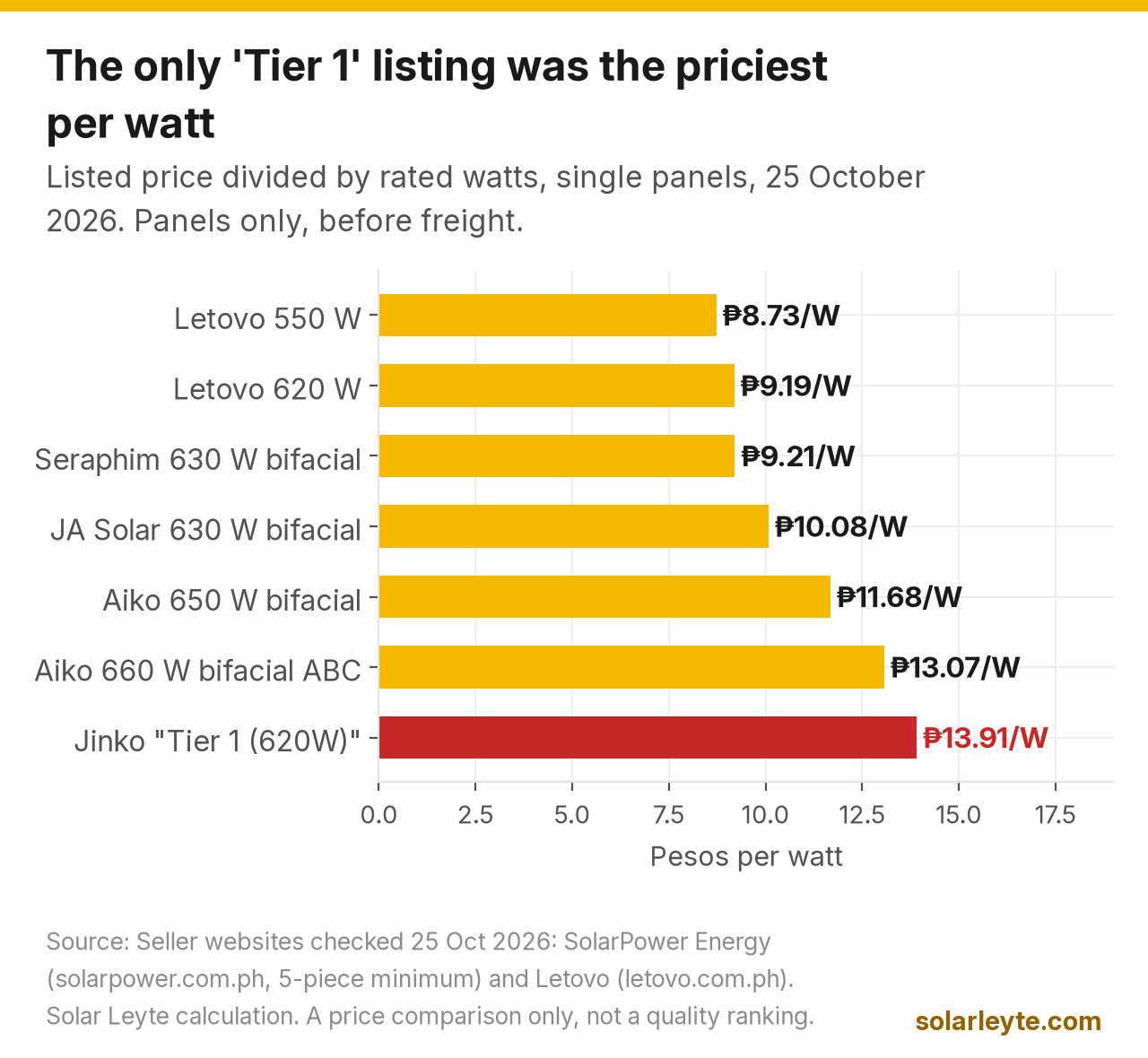
The chart below ranks the same listings by price per watt.
A few things stand out:
- The only "Tier 1" listing was the most expensive per watt. JA Solar and Aiko at the same seller don't use the word, yet both appear among Kiwa PVEL's 2026 Top Performers.
- The Jinko listing doesn't match itself. The title says 620 W; the description lists Tiger Neo 625–725 W models (compare our Jinko vs Trina vs LONGi post). Ask for the exact model code and datasheet.
- "12 years Product Warranty" is a seller badge. Ask for the maker's warranty PDF and who handles claims here; see our lifespan and warranty guide.
For wider price ranges by wattage, see our 550 W to 620 W panel price list and the solar panel price guide.
Worked example: what the label costs on 8 panels
Example only. Assumptions: 8 panels for a roughly 5 kWp home system; listed prices on 25 October 2026; panels only, with no freight, mounting, inverter or labour.
Listing | 8 panels | System size |
|---|---|---|
Letovo 620 W | 8 × ₱5,700 = ₱45,600 | 4.96 kWp |
JA Solar 630 W | 8 × ₱6,350 = ₱50,800 | 5.04 kWp |
Jinko "Tier 1 (620W)" | 8 × ₱8,624.98 = ₱69,000 (rounded) | 4.96 kWp |
For the same 4.96 kWp, the "Tier 1" listing costs about ₱23,400 more. That can be worth it for a better warranty, local claim support or a tested BOM, but ask the seller to show what the extra buys, in writing.
How to check a panel yourself (5 steps)
- Get the model code from the datasheet and the label on the back. DTI's draft rules would require that label to show trade name, model, serial number, date of manufacture, maximum system voltage and rated power.
- Ask for the IEC 61215 and IEC 61730 certificates for that model and look the number up in the issuing lab's database, such as TÜV Rheinland Certipedia or the Intertek Directory.
- Check Kiwa PVEL's free Top Performers search. A match is a plus; a missing name means "no data", not "bad".
- Read the warranty PDF: does it cover the Philippines, who takes claims, is registration required?
- Ignore a "Tier 1 certificate". BNEF gives buyers none. Since March 2026 it offers dated badges only to listed makers that are BNEF clients.
Our installer guide covers the paperwork you should get at handover.
Will the Philippines require certified panels?
Not yet. In May 2026 DTI's Bureau of Philippine Standards released a draft order requiring PS (local) or ICC (imported) certification for panels, inverters, batteries, rapid shutdown devices, charge controllers and PV cables, with panels tested to the PNS IEC 61215 series and 12 months to comply after it takes effect (draft DAO, 25 May 2026). The WTO notice (27 May 2026) set comments to 25 July 2026 and adoption "to be determined" (WTO notification G/TBT/N/PHL/368). We found no signed order on the BPS site on 25 October 2026, so for now checking certificates is up to you.
FAQ
What are Tier 1 solar panels? Panels from makers on BloombergNEF's quarterly list: own-brand panels used in at least six projects over 10 MW, financed by six different commercial banks in two years. It measures bank acceptance, not quality.
Are Tier 1 solar panels better? Not automatically. BNEF says some Tier 1 makers have had quality problems or gone bankrupt. Compare certificates, test data and the warranty for the exact model.
Where can I see the Tier 1 solar panel list for 2026? Only BNEF clients get it, and BNEF warns online copies may be altered. A seller's screenshot isn't proof.
Is there a Tier 2 or Tier 3 solar panel? Not from BNEF. It publishes only a Tier 1 list. "Tier 2" and "Tier 3" are informal sales terms.
How do I know if a solar panel is legit? Match the model code to IEC 61215 and IEC 61730 certificates you can look up, and get a warranty PDF that covers the Philippines.
Solar Leyte is run by MACC Systems & Energy Solutions Inc., a solar installer in Naval, Biliran.
Get a free solar quote from MACC
Send a photo of your last BILECO or LEYECO bill and your roof. We'll size the system and list every panel by model code, with its datasheet, certificates and warranty document, so you can check it yourself. No obligation.
- Call/Text: 0955 723 5093
- Email: official@macc-inc.com or benjie@macc-inc.com
- Website: www.macc-inc.com
- Request a quote online: solarleyte.com/quote
- Office: Brgy. Talustusan, Naval, Biliran 6543
Sources (all checked 25 October 2026)
- BloombergNEF: Tier 1 Solar Module Methodology, 4 September 2026 (six projects, six commercial banks, two years, own-brand and own-manufacture, over 10 MW since 2Q 2025 (5 MW before, 1.5 MW before 1Q 2024), quarterly timing, clients only, no Tier 2/3, not a quality measure, badges since March 2026); Tier 1 reports page
- IEC: IEC 61215-1:2021, design qualification and type approval (results not a lifetime prediction); IEC 61730-1:2023, module safety qualification
- Kiwa PVEL: 2026 PV Module Reliability Scorecard (43 Top Performer manufacturers, 246 BOMs, no BOM a Top Performer in all tests, update due November 2026); announcement, 27 May 2026 (87% of manufacturers and 61% of BOMs with at least one failure, 45% of manufacturers with a major delamination defect, eligibility); damp heat (2,000 h vs certification, 32% of BOMs with a failure); thermal cycling (200 to 600 cycles, 37% of BOMs with a failure); Top Performers search (manufacturer list incl. Aiko Solar, JA Solar, Jinko, LONGi, Trina Solar)
- DTI-BPS: draft DAO on mandatory certification of solar energy systems, 25 May 2026 (scope, PNS IEC 61215 series for modules, module markings, 12-month transitory provision); WTO TBT notification G/TBT/N/PHL/368, 27 May 2026 (comments to 25 July 2026; adoption to be determined); Bureau of Philippine Standards
- Prices (25 October 2026): SolarPower Energy panel category (Seraphim 630 W ₱5,800; JA Solar 630 W ₱6,350; Aiko 650 W ₱7,590; Aiko 660 W ₱8,625; Jinko "Tier 1 (620W)" ₱8,624.98; 5-piece minimum); SolarPower Energy Jinko listing (625–725 W in description, "12 years Product Warranty" badge); SolarPower Energy 630 W bifacial; Letovo 550 W (₱4,800) and 620 W (₱5,700)
- Certificate lookups: TÜV Rheinland Certipedia; Intertek Directory
- Price per watt, the 10 MW = 2,000 home systems comparison and the worked example: Solar Leyte calculations from the figures above