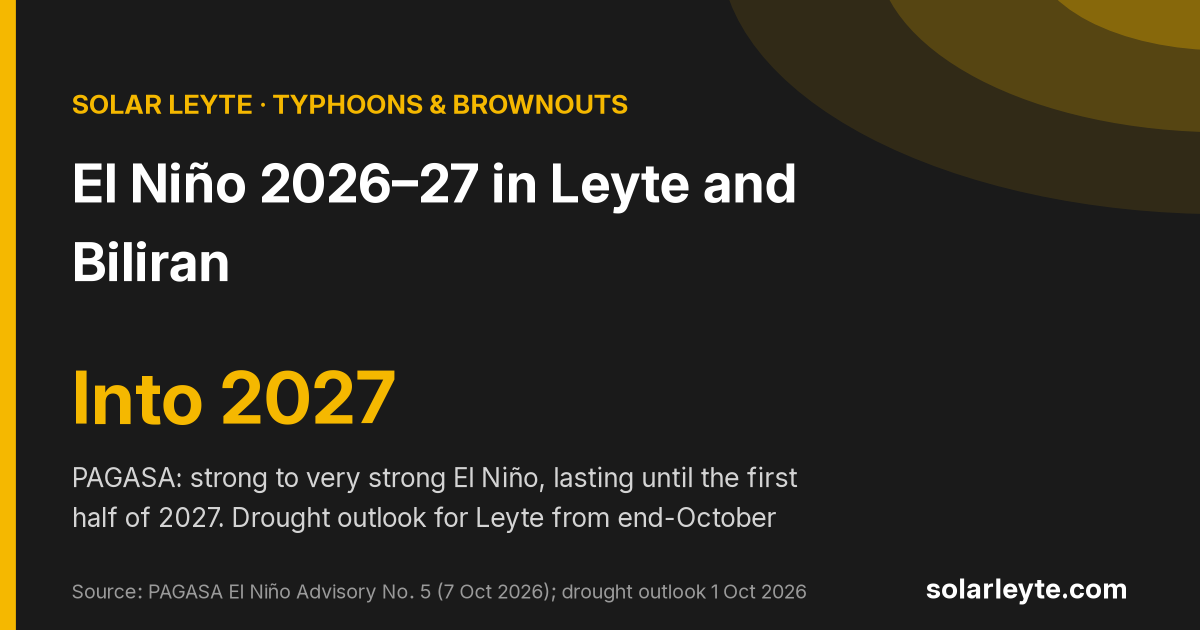
Short answer: yes, El Niño is here. PAGASA's El Niño Advisory No. 5, issued 7 October 2026, says "a strong to very strong El Niño is present" and should "continue until the first half of 2027", possibly peaking before the end of 2026. For Leyte and Biliran that means a long dry stretch: PAGASA's 1 October outlook puts Leyte at risk of drought by the end of October, and Biliran and Southern Leyte by the end of December, through March 2027. Expect more pressure on the already tight Visayas grid, higher electricity use in the heat, and stress on wells and irrigation. One piece of good news: in past strong El Niños, Naval got more sunshine in the dry months, not less, so rooftop solar tends to produce a bit more.
Sa madaling salita: hulaw na pud. Plan for less rain until about March or April, keep following PAGASA and NGCP advisories, and get your water, backup power and solar plans sorted before the driest months, not during them.
Last checked: 19 October 2026. Forecasts change every month, so check PAGASA's next advisory (it's issued monthly) and NOAA's next update (12 November 2026).
Is El Niño already in the Philippines?
Yes. Both the Philippine and US weather agencies have an El Niño Advisory up, the status each uses once El Niño has actually formed.
Agency | Status (as of 19 Oct 2026) | Latest update | What it says |
|---|---|---|---|
DOST-PAGASA | El Niño Advisory (first issued 9 June 2026) | Advisory No. 5, 7 Oct 2026 | Strong to very strong El Niño present; continues until the first half of 2027; may peak before the end of 2026 |
NOAA Climate Prediction Center (US) | El Niño Advisory | ENSO discussion, 8 Oct 2026 | Niño-3.4 at +2.1°C; strong-to-very-strong El Niño likely through January–March 2027 (more than 83% chance) |
NOAA even gives an 83% chance that October–December beats every El Niño since 1950. That's about ocean temperatures, not exactly how dry it gets here, but PAGASA warns El Niño "increases the likelihood of below-normal rainfall".
For October, PAGASA forecasts below-normal rain over most of Luzon, Visayas and Caraga, with "meteorological drought/dry spells … likely" by month-end in most of Eastern Visayas. September was already hot nearby: Catbalogan (37.2°C) and Borongan (37.7°C) broke their September records.
What PAGASA expects for Leyte, Biliran and Samar
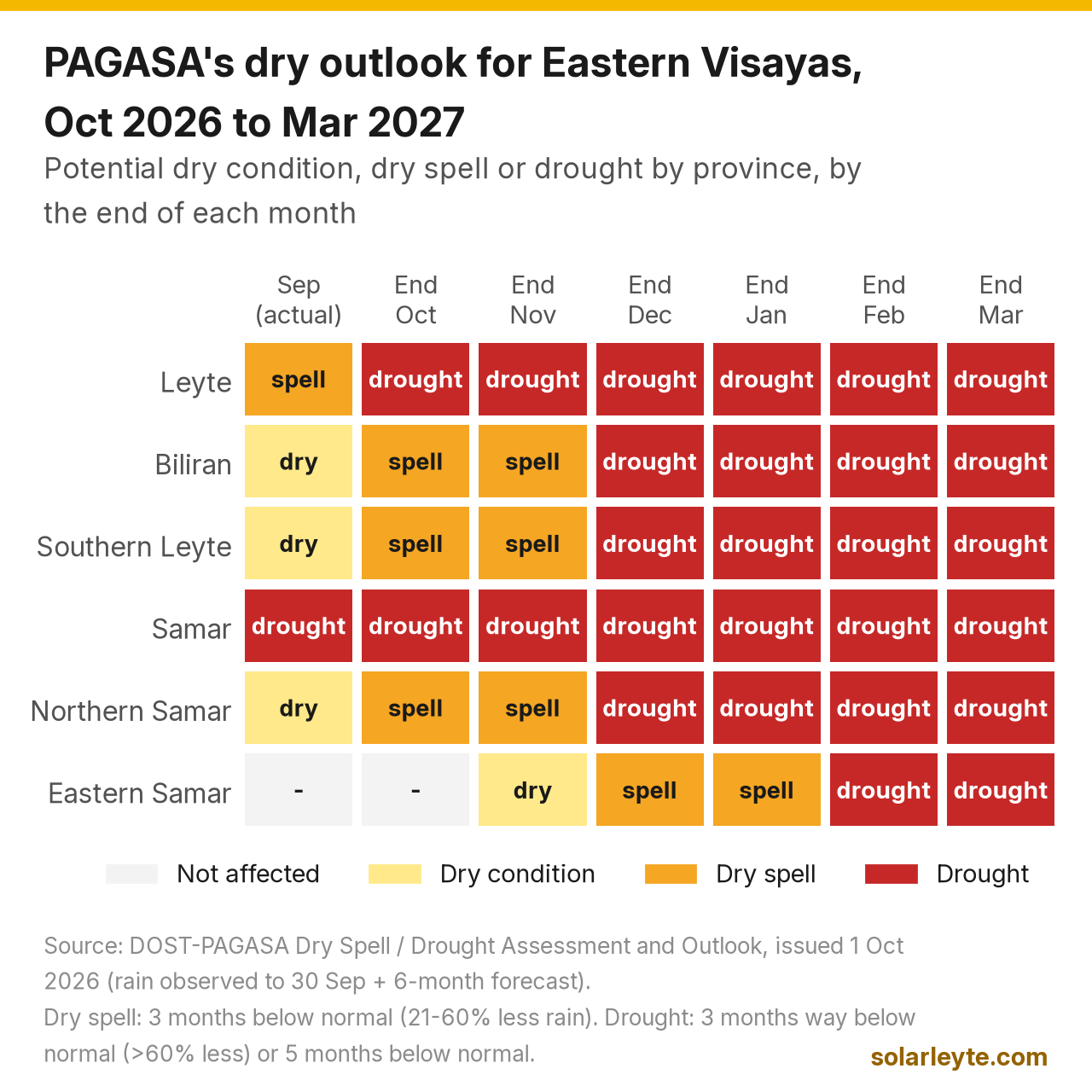
PAGASA's drought and dry spell outlook, issued 1 October 2026, classifies each province month by month. Here are ours:
Province | Sep 2026 (actual) | End Oct | End Nov | End Dec | End Jan–Mar 2027 |
|---|---|---|---|---|---|
Leyte | Dry spell | Drought | Drought | Drought | Drought |
Biliran | Dry condition | Dry spell | Dry spell | Drought | Drought |
Southern Leyte | Dry condition | Dry spell | Dry spell | Drought | Drought |
Samar (Western Samar) | Drought | Drought | Drought | Drought | Drought |
Northern Samar | Dry condition | Dry spell | Dry spell | Drought | Drought |
Eastern Samar | Not affected | Not affected | Dry condition | Dry spell | Dry spell (Jan), drought (Feb–Mar) |
Source: PAGASA, Dry Spell / Drought Assessment and Outlook, issued 1 October 2026 (observed rain to 30 September plus the six-month forecast).
PAGASA's terms are about rain, not taps:
- Dry condition: two months in a row of below-normal rain (21% to 60% less than average).
- Dry spell: three months in a row below normal, or two months way below normal (more than 60% less).
- Drought: three months in a row way below normal, or five months in a row below normal.
By the end of March 2027 PAGASA has 84 provinces under potential drought, including all of Eastern Visayas. Its September climate forum outlook also forecasts more dry days than normal. Biliran is forecast to get 22 dry days in February against a normal 16, and Leyte 21 against 15.
The Department of Agriculture lists Naval, Caibiran, Biliran and Almeria in Biliran, and Tabango, Villaba, Sta. Fe, Alangalang, Palo, San Miguel and Ormoc City in Leyte, among the rice areas most vulnerable to El Niño. NIA Eastern Visayas is preparing water-saving measures, including possible shallow tube wells, as irrigation supplies decline.
Will El Niño mean more brownouts in Leyte and Biliran?
It can, but mostly through demand and plant outages, not dams. The Visayas grid isn't very hydro-dependent: in 2025 it got 50.4% of its power from coal and 34.4% from geothermal and 5.8% from solar (DOE power statistics). Mindanao is different; there the DOE worries about lower output from the Agus-Pulangi hydro plants.
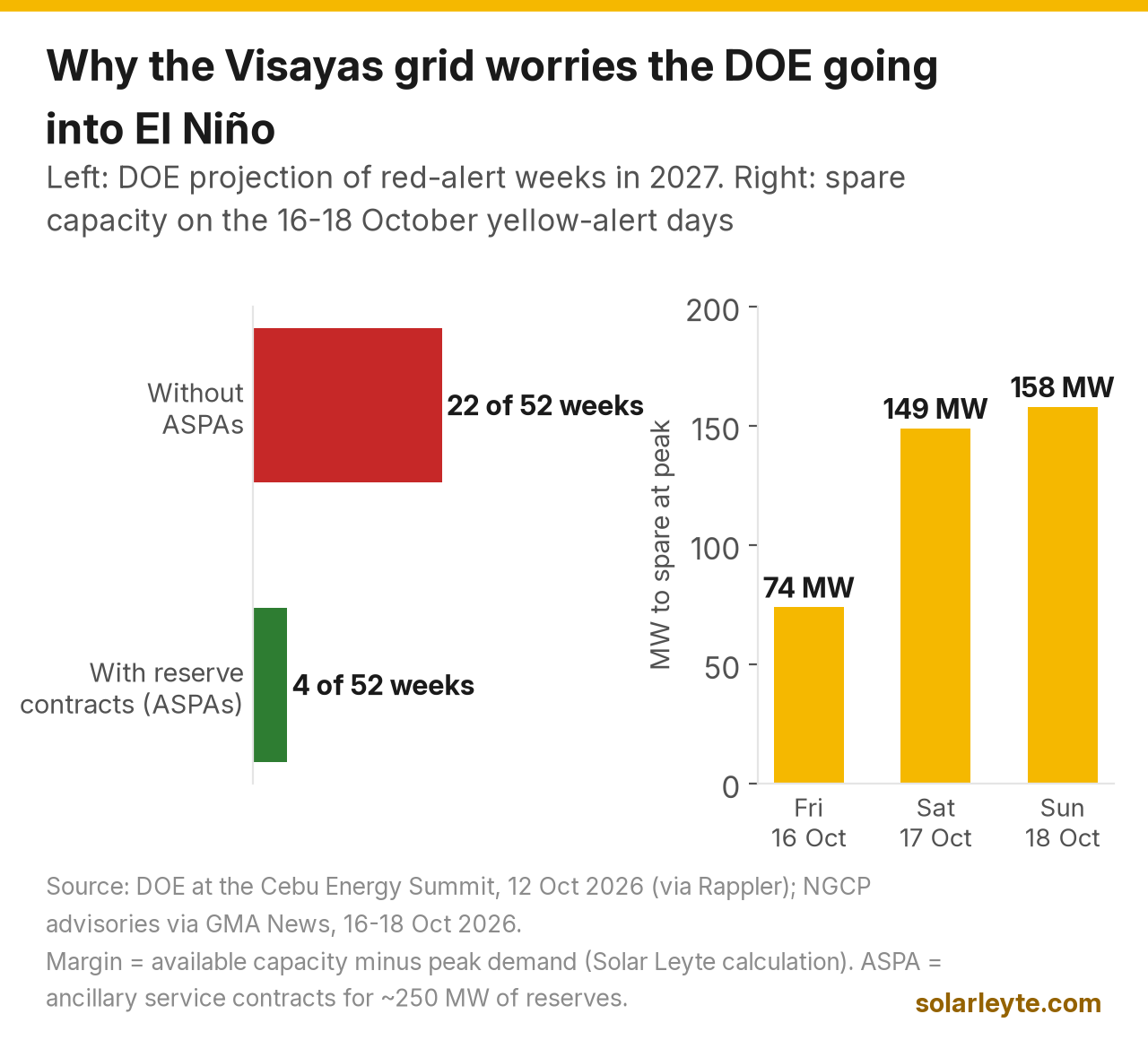
What El Niño does here is push demand up as people run fans and aircon harder, on a grid with too little spare capacity. The yellow alerts of 16 to 18 October show how thin it is:
Date | NGCP yellow alert | Available capacity | Peak demand | Margin (our calculation) |
|---|---|---|---|---|
Fri 16 Oct 2026 | 5–7 p.m. | 2,545 MW | 2,471 MW | 74 MW |
Sat 17 Oct 2026 | 5–8 p.m. | 2,511 MW | 2,362 MW | 149 MW |
Sun 18 Oct 2026 | 5–8 p.m. | 2,512 MW | 2,354 MW | 158 MW |
Source: NGCP advisories as reported by GMA News, 16–18 October 2026. On 18 October NGCP said 655.5 MW was unavailable to the grid because of forced outages and derated plants, including the PEDC Unit 3 and KSPC Unit 1 coal plants.
A yellow alert isn't a brownout by itself. It means one more plant trip could tip the grid into a red alert, which is when rotating brownouts can be ordered. Our Visayas grid yellow and red alert guide explains the levels and how BILECO and LEYECO areas get notified.
The DOE's outlook is not reassuring:
- At the Cebu Energy Summit on 12 October 2026, Energy Secretary Sharon Garin said the Visayas could still face red alerts through 2028. The DOE expects the grid to stay unstable "particularly during the dry months and the anticipated El Niño."
- Without the ancillary service contracts (ASPAs) for about 250 MW of reserves, the DOE projected red alerts in at least 22 of the 52 weeks of 2027, around February to November. With them, about 4 weeks.
- The DOE is targeting nearly 300 MW of power barges for the first quarter of 2027, and planning about 250 MW of battery storage across Iloilo, Bohol, Leyte and Cebu.
- Transmission limits also matter here. The DOE says congestion has restricted power flows "from Luzon to Leyte and from Leyte to Cebu."
Those alerts ran from 5 to 8 p.m., after the sun goes down, so panels alone won't keep your lights on. A grid-tie inverter also shuts off in a brownout for safety. If you want power during an outage, you need a battery: a hybrid system or a portable power station (see our grid-tie vs hybrid guide).
What El Niño can do to your BILECO or LEYECO bill
Two things push the bill up, and you control only one.
1. The rate. Co-ops pass their generation charge straight through to you; they don't earn a markup on it. When the Visayas grid is tight, spot and reserve-market prices can "rise sharply", the DOE says, and a market operator (IEMOP) simulation it cited projected prices averaging above ₱12 per kWh if the reserve contracts stay delayed. Secondary price caps are meant to limit the spikes. Our bakit mahal ang kuryente explainer explains how those costs reach your bill.
2. Your usage. Hot nights mean longer fan and aircon hours. These are examples, priced at the September 2026 residential rates on PRESYO-PH (BILECO ₱18.93/kWh, LEYECO II ₱14.05/kWh). LEYECO II's posted rate excludes VAT, so actual bills there run a bit higher.
Example (assumptions) | Extra kWh a month | Extra cost at BILECO | Extra cost at LEYECO II |
|---|---|---|---|
Two 16-inch stand fans on medium, 6 more hours a day (0.0476 kWh an hour each, Meralco test) | 17.1 | about ₱324 | about ₱240 |
One 1 HP inverter aircon, 2 more hours a night (about 0.475 kWh an hour) | 28.5 | about ₱540 | about ₱400 |
Our calculation: kWh × rate, 30 days, before any rate change. The fan and aircon figures come from our appliance kWh guide and solar for aircon post.
Does El Niño help or hurt solar panels?
This surprises people: fewer rain clouds have meant more sunshine on panels at Naval, not less.
We pulled NASA's satellite record for Naval, Biliran (NASA POWER, 1984–2025) and compared the October-to-March season in the four strong El Niños in it (1991–92, 1997–98, 2009–10 and 2015–16, picked by NOAA's relative Niño index at 1.5°C or more) with the average of the 29 seasons from 1991–92 to 2019–20.
Strong El Niño season (Oct–Mar) | Sunlight vs average | Rain vs average |
|---|---|---|
1991–92 | +10.8% | −46.8% |
1997–98 | +13.9% | −61.4% |
2009–10 | +4.1% | −32.7% |
2015–16 | +13.6% | −44.5% |
Source: NASA POWER monthly data for 11.56°N, 124.40°E (all-sky sunlight on a flat surface, corrected rainfall); seasons chosen with NOAA's RONI. Solar Leyte calculation.
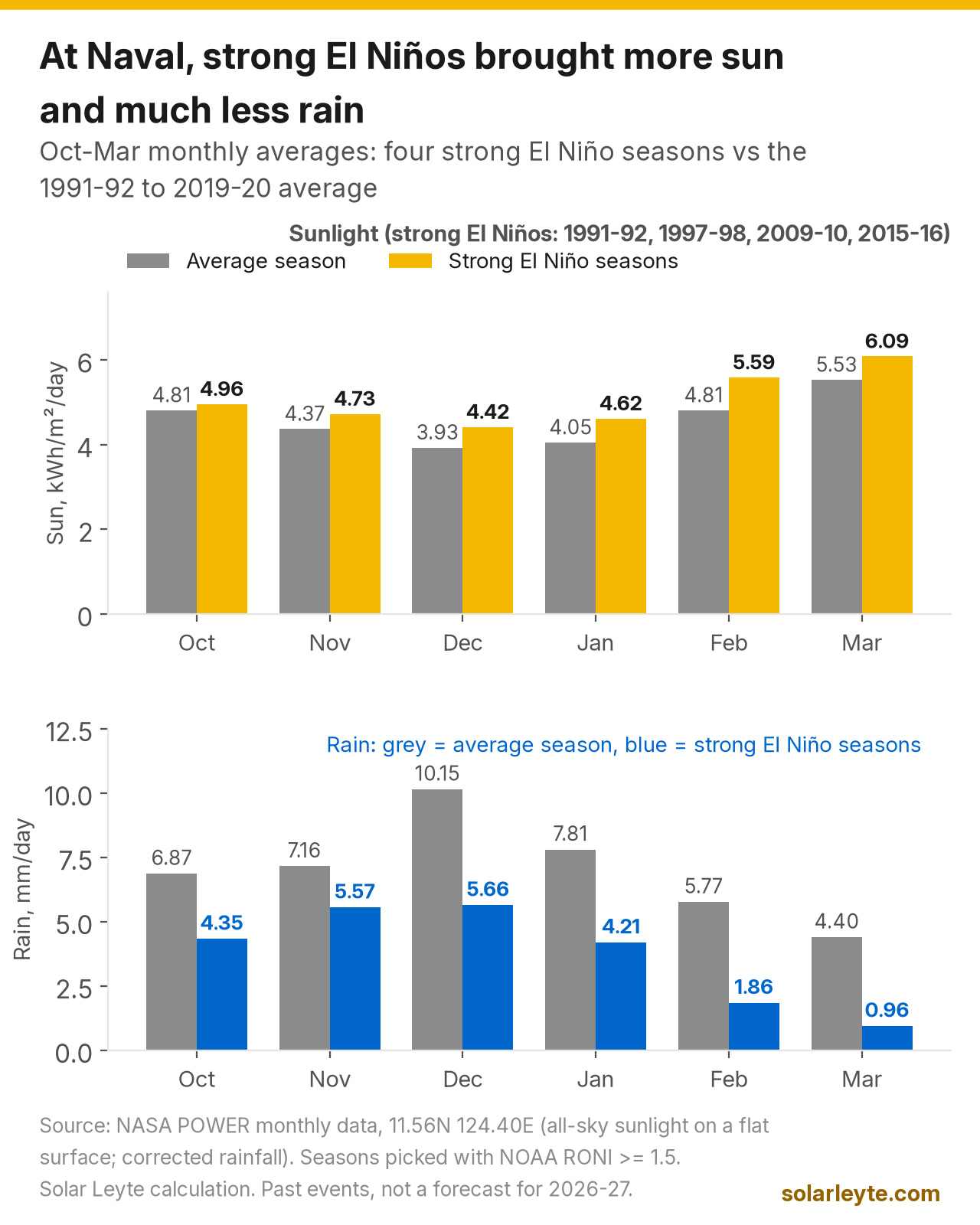
The sunniest gains came in December to March, the cloudiest months of a normal year. January averaged 4.62 kWh per m² a day in those El Niños against 4.05 normally (+14%), and February 5.59 against 4.81 (+16%).
Worked example (assumptions, not a forecast): a 5 kWp rooftop system at Naval, with 80% of the sunlight figure reaching your outlets after losses.
- January, normal year: 5 × 4.05 × 0.80 ≈ 16.2 kWh a day. January in past strong El Niños: 5 × 4.62 × 0.80 ≈ 18.5 kWh a day.
- December to March together: about 2,210 kWh normally against about 2,500 kWh in the El Niño years, roughly 290 kWh (13%) more. If you use it all at home, that's worth about ₱5,490 at BILECO's ₱18.93.
What about the heat? Panels lose about 0.28–0.30% of their power for every °C hotter (see the datasheets in our 550–620 W panel post). In 1997–98 and 2015–16 the average daily high at Naval ran about 0.7–0.8°C above normal, costing well under 1%. The extra sun far outweighed it.
In mid-October Secretary Garin said solar output could fall by 20% under the projected El Niño conditions (PowerPhilippines, 14 October). We couldn't find the basis for that national figure, and it doesn't match what past strong El Niños did at Naval. Two real catches for solar owners:
- Dust. Less rain means less free washing. Check your panels during the long dry months; our cleaning and maintenance guide covers how often and what it costs.
- It's still daytime power. More sun doesn't help at 7 p.m. during a red alert unless you have a battery.
Water, wells and pumps
PAGASA's drought terms are about rainfall. As the Local Water Utilities Administration put it on 9 October, "Meteorological drought, meaning konti ang ulan. Hindi sinasabing walang tubig." No need to hoard bottled water, but fix leaks and store water sensibly.
The DILG told LGUs on 13 October to reactivate their Local El Niño Teams, restrict non-essential water use, and prepare backup power and emergency water storage. OCD Eastern Visayas set up a regional Task Force El Niño in July.
If you rely on a well or pump, measure the water level now and again in the dry months. Shallow wells usually drop in a dry spell, so the pump works harder. Our solar water pump guide shows how to size for the dry season.
Typhoons don't stop for El Niño
PAGASA still expects one to two tropical cyclones in October, and its July–December outlook expects three to six from October to December. El Niño Advisory No. 5 warns that "above-normal rainfall conditions may still occur during the passage of tropical cyclones." Keep your typhoon prep going: our typhoon guide and before-during-after checklist still apply.
An El Niño checklist for Leyte and Biliran homes
- Follow the official updates: PAGASA's monthly advisory and drought outlook, and your co-op's Facebook page for alerts and brownout schedules.
- Move heavy loads out of 5 to 8 p.m. Run laundry and pumping earlier in the day, on your own solar if you have it.
- Use fans first. One fan on medium uses about a tenth of what a 1 HP inverter aircon does (our appliance guide).
- Size backup for the evening. For a few hours of lights, fans, Wi-Fi and phones, a portable power station may be enough. For a fridge or aircon, look at a battery and hybrid system.
- If you have solar, check it before the driest months. Clean the panels and make sure the inverter area has airflow and no dust buildup.
- Store water and protect your pump. Use covered containers and gutters into a tank, and a float switch or dry-run protection on pumps.
- Don't drop your typhoon prep. A strong storm can still arrive in the middle of a drought.
FAQ
Is El Niño already in the Philippines in 2026? Yes. PAGASA has had an El Niño Advisory up since 9 June 2026. Its Advisory No. 5 (7 October) calls it strong to very strong.
Until when will El Niño last? PAGASA says it should continue until the first half of 2027 and may peak before the end of 2026. NOAA gives a strong-to-very-strong El Niño more than an 83% chance through January–March 2027. PAGASA's dry outlook for Leyte and Biliran runs to at least March 2027.
Will there be rotating brownouts in Leyte and Biliran because of El Niño? Nobody can promise either way. The Visayas grid was on yellow alert on 16, 17 and 18 October 2026, and the DOE warns of red alerts through 2028. Grid-ordered rotating brownouts come with red alerts, and your co-op usually posts the schedule, sometimes on short notice.
Do solar panels produce less during El Niño? Not at Naval, going by history. In the four strong El Niños since 1991, dry-season sunlight was 4% to 14% above average (NASA POWER). Heat costs a little, and dust more if you never clean the panels.
Does drought mean the water will run out? No. PAGASA's drought means rainfall well below normal for months. LWUA says there's no need to hoard, but conserve and store sensibly.
Solar Leyte is run by MACC Systems & Energy Solutions Inc., a solar installer in Naval, Biliran.
Get a free solar quote from MACC
Planning backup power or solar before the dry months? Send us a recent electric bill and a photo of your roof. We'll get back to you with a free, no-obligation written quote.
- Call/Text: 0955 723 5093
- Email: official@macc-inc.com or benjie@macc-inc.com
- Website: www.macc-inc.com
- Office: Brgy. Talustusan, Naval, Biliran 6543
- Or use the site quote form: /quote
Related guides
- Solar in typhoon country: installing and protecting a system
- Visayas grid yellow and red alerts: what they mean for Biliran and Leyte
- Solar water pump price and dry-season sizing
- Off-grid solar for island and farm homes: sizing for cloudy days
- Grid-tie vs hybrid vs off-grid: which one works in a brownout?
Sources (all checked 19 October 2026)
- DOST-PAGASA, El Niño Advisory No. 5 (7 Oct 2026): strong to very strong El Niño present, until the first half of 2027, may peak before end-2026; October below-normal rain over most of Luzon, Visayas and Caraga; drought/dry spells likely by end-October in most of Eastern Visayas; 1–2 tropical cyclones in October; Catbalogan 37.2°C and Borongan 37.7°C September records; and El Niño advisories list (Advisory No. 1, 9 June 2026)
- DOST-PAGASA, Dry Spell / Drought Assessment and Outlook (issued 1 Oct 2026): September 2026 actual and end-October 2026 to end-March 2027 province outlooks; definitions of dry condition, dry spell and drought; 84 provinces under potential drought by end-March 2027
- DOST-PAGASA, Climate Outlook October 2026 – March 2027 (climate forum, issued 23 Sep 2026): forecast dry days, Biliran February 22 (normal 16), Leyte 21 (normal 15)
- DOST-PAGASA, Seasonal Climate Outlook July–December 2026: three to six tropical cyclones in October–December; and press release, 23 Sep 2026
- NOAA Climate Prediction Center, ENSO Diagnostic Discussion (8 Oct 2026): El Niño Advisory; Niño-3.4 +2.1°C; strong-to-very strong El Niño likely through JFM 2027 (>83%); historic-event chance 54% SON, 83% OND, 70% NDJ; next update 12 Nov 2026; and Relative Oceanic Niño Index (RONI) table used to pick the 1991–92, 1997–98, 2009–10 and 2015–16 seasons (late-year RONI 2.0, 2.3, 1.5, 2.3)
- NASA, POWER monthly data for 11.56°N, 124.40°E (Naval, Biliran), 1984–2025: ALLSKY_SFC_SW_DWN, PRECTOTCORR, T2M_MAX (Solar Leyte calculation of season averages and percentages)
- Department of Energy, 2025 Power Statistics, gross generation per grid and technology: Visayas coal 50.4%, geothermal 34.4%, solar 5.8%
- Department of Energy, DOE: NGCP reserves failure exposed Visayas to red and yellow alerts (5 Oct 2026): ASPAs for at least 250 MW; reserve-market prices; IEMOP simulation of at least 10 red and 30 yellow alerts with prices averaging above ₱12/kWh; Luzon–Leyte and Leyte–Cebu transmission constraints
- Rappler, DOE: Visayas may face more red alerts in 2027 without sufficient backup systems (12 Oct 2026): red alerts in at least 22 of 52 weeks of 2027 without ASPAs, about 4 with them
- Inquirer, Visayas power woes may persist until 2028, DOE chief warns (12–13 Oct 2026): red alerts through 2028; nearly 300 MW of barges targeted for Q1 2027; about 250 MW of battery storage across Iloilo, Bohol, Leyte and Cebu
- PowerPhilippines, 'Super El Niño' could trigger more red alerts without new power capacity, DOE warns (14 Oct 2026): hydropower could decline by 60% and solar output by 20% (Sec. Garin); Agus-Pulangi hydro; secondary price caps; Interruptible Load Program
- GMA News, Visayas yellow alerts on 16 Oct (2,545 MW vs 2,471 MW, 5–7 p.m.), 17 Oct (2,511 MW vs 2,362 MW, 5–8 p.m.) and 18 Oct 2026 (2,512 MW vs 2,354 MW, 5–8 p.m.; PEDC 3 and KSPC 1 out; 655.5 MW unavailable)
- ICSC, PRESYO-PH (September 2026 residential rates): BILECO ₱18.93/kWh, LEYECO II ₱14.05/kWh (BILECO's figure includes VAT; LEYECO II's posted rate excludes VAT)
- Philippine News Agency, DA Region 8 readies measures for 30K hectares vulnerable to El Niño (11 Sep 2026): vulnerable towns in Leyte and Biliran
- Leyte Samar Daily News / PIA Leyte, NIA-8 prepares water-saving measures as El Niño threatens EV farms (14 Oct 2026)
- Daily Tribune, DILG orders LGUs to brace for El Niño (13 Oct 2026); PIA, OCD-8 reactivates Task Force El Niño (2 Jul 2026)
- ABS-CBN News, Water agency: meteorological drought does not mean water supply will run out (9 Oct 2026): LWUA Administrator Jose Moises Salonga
- Appliance figures: 16-inch stand fan on medium 0.0476 kWh an hour (Meralco test) via our appliance kWh guide; 1 HP inverter aircon about 3.8 kWh per 8 hours (Midea figures) via our solar for aircon post; panel temperature coefficients −0.28% to −0.30%/°C from the LONGi, Jinko and Trina datasheets in our 550–620 W panel post