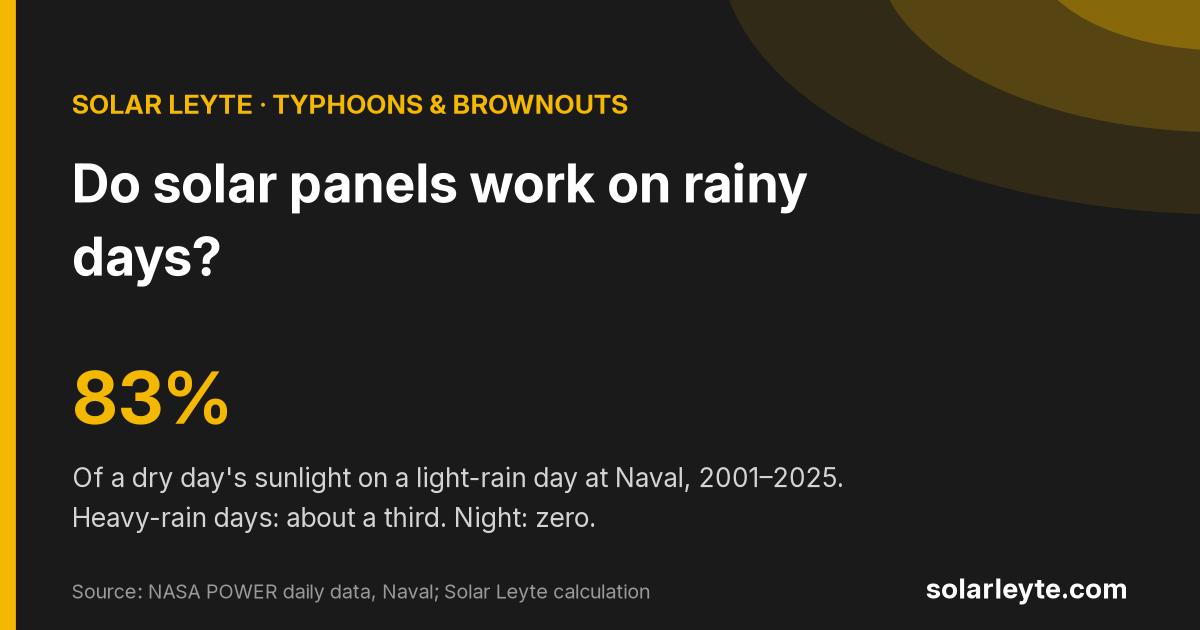
Yes, solar panels work on rainy and cloudy days, just less. In 25 years of NASA satellite data for Naval, Biliran, a day with light rain still got about 83% of the sunlight of a dry day, a day with moderate rain about 61%, and a heavy-rain day about a third. What solar panels can't do is make power at night, and a grid-tie system without a battery switches itself off during a brownout, even under a bright sun.
Maulan na naman? That's normal here. On the NASA record, three out of four days at Naval get at least 1 mm of rain. So the real question isn't "does solar work when it rains?" but "how much does it make on the kind of days we actually get?" We pulled the numbers and checked seven things people often tell us about rain, clouds, heat and night.
Last checked 25 October 2026. Weather figures are from NASA POWER (2001–2025) for Naval, Biliran. The grid and brownout rules are from Meralco's net-metering FAQ and DOE Department Circular DC2026-08-0017.
The short version
What people say | What the data and rules say |
|---|---|
"Solar doesn't work when it's cloudy or raining." | It works at a lower level. Light-rain days averaged 5.01 kWh/m² of sun, against 6.02 on dry days. |
"The rainy season makes solar useless." | December, the weakest month, still averaged 3.86 kWh/m² a day, about 63% of April. |
"Typhoon days wipe out solar for the week." | Days with 30 mm or more of rain were 3% of days. They averaged 2.02 kWh/m², about a third of a dry day. |
"Panels store sunlight for the night." | Panels make nothing after sunset. Night power needs a battery or the grid. |
"If it's sunny during a brownout, my grid-tie solar still runs the house." | A grid-tie system without a battery stops during an outage (anti-islanding). |
"Hotter days mean more solar power." | Panels lose about 0.29% of their power for every °C above 25°C. Sun helps; heat doesn't. |
"Rain cleans the panels, so I never need to." | Rain rinses loose dust but not bird droppings, sap or salt film. |
How we checked: 25 years of sun and rain at Naval
NASA's POWER project publishes daily satellite-based estimates of sunlight reaching the ground and rainfall for any point on Earth. We downloaded every day from 1 January 2001 to 31 December 2025 (9,131 days) for Naval, Biliran (11.56° N, 124.40° E) and sorted the days by how much rain fell.
Two things to keep in mind:
- Sunlight is in kWh per m² per day. It's the same as "peak sun hours". A day with 5 kWh/m² is like 5 hours of full, strong sun.
- The rainfall is a satellite and model estimate for a grid area around Naval, not a rain gauge on your roof. It's good for comparing types of days, not for checking one storm in one barangay.
Myth 1: "Solar doesn't work when it's cloudy or raining"
Clouds block part of the sunlight, not all of it. Some of the light gets through as diffuse light, and solar panels use that too. Here's what each kind of day gave at Naval:
Kind of day (rain that day) | Share of days, 2001–2025 | Average sun (kWh/m² a day) | Compared with a dry day | Example: 5 kWp system (kWh a day) | Example value at BILECO's ₱18.93 |
|---|---|---|---|---|---|
Dry (under 1 mm) | 25.1% | 6.02 | 100% | 24.1 | ₱456 |
Light rain (1–10 mm) | 54.9% | 5.01 | 83% | 20.1 | ₱380 |
Moderate rain (10–30 mm) | 16.9% | 3.70 | 61% | 14.8 | ₱280 |
Heavy rain (30 mm or more) | 3.1% | 2.02 | 34% | 8.1 | ₱153 |
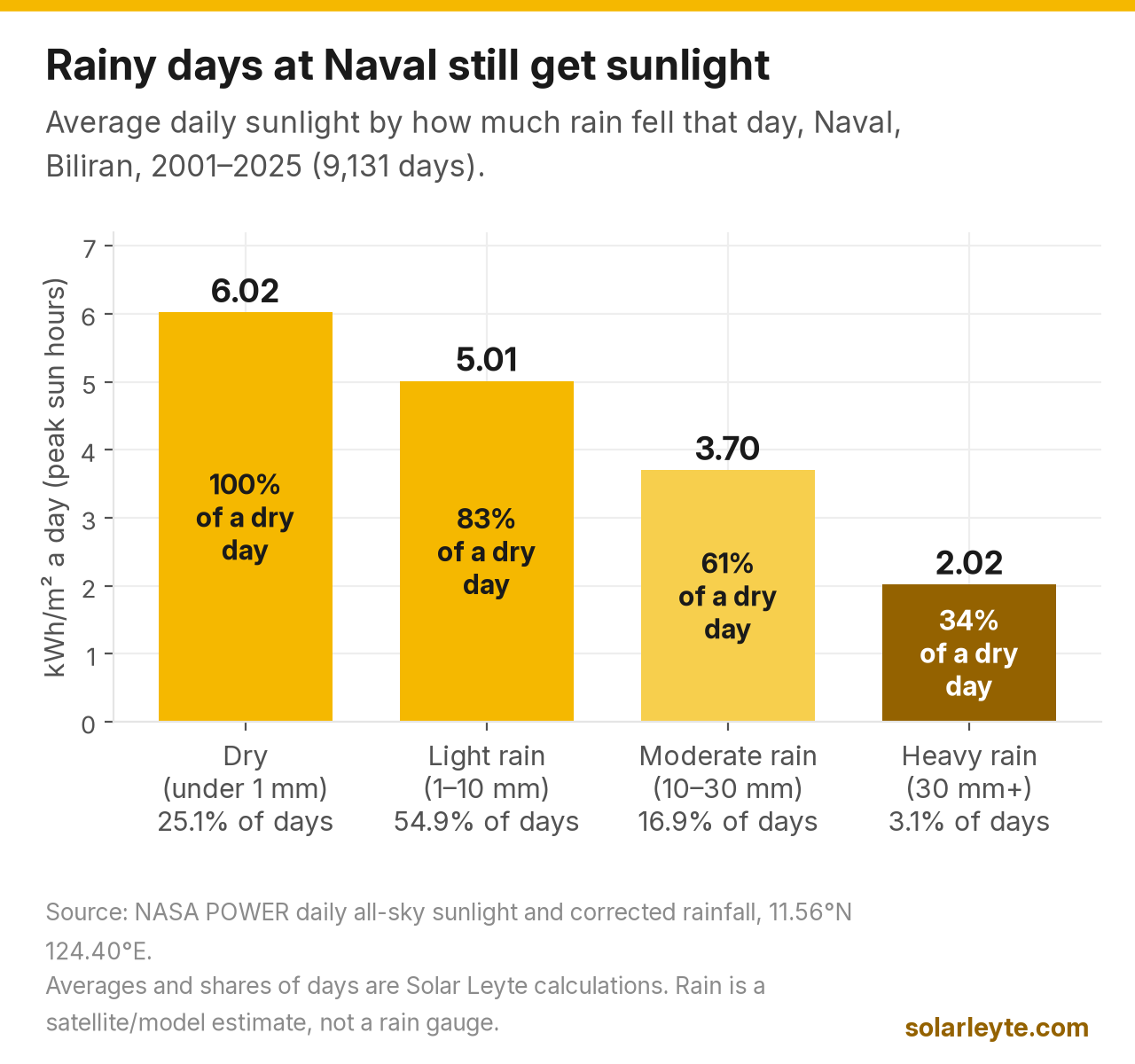
Source: NASA POWER daily data for Naval, 2001–2025 (all-sky sunlight and corrected rainfall). Shares and averages are Solar Leyte calculations. Example columns are our estimate, not a guarantee: 5 kWp × average sun × 80% (allowing about 20% for heat, wiring, inverter and dirt losses), valued at BILECO's September 2026 residential rate of ₱18.93 per kWh (PRESYO-PH) if you use the power at home.
So a typical drizzly day in Biliran isn't a lost day. Even a properly wet day with 10 to 30 mm of rain still gave about three-fifths of a dry day's sun. Days darker than 1 kWh/m², the ones that really feel like "walang solar", were only about 1% of the record, roughly four days a year.
Myth 2: "The rainy season makes solar useless"
At Naval the dimmest months are November to January. December is the weakest month at Naval, at 3.86 kWh/m² a day, and 86% of December days got at least 1 mm of rain. April is the best, at 6.09 kWh/m², with rain on about half the days.
That makes December about 63% of April. For the same 5 kWp example, that's roughly 15.4 kWh a day in December against 24.4 kWh in April (our estimate, same 80% assumption). Lower, yes. Useless, no.
What it does change is sizing:
- Grid-tie or hybrid on a BILECO or LEYECO line: the grid fills the gap, so you size for your daytime use and accept smaller bills in December.
- Off-grid: you size for December and January, or you'll run out. Our off-grid solar post has the full month-by-month table and the battery maths for runs of grey days.
Does El Niño change this? In past strong El Niños, Naval got more sun from October to March, not less. Our El Niño 2026–27 post has those numbers.
Myth 3: "Typhoon days wipe out solar for the whole week"
Heavy-rain days are real, but they're rare and they don't last a week on average. Days with 30 mm or more of rain were 3.1% of the record (about 11 days a year) and averaged 2.02 kWh/m². In December, the stormiest month for rain at Naval, they were about 7% of days.
The worst day in 25 years was 16 December 2017, at 0.27 kWh/m², the day after about 153 mm of rain. That was Tropical Storm Urduja, which caused deadly landslides in Biliran (Rappler/AFP). Even then, the panels made a little.
During a typhoon the bigger worries are wind, flying debris and flooding, not lost kWh. Our typhoon guide and before, during and after checklist cover what to do with your system when a storm is coming.
Myth 4: "Solar panels store the sun's energy for the night"
Panels are not batteries. They make power only while light is falling on them. Here are three real days at Naval in 2025, hour by hour, from NASA POWER's hourly data (local time):
Hour | 4 Aug 2025 (dry, 0.1 mm) | 14 Aug 2025 (28.8 mm rain) | 25 Sep 2025 (47.6 mm rain) |
|---|---|---|---|
6 a.m. | 131 | 62 | 64 |
9 a.m. | 737 | 485 | 342 |
11 a.m. | 911 | 625 | 224 |
1 p.m. | 835 | 442 | 124 |
3 p.m. | 257 | 110 | 55 |
5 p.m. | 38 | 15 | 3 |
6 p.m. to 4 a.m. | 0 | 0 | 0 |
Whole day (kWh/m²) | 6.14 | 3.73 | 1.71 |
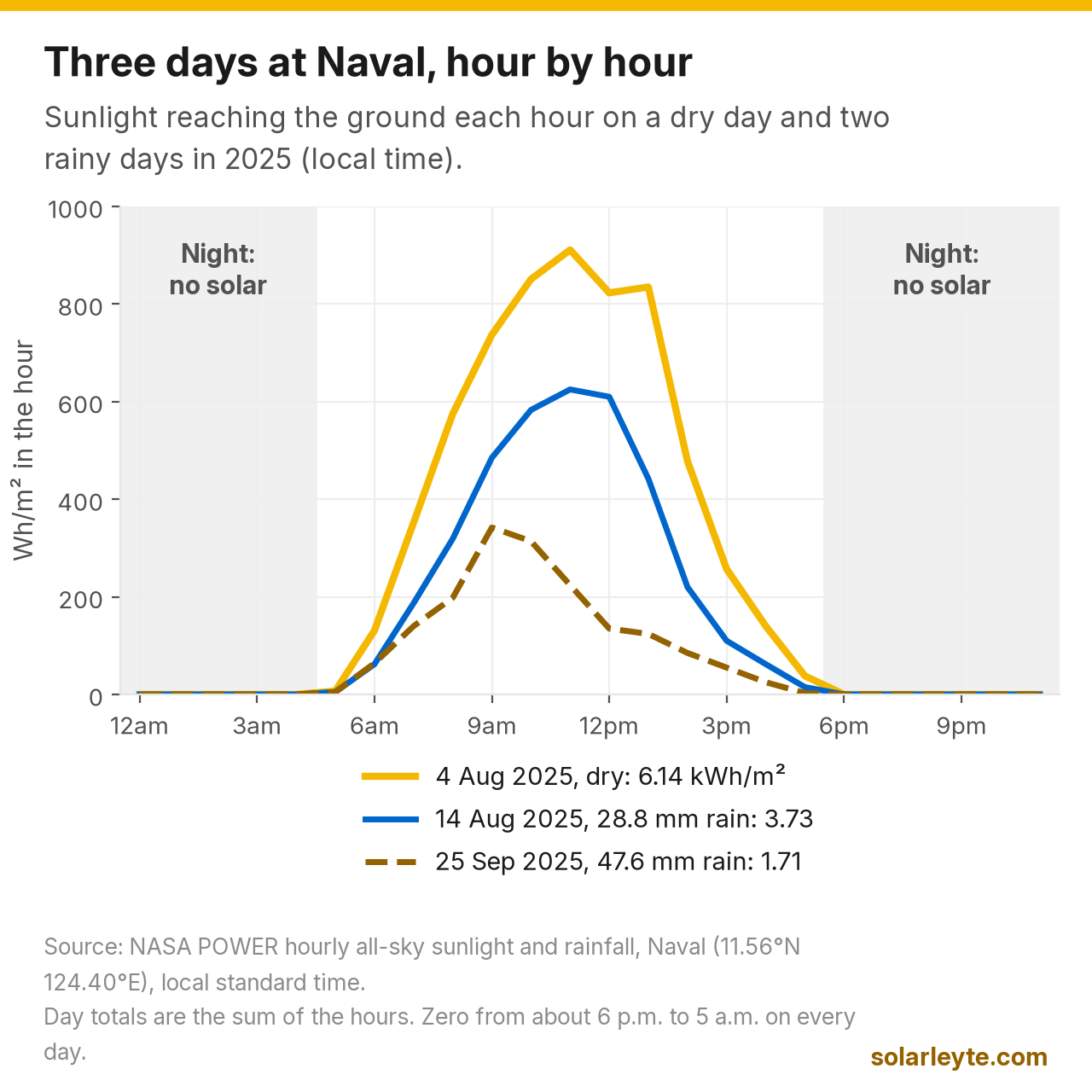
Source: NASA POWER hourly all-sky sunlight (Wh/m² in each hour) and rainfall for Naval, local standard time. Day totals are the sum of the hours.
From about 6 p.m. to 5 a.m. every day the number is zero. Rain or shine, that's 11 hours with no solar. If you want lights, fans or the ref on solar power at night, you need a battery, or you use the grid like everyone else. Our solar battery price guide explains sizes and costs.
Myth 5: "If it's sunny during a brownout, my grid-tie solar still runs the house"
This one catches a lot of new owners. A grid-tie system without a battery switches off when the grid goes down, even at noon on a clear day. Meralco's net-metering FAQ puts it plainly: if your system has no battery, it "will automatically stop supplying power during an outage through its anti-islanding function", to protect the linemen working on the lines (Meralco). The same safety feature is required on the micro-inverters in the DOE's new plug-and-play micro-solar rules (DOE DC2026-08-0017, Section 3.2.2).
What keeps power on in a brownout:
- A hybrid inverter with a battery, which can keep running selected loads during an outage, depending on how it's set up (same Meralco FAQ). See our grid-tie vs hybrid vs off-grid guide.
- An inverter and battery without panels, charged from the grid while the power is on. Our inverter battery backup post works out the sizes.
Myth 6: "Hotter days mean more solar power"
Solar panels like light, not heat. Panel ratings are measured at 25°C cell temperature. Above that, power drops. Trina's Vertex N 590–620 W datasheet gives a temperature coefficient of −0.29% per °C and a nominal operating cell temperature (NOCT) of 43°C in 20°C air under 800 W/m² of sun (Trina Solar datasheet). Jinko's Tiger Neo 575–600 W lists the same −0.29% per °C (Jinko datasheet).
Worked example (our estimate, using the NOCT rule of thumb): on a sunny late morning at Naval, with 30°C air and about 800 W/m² of sun, the cells run about 23°C above the air, so roughly 53°C. That's 28°C above the rating temperature, or about 8% less power than the label (28 × 0.29%). For context, Naval's average daily high is 29.2°C on the NASA record.
So a hot, bright April day still beats a cool cloudy one, because there's far more light. But the heat takes a slice.
Myth 7: "Rain cleans the panels, so I never need to"
Rain does rinse off loose dust, and LONGi's cleaning instructions suggest less frequent cleaning in rainy regions (every 40–50 days for large solar farms) than in dry ones (20–30 days) (LONGi cleaning work instruction). But rain won't shift sticky things like bird droppings or plant sap. LONGi says those should be cleaned off, and that shading part of a panel can cause hot spots. Coastal roofs also collect salt film.
The practical answer: look at your panels after a long dry spell and after a storm, and check your inverter app for a drop that isn't explained by the weather. Our cleaning and maintenance guide covers how, how often and what it costs.
What this means if you're thinking about solar
- On a BILECO or LEYECO line, rain mostly means a smaller saving that day, not zero. Size for your daytime use. The grid covers the rest.
- If brownouts are your main problem, the battery matters more than the weather. A grid-tie system without one does nothing in an outage.
- Off-grid, size for December and for runs of bad days, not the yearly average.
- Ask any installer for a month-by-month estimate, not just a yearly kWh figure, so you know what a December bill will look like.
FAQ
Do solar panels work on cloudy days?
Yes. At Naval, days with light rain averaged about 83% of a dry day's sunlight on the NASA record. Output falls with thicker cloud but rarely goes to zero in daylight.
How much does a solar panel produce on a rainy day?
It depends on how heavy the rain is. On our example 5 kWp system, a light-rain day works out to about 20 kWh, a moderate-rain day about 15 kWh and a heavy-rain day about 8 kWh, against about 24 kWh on a dry day. Those are estimates using an 80% loss allowance, not a guarantee.
Gumagana ba ang solar panel kahit umuulan?
Oo, pero mas mahina. Kahit maulan, may liwanag pa rin na nakakarating sa panel. Sa datos ng NASA para sa Naval, ang araw na may katamtamang ulan ay may mga 61% pa rin ng araw ng tuyong araw. Sa gabi lang talaga walang solar.
Do solar panels work at night?
No. They need light, and NASA's hourly data for Naval shows zero sunlight from about 6 p.m. to 5 a.m. For night power, store daytime solar in a battery or use the grid.
Is it safe to have solar panels on the roof when it rains?
Panels are made to sit outside in the rain. The risk is damage: if a typhoon cracks a panel or breaks a cable, don't touch it, because it can still make power in daylight. LONGi warns that panels with broken cables or glass shouldn't be cleaned because of shock risk. Switch off and call your installer.
Solar Leyte is run by MACC Systems & Energy Solutions Inc., a solar installer in Naval, Biliran.
Get a free quote from MACC
Want to know what solar would make on your roof in December, not just in April? Send a photo of your latest BILECO or LEYECO bill. MACC will look at your daytime use and reply with options and a written quote. No obligation.
- Call/Text: 0955 723 5093
- Email: official@macc-inc.com or benjie@macc-inc.com
- Website: www.macc-inc.com
- Request a quote online: solarleyte.com/quote
- Office: Brgy. Talustusan, Naval, Biliran 6543
Sources (all checked 25 October 2026)
- NASA Langley Research Center, POWER Project (documentation): daily all-sky and clear-sky surface sunlight (ALLSKY_SFC_SW_DWN), corrected rainfall (PRECTOTCORR) and daily maximum air temperature (T2M_MAX) for 11.56° N, 124.40° E, 1 January 2001 to 31 December 2025: dry days 6.02, light rain 5.01, moderate rain 3.70 and heavy rain 2.02 kWh/m² a day; December 3.86 and April 6.09 kWh/m² a day; worst day 16 December 2017 at 0.27 kWh/m²; average daily high 29.2°C (Solar Leyte calculations from the downloaded data)
- NASA POWER, hourly API: hourly all-sky sunlight and rainfall for Naval, 4 August to 25 September 2025, local standard time (4 Aug 6.14, 14 Aug 3.73, 25 Sep 1.71 kWh/m²)
- ICSC, PRESYO-PH: BILECO's September 2026 residential rate, ₱18.93 per kWh (latest month available on 25 October 2026)
- Meralco, Solar and Net-Metering FAQ, question 19 (anti-islanding: systems without a battery stop supplying power during an outage)
- Department of Energy, Department Circular DC2026-08-0017, Section 3.2.2 (micro-inverters must have an automatic anti-islanding disconnection)
- Trina Solar, Vertex N TSM-NEG19RC.20 590–620 W datasheet (−0.29%/°C; NOCT 43°C at 800 W/m², 20°C air, 1 m/s wind)
- JinkoSolar, Tiger Neo JKM575-600N-72HL4-BDV datasheet (−0.29%/°C; ratings at 25°C cell temperature)
- LONGi, PV Modules Cleaning Work Instruction V02 (cleaning every 40–50 days in rainy regions, 20–30 in dry; sticky dirt and bird droppings; hot spots; broken glass or cables are a shock risk)
- Rappler / Agence France-Presse, 26 dead in Biliran landslides after Urduja (17 December 2017)